The artificial intelligence boom presents Canada with unique opportunities and risks as we seek to benefit from a technology that could reshape how we live.
In this special series, Canada’s AI Advantage, The Logic examines how our companies, investors, institutions and workers can gain from the country’s early lead in AI, even as Canada’s pioneers in the field become the world’s most powerful voices of caution.
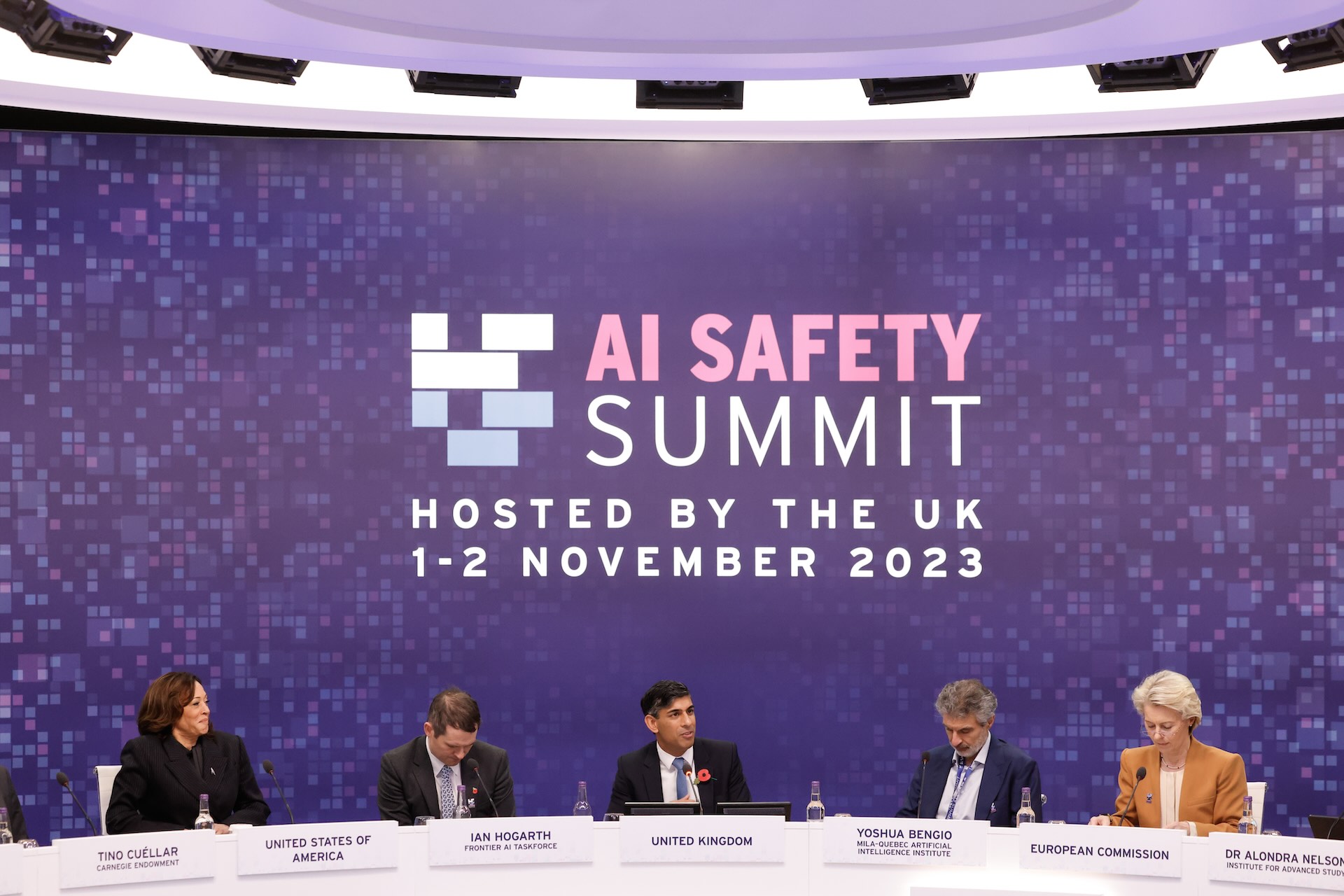
MILTON KEYNES, England — British Prime Minister Rishi Sunak was at the centre; this was, after all, his summit. Two chairs over on either side, European Commission President Ursula von der Leyen and U.S. Vice-President Kamala Harris made this, merely by their attendance, an important meeting.
Few inhabitants of this London commuter town would recognize the Canadian computer scientist seated at Sunak’s left hand. But without the work and words of Yoshua Bengio, the world leaders and technology executives at Bletchley Park that drizzly Thursday might not have assembled to talk artificial intelligence.
Talking Points
- As powerful nations and firms compete for AI leadership, Canada hopes to turn its heritage in the field into financial rewards while taking a prominent role in governance of the technology
- Policymakers, founders and funders insist the country can profit from AI, even as we manage its risks. But while Canada already has talent, companies and regulatory proposals, there’s plenty left to do.
Over dozens of years and papers, a community of researchers around the Montreal-residing professor and his Toronto contemporary Geoffrey Hinton made major breakthroughs with neural networks, models that approximate human thinking. Combined with advances and capital elsewhere, Canadian innovators helped shift AI from science fiction to commercial fact.
Companies are now hustling to develop and sell applications—climate solutions; quicker methods to discover chemicals and drugs; autonomous coaches and agents that will dispense advice and handle errands. Governments see the potential to grow their economies and solve significant societal challenges.
Yet countries seeking AI’s promise are also being confronted by its perils. As their work has proliferated and enabled products of mass adoption like ChatGPT, deep-learning pioneers Bengio and Hinton have become heavily amplified voices of caution about what they see as the technology’s catastrophic risks. Policymakers around the world are paying heed, convening in fora like last month’s U.K. AI Safety Summit and the G7 to discuss defences. Unions, artists and rights advocates are pushing for action to address the technology’s near-term impacts on work, creativity and marginalized people.
From left: U.S. Vice-President Kamala Harris, U.K. Frontier AI Taskforce chair Ian Hogarth, U.K. Prime Minister Rishi Sunak, Université de Montréal professor Yoshua Bengio and European Commission President Ursula von der Leyen at the U.K. AI Safety Summit at Bletchley Park on Nov. 2, 2023. Photo: Handout/No. 10 Downing Street/Kirsty O'Connor
Canada hopes to lead in both spheres, turning its AI heritage into financial rewards while taking a prominent role in governance of the technology. Policymakers, founders and funders insist the country can profit from AI while managing its risks. “We need to move from uncertainty and fear to opportunities,” says Innovation Minister François-Philippe Champagne.
In a special series now drawing to a close, The Logic has explored Canada’s AI advantage, and the task ahead to maintain it. Institutes here are still turning out scores of scientists and specialists who could come up with the technology’s next big thing. Labs are putting AI to work on problems of enormous social import or unimaginable natural scale. Policymakers are engaging with the geopolitical and productivity possibilities, though not as swiftly as the moment may warrant. The country will need to figure out how to keep more of its AI luminaries, get the technology into more firms and sectors, and ensure the rest of the population isn’t left behind.
So far, we’re doing fine. Better than fine, even, for a small country with middling geopolitical and economic clout. But as powerful nations and firms compete for AI leadership, Canada needs more than past research glories and aspirations of prosperity to make the most of this AI moment.
“Canada has a lot of leadership naturally in AI,” Sara Hooker noted from The Logic Summit stage in June.
We’d better. For many years, the country’s research infrastructure provided the funding to keep work on neural networks alive, even as the rest of the AI field focused on other approaches. That commitment created a web of expertise that spread at home and abroad. Hooker did her doctorate at Mila, the multi-university Montreal research institute that grew out of Bengio’s lab. During a stint at Google Brain, the search giant’s former AI unit based in Silicon Valley, she worked with a heavily Canadian executive team. These days, Hooker heads Cohere for AI, a research lab that Toronto-headquartered Cohere launched in June 2022 to tackle the field’s fundamental challenges.
By newsworthiness and numbers, Canadian AI scientists and startups make a strong showing.
Hinton and Bengio are the most-cited AI researchers in the world, according to Google Scholar. Third-place Ilya Sutskever is also Canadian; at ChatGPT-maker OpenAI, he reportedly led the boardroom coup that briefly ousted CEO Sam Altman, and lived long enough—three days—to regret it.
Plenty more are coming up behind them. “We have amazing thinkers here,” said Shelby Austin, co-founder and CEO of Toronto-based Arteria AI, which makes software for financial-services analytics and documentation. Sitting beside Hooker on the summit stage, she gave Canada an “A+ on talent.”
On the commercial field, Cohere is contending with OpenAI and other lavishly funded firms to sell generative tools. Beyond that buzzy domain, startups across the country are promising world-altering AI applications and amassing global customer bases. Many have raised significant sums to pay for the workers and infrastructure to grow their clientele and advance their products. “The scale of the opportunity in the next decade is so enormous,” says Jordan Jacobs, managing partner of Toronto-based Radical Ventures, which expects AI to replace all currently available software in the next decade.
“Fast forward five years from now. Will we call ourselves a leader if all the Canadian inventions and innovation in AI are owned by foreign investors?”
Still, Canada’s AI champions face some familiar challenges to earning the great rewards on offer. Founders interviewed for this series reprised concerns that have long plagued the country’s innovation economy about brain drain, corporate indifference and foreign buyouts.
Canadian institutes are producing thousands of AI-capable scientists and scores of fielding-leading research papers each year. But as The Logic’s Catherine McIntyre chronicled, too many are still finding their employment and entrepreneurial opportunities in Silicon Valley and other global tech hubs. Back home, meanwhile, the list of multinationals with Canadian AI labs has steadily grown. Unilever last month joined the likes of HCL Technologies, Meta, Samsung and Unity Technologies in hiring Canadian talent to develop IP that will likely lead to profits in other countries.
“Fast forward five years from now—will we call ourselves a leader if all the Canadian inventions and innovation in AI are owned by foreign investors?” says Louis Têtu, CEO of Quebec City-based Coveo, which sells enterprise search and recommendation tools.
From left to right: The Logic's executive editor April Fong moderates a panel featuring Arteria AI CEO Shelby Austin and Cohere for AI head Sara Hooker at The Logic Summit in Toronto on June 26, 2023. Photo: Christopher Katsarov Luna for The Logic
Meanwhile, the rest of the economy is not keeping up. As my colleague Jesse Snyder reported, corporate Canada is employing AI sparingly, waiting for someone else to prove the technology out first. “We need to really push on that demand side,” Austin said on stage, giving Canada a grade of “C” for its adoption of the technology.
Canada’s prosperity has long rested on its people applying ingenuity to the resources bestowed upon this land. In the AI era we’ve been promised, the people and the ingenuity are the resources. Resting is not an option.
“When Canada speaks on AI, people definitely listen,” Champagne says at Bletchley Park. Over two days of group chats, side meetings and stage time, the minister and his team had set out to claim a leading global role for the country on the technology’s responsible use and regulation.
Lots of nations are speaking right now, though, generating a cacophony of domestic proposals and international initiatives in response to the safety concerns of celebrated researchers and ordinary folk. “You’re seeing a lot of governments trying to throw their hat in the ring,” says Amba Kak, executive director of the AI Now Institute, a policy think tank in New York.
The European Union is in the late stages of adopting its AI Act, which would impose high fines for violations and outright ban applications like live facial recognition. Officials from the continent have been working to popularize its approach in other capitals. In Washington, the Biden administration began with voluntary guardrails, and is now looking at firmer rules. (So is Congress.) The U.S. also hosts most of the field’s largest firms, who are pushing their own regulatory models.
Then there’s Sunak, and his summit. Like Canada, the U.K. has positioned itself as a broker between various countries’ approaches to AI governance. At the AI Safety Summit, digital ministers shared roundtables with tech CEOs, researchers and some civil-society representatives to discuss risks, particularly those raised by so-called frontier AI, the multi-purpose models on which tools like ChatGPT run.
The summit got a lot of governments thinking together about AI policy, says Rebecca Finlay, the Canadian CEO of the Partnership on AI, who chaired one of the roundtables. The San Francisco-headquartered non-profit develops standards to guide its members, which include firms, academic institutes and civil-society groups. “It’s not like we’re starting from scratch,” Finlay says, but the meetings did create more room for cross-border conversation.
“We’re lucky to have an amazing talent pool that could contribute to [solving] this global problem and keep Canada in the lead in AI.”
The U.S. competed for attention: many attendees broke away from the summit on the first day to watch a speech by Harris in London, where the vice-president made the case that bias, errors and deepfakes are as pressing and existential as the prospect of machine-made cyberattacks or bioweapons. In the rooms, plenty of participants pushed back on “doomsday scenarios” to focus on more imminent risks, said Cohere CEO Aidan Gomez.
In the end, British brokerage yielded deals. The 29 governments represented at Bletchley signed a pledge of greater cooperation on AI safety; Sunak’s team counted it as a bit of a coup that the U.S. and China appeared together on both the document and the stage. Eight leading AI firms also agreed to let the new U.K. and U.S. AI safety institutes test their models before release. “Considering where this whole debate was before the prime minister intervened in the summer, I think it’s been a real triumph,” Matt Clifford, Sunak’s summit representative, told reporters.
If Britain made a star turn on the Bletchley Park stage, Champagne insisted Canada is still playing a lead role on AI governance. “We’re very much front and centre,” he said, citing Ottawa’s role in establishing the Global Partnership on Artificial Intelligence, another 29-government group fostering international cooperation. “All these initiatives are complementary.”
International AI undertakings and panels are proliferating almost as fast as the technology. The OECD has a set of AI principles. So do the G20 and G7. And the United Nations just appointed its own group to “bridge other existing and emerging initiatives.” Canada is here for all of it. “We’re not watching on television—we’re actually in the room,” Simon Kennedy, deputy minister of Innovation, Science and Economic Development Canada, told an audience of business executives last month.
As proof of this influence, a source familiar with Ottawa’s approach pointed to the overlap between Canada’s code of conduct on advanced AI systems, launched in September, and the G7 version, published the following month. Both include commitments for organizations building such tools as well as those using them. (The U.S. domestic equivalent focuses on developers.) Canada pushed for the distinction in the G7 document, said the source, who requested anonymity to discuss the process.
(Amid all the cross-border bonhomie, Kak says policymakers must avoid letting industry set the terms of AI governance, and should prioritize binding, national regulation. “We are at risk if all of these governments come together [to] agree on some high-level international principles, [then] go home and think they’ve done their job.”)
A Canadian will play a lead role in the next major stage of international AI governance. At Bletchley Park, Sunak announced that Bengio will hold the pen on a “state-of-the-science” report examining the capabilities of frontier systems. The document is designed to inform policymaking, and will be presented at a follow-on summit in six months.
Champagne pointed to the appointment as evidence that Canada is showing “thought leadership and excellence.” Gomez described Bengio as “among the best scientists in our space and very well qualified to lead the initiative,” adding, “He’s certainly inclined towards doomsday scenarios—which I hold out hope will change.”
Bengio himself says this country can play a part in AI safety, just as it did in the technology’s development. “We’re lucky in Canada to have an amazing talent pool that could contribute to [solving] this global problem and keep Canada in the lead in AI.”
In startupland, there’s no shortage of optimism. “There’s such an opportunity for Canada’s AI brand to really flourish internationally now,” says Mike Murchison, CEO of Toronto-based Ada, which makes customer-service automation tools. But while the country and its companies may dream of starring on the world AI stage, there’s plenty left to do at home.
Some in the sector believe Ottawa is overcorrecting on the side of safety. “Let other countries regulate while we take the more courageous path and say ‘come build here,’” Shopify CEO Tobi Lütke tweeted when the code was announced, declining to sign. Even Murchison, whose firm committed to the guardrails, thinks the country needs a tone shift. “We could be much more opportunity-focused, and much less risk averse,” he says, citing potential gains in productivity and quality of life.
Both sides of the balance must command our attention, insists Champagne. “Without trust, it’s going to be very difficult to perceive the opportunities, whether it’s in the field of research, education or climate change.”
The stakes and the stage could hardly be bigger. AI will grow our economies and save us from our worst social and environmental predicaments. Or AI will fracture our workforces, splinter our societies and create unforeseen catastrophes. Wherever along the spectrum the future falls, you’re likely to find Canadians in the spotlight.
The country has retained its central place in the AI research community, says Gomez. That’s what started all of this. Now comes the next, critical phase of a transformative technology: realizing the rewards while handling the risks. “Canada,” Gomez says, “has an important leadership role to play on the global stage.”