
Listen Now
0:00
CALGARY — Executives at Canada’s largest oil producers told investors that shareholder returns would remain their top priority, but earnings calls this week revealed growing confidence that a landmark agreement signed last month with Ottawa and Alberta could finally unlock a new era of oilsands growth.
Windfall quarter: Canada’s four biggest oilsands producers generated more than $14 billion combined in free cash flow or free funds flow in one of the strongest quarters the Canadian oilpatch has ever seen, driven by higher oil prices sparked by the Iran war.
Related Articles
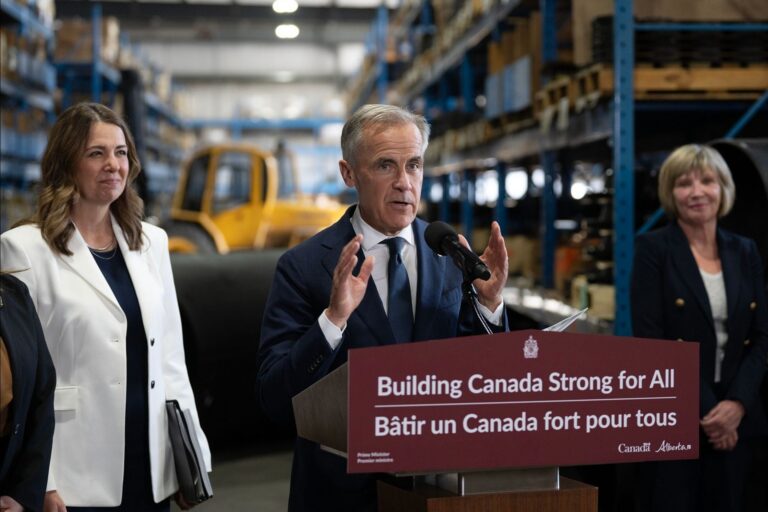

Canadian Natural Resources, Suncor Energy and Cenovus Energy all broke quarterly financial and operational records, but earnings calls were dominated by questions about where that money might go next.
Executives largely stressed that shareholder returns remain the priority. Yet they also signalled that the recent memorandum of understanding with the federal and Alberta governments—which links oilsands production growth and new export capacity to a large-scale carbon capture and storage project—could eventually justify the biggest wave of oilsands investment in years.
“Where we are today and what’s been discussed and agreed on unlocks this business in terms of its investability,” Cenovus CEO Jon McKenzie said. “This is probably the largest investment opportunity that we have as a country… It is pretty exciting for this industry.”
Since the 2014 oil price crash, Canada’s oilsands majors have largely avoided the multibillion-dollar megaprojects that had previously defined the sector, focusing instead on smaller expansions, efficiency gains and more recently, on directing surplus cash towards dividends and share buybacks. But with multiple new export pipeline proposals currently in development, and renewed government focus on boosting Canadian energy exports, producers are facing increased pressure to boost capital spending on growth projects.
Shareholder returns dominate: Suncor signalled it would accelerate share buybacks, announcing this week it would increase monthly buybacks from $350 million to $500 million beginning in August, its second increase this year.
Suncor CEO Rich Kruger—who announced on Thursday his intention to step aside next spring to make way for successor Peter Zebedee—sounded the most skeptical about the possibility of accelerating production growth.
“It’s hard to see us manoeuvring around reinvestment rates or capital year to year to chase a rabbit,” Kruger said Wednesday. “We really spend a lot of time thinking about the business we’re in and trying not to overreact or pursue the flavour of the day.”
The country’s largest oil producer, Canadian Natural Resources, meanwhile, said its medium and long-term growth projects—totalling some 340,000 barrels per day in new production— “remain on hold” until agreements are finalized between the federal and Alberta governments and the five companies that make up the Oil Sands Alliance.
Final, binding agreements could come in November, with oilsands companies seeking new fiscal incentives from governments that would help them recover the cost of large oilsands investments more quickly.
Internal briefing notes prepared by Natural Resources Canada, obtained by The Logic through an access-to-information request, suggest the Oil Sands Alliance is urging Ottawa to enable the immediate expensing of capital investments in oilsands projects—a tax measure that would let companies deduct qualifying capital costs immediately rather than over time. The federal government under Prime Minister Mark Carney has already adopted a similar approach for investments in manufacturing buildings and equipment, clean-energy generation, scientific research and data network infrastructure.
Canadian Natural Resources president Scott Stauth assured investors Thursday that future growth wouldn’t come at the expense of shareholders.
“We’re not sacrificing shareholder returns,” Stauth said. “We’re not laying long-term projects over top of medium-term projects in such a way that it presses hard on the capital.”
But Stauth also called the trilateral MOU “transformative,” if governments follow through on the fiscal and regulatory reforms the agreement promises.
“It really transitions Canada from a country where we’ve been somewhat stagnant in growth to a country that has a real significant opportunity here to be an energy superpower,” he said.
Deals in the pipeline: The industry’s renewed discussion about growth is being driven in part by a wave of pipeline proposals that would significantly expand Western Canada’s crude export capacity by more than two million barrels a day.
This week, South Bow said its proposed Prairie Connector project, using leftover pipe and assets from the cancelled Keystone XL project, had secured key long-term commitments from nine shippers.
“The production growth associated with these commitments will help generate the cash flows needed to enable ambitious, larger-scale investments across the Western Canadian Sedimentary Basin in the years ahead,” South Bow CEO Bevin Wirzba said Thursday.
However, pipeline giant Enbridge threw investors a curveball last Friday, announcing it would delay a planned second expansion of its Mainline Pipeline, suggesting producers were not yet prepared to make long-term commitments to the project.
“Producers and governments are still in a non-binding MOU stage,” Enbridge executive Colin Gruending said. “We don’t expect producers to start meaningfully FID-ing [Final Investment Decision] production growth yet. Nor do we expect producers to be making binding, FID-able commitments to new pipelines until then.”
With files from David Reevely












