VANCOUVER & OTTAWA — The sidewalks around AbCellera’s main Vancouver office were closed at times this summer due to nearby construction, making it difficult for its hundreds of employees to access the five-storey headquarters they have already outgrown.
Soon, much of the company’s staff will move into new, custom-built space one street away, filling an additional 380,000 square feet across two buildings. The urgent expansion of AbCellera’s campus reflects the company’s emergence as a leader in finding new ways to fight disease via antibody therapies its scientists discover with the help of artificial intelligence.
Talking Points
- Canada’s trailblazing work in artificial intelligence makes it a hotbed for the basic research on molecular interactions that leads to new drugs to treat illnesses
- So far, we lack the “wet labs,” financing and manufacturing capabilities to turn that success into a next-generation pharma industry
The pharmaceutical research sector offers some of the best examples of Canadian companies trying to build on the opportunities created by the vital, early AI breakthroughs that were made in the country’s research universities and laboratories. It also offers some of the clearest examples of the challenges companies face in this market as they try to scale up and compete on the global stage.
With a record-breaking IPO in the rearview mirror, AbCellera is often lauded as a success story. It’s an exception. While Canada has gained renown for its prowess in the first stages of AI-assisted pharmaceutical research, biotech leaders say they need more of many things if the country wants to turn its early lead in AI drug discovery into more AbCelleras. More wet labs, where they can perform tests in real-world conditions they’ve previously modelled on computers. More manufacturing space to make the products they develop. More financial investment and, according to some in the increasingly competitive field, a bit more can-do spirit.
CEO Carl Hansen remembers when AbCellera existed in a University of British Columbia lab with a half-dozen employees and modest ambitions that saw them leave a local pitch competition dejected.
Hansen and the others included an exit plan in that pitch, a piece of bad advice he said they picked up while preparing. They set their sights on being acquired for $100 million within eight years. Their group was met with incredulity. “It can’t be done. It’s too big,” he recalls being told. AbCellera’s first day of trading, roughly eight years after it was founded, gave it a market capitalization of nearly US$16 billion.
That propensity to think small—distinctly Canadian, in Hansen’s estimation—is a big part of why Canadian startups fail to scale into global powerhouses. To him, AbCellera’s status as a Vancouver anchor firm is an insufficient marker of success.
“The game in biotech or technology or business in general is not to win in your neighbourhood or in your province, or even in your country,” he said. “It’s to win on a global stage.” In Hansen’s mind, AbCellera has only just entered that arena.
Science fiction to science
On a Tuesday afternoon, sitting in one of the company’s sun-drenched meeting spaces, Hansen seemed frustrated by the hype around AI in drug discovery. He pointed to a line in the company’s latest annual report: “Many of the claims associated with AI drug discovery are ahead of current capabilities.” In conversation, he offered a translation: “We’re calling BS on a lot of this.”
While some AI applications for drug discovery are powerful, “it is not a Star Trek computer. You can’t go to this thing and ask it, ‘Hey, can you give me an antibody drug?’” he said. “That’s currently science fiction.”
But then, five years ago, Philip Kim would have told you the work his University of Toronto lab does today was impossible.
He’d published on machine learning in biochemistry in 2003—practically the dawn of time in this field—when he was finishing a PhD at the Massachusetts Institute of Technology.
Now a molecular biologist cross-appointed to U of T’s computer-science department, he works on how proteins (and peptides, their building blocks) interact in biological systems. A peptide that interferes with certain cells could be the basis of a cancer drug; one that helps brain cells stay together could fight Parkinson’s.
One obstacle that once seemed monumental: A computer understands a protein molecule as a long set of three-dimensional coordinates. Teaching it that if you rotate the molecule a few degrees, its new coordinates represent the same protein, is essential. Especially if you’re sifting through millions of them.
If you can dream up the protein on the computer, it’s going to do more or less exactly what you want. — Philip Kim
“All the numbers have changed, so for the computer, it’s a new object,” Kim said. “There’s ways to counteract that, but it becomes very inefficient.”
As artificial intelligence researchers knocked these barriers down, progress in AI-assisted biochemistry accelerated, to the point where it’s now commercially attractive because simulations of chemicals are nearly as good for understanding their properties as the real things in test tubes.
“In 2023, if you can dream up the protein on the computer, it’s going to do more or less exactly what you want,” he said.
Much of the progress can be traced to AI all-stars Geoffrey Hinton (one of Kim’s colleagues), and Yoshua Bengio at the Université de Montréal, Kim said. Neither is a biologist or a chemist, but both attracted and trained talented people to create world-class AI ecosystems in Toronto and Montreal that have many applications.
In 2012, for example, a student of Hinton’s, George Dahl, led a group that won a $40,000 prize sponsored by Merck, for finding statistical techniques to predict certain molecules’ biological effects. That was a side hustle; Dahl’s main PhD research was on using AI in speech recognition.
As rich as the Toronto ecosystem is, it is incomplete. Kim is a co-founder of a venture-backed pharma startup that remains in stealth mode, so he’s circumspect about its mission, other than designing biologic drugs. When the time comes to take potential medicines off the screen and into a wet lab for real-life experiments, “that will probably have to be in one of the U.S. hubs, so likely Boston,” he said.
Toronto just doesn’t have facilities and talent on anything like that scale, Kim said. Nowhere in Canada does. A Moderna research centre in Montreal—a component of a deal the company made to build a factory there—and AbCellera’s Vancouver expansion could be parts of a solution. But not many pharmaceutical firms have gone from idea to commercial product here.
“There’s certainly some successes, but the list is pretty short,” Kim said.
AbCellera has attacked the problem by building some of the infrastructure itself.
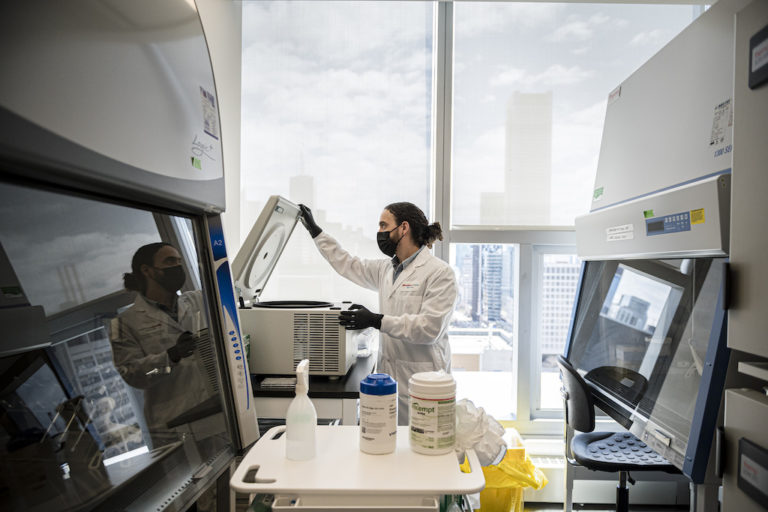
The biotech partners with other companies that come to it with a hypothesis—say, that an antibody developed for one of the tens of thousands of proteins our bodies make could help treat cancer. AbCellera then creates large numbers of antibodies, looking for the proverbial needles in the haystack, that is, the select few that could become drugs.
Innovation Minister Francois-Philippe Champagne, centre, and B.C. Premier David Eby, on a tour of an AbCellera lab, with Raffi Tonikian, the company’s translational biomarker director, in Vancouver in May 2023. Photo: The Canadian Press/Darryl Dyck
With U.S. pharma giant Eli Lilly, AbCellera co-developed two antibody treatments for COVID-19. They started by screening more than 5.5 million immune cells and found more than 2,000 antibodies, which AbCellera whittled down to 24 frontrunners within about three weeks.
The company’s “secret sauce” is end-to-end capability for drug discovery, said Steven Mah, a senior research analyst for life science and diagnostic tools at TD Cowen. They source, search out, analyze and engineer antibodies. “They’re one of the few companies that put all of the key differentiators together and brought all these technologies under one roof into a faster and more efficient workflow.”
They’re working on the next logical step in that chain. In June 2021, AbCellera secured a site to build a manufacturing facility in Vancouver, which the company expects to be operational in 2025. There, it will produce antibodies for Phase 1 clinical trials. That will help AbCellera attract partners, said Mah, because those companies won’t have to find third-party firms to do their manufacturing.
Finding the money
What wet labs are to a scientist like Kim, growth capital is to a CEO like Naheed Kurji, the head of Recursion Canada.
Until last spring, he was chief executive of a Toronto company named Cyclica. He joined the firm in 2014 when it was still a nestling, after first hearing about it in business school.
On the same day in May, Cyclica and Montreal’s Valence Discovery sold to Recursion, an AI-driven drug-development company in Utah; Cyclica and Valence made AI tools for discovering drug candidates. Cyclica’s Toronto staff merged with a small Recursion operation already in Toronto, while Valence Discovery became Valence Labs, a Recursion research centre.
The game … is not to win in your neighbourhood or in your province or even in your country. It’s to win on a global stage. — Carl Hansen
“Canada is the best in the world at defining the scientific problem and doing all the brute-force, basic research to come up with the invention to solve that problem scientifically,” Kurji said recently in a video interview from Recursion Canada’s new office on Toronto’s Queen Street West.
Finding funding to go to the next level is another matter.
AbCellera has joined calls for Canada to give special tax treatment to the revenue from Canadian discoveries and inventions, so the money can be reinvested in Canadian operations. But many companies would still need outside investment to take an innovation global.
Kurji dates investor interest in AI-driven drug research to a 2013 paper from consulting firm McKinsey & Company proposing that machine learning could give new energy to languid development pipelines.
“What McKinsey says, people start to pay attention to,” Kurji said.
But the sector is not for skinflints. Sometimes in pharma, hundreds of millions of dollars and decades of research and development fall flat.
“It’s a highly esoteric space that requires a long-term view and a patient approach to investment,” Kurji said. “And that’s generally not the way in which Canada has built itself.”
Cyclica chose early on to stay in Canada to keep ready access to the local talent, he said, but ultimately it ran up against a shortage of capital for massive growth. Some U.S. venture firms are looking north, seeing opportunity in filling the gap, he said, but “that next inflection is still difficult.”
When companies start slapping ‘AI’ on their website or at their door, that is when we get a bit less interested. — Jean-François Pariseau
Selling to Recursion means Cyclica’s early backers can recycle their profits into new investments, and researchers can work on new discoveries, Kurji said. He also thinks it’s important that Recursion is committed to a Canadian operation—the one he now heads.
“We did not sell out and move our IP and talent,” Kurji said.
One Canadian money man has some ambivalence about the buyouts.
“Our investors are very happy with the exits,” said Jean-François Pariseau, a co-founder of Montreal’s Amplitude Ventures. “But is it the best way to build a national industry? I’m not sure.” Amplitude spun out of the Business Development Bank of Canada (BDC), where Pariseau and several other members of the team were venture investors, and raised $200 million for its first fund. Valence Discovery was in Amplitude’s portfolio until Recursion bought it.
Pariseau, who was educated as a biologist, said Amplitude seeks to invest in companies that use AI as a tool, not an end in itself: “When companies start slapping ‘AI’ on their website or at their door, that is when we get a bit less interested.”
Pariseau agreed with Kurji that buyouts—the Cyclica and Valence sales are just a couple of recent examples—mean talented entrepreneurs can start again and be funded again.
At BDC, Pariseau’s team invested in Montreal’s Clementia, a unicorn that the Paris-based pharmaceutical giant Ipsen bought in 2019. Now Clementia’s ex-CEO Clarissa Desjardins leads Congruence Therapeutics, another of Amplitude’s portfolio companies. What’s Congruence’s aim? Using AI to hunt for molecules that can correct disease-causing protein defects.
“All these companies that were acquired recently, we know them very well,” Pariseau said. “All the entrepreneurs that were very successful, they’re still pretty young, and they’re going to be repeat entrepreneurs, and we’re going to work with them, and the next companies they’re going to be building will be even bigger.”