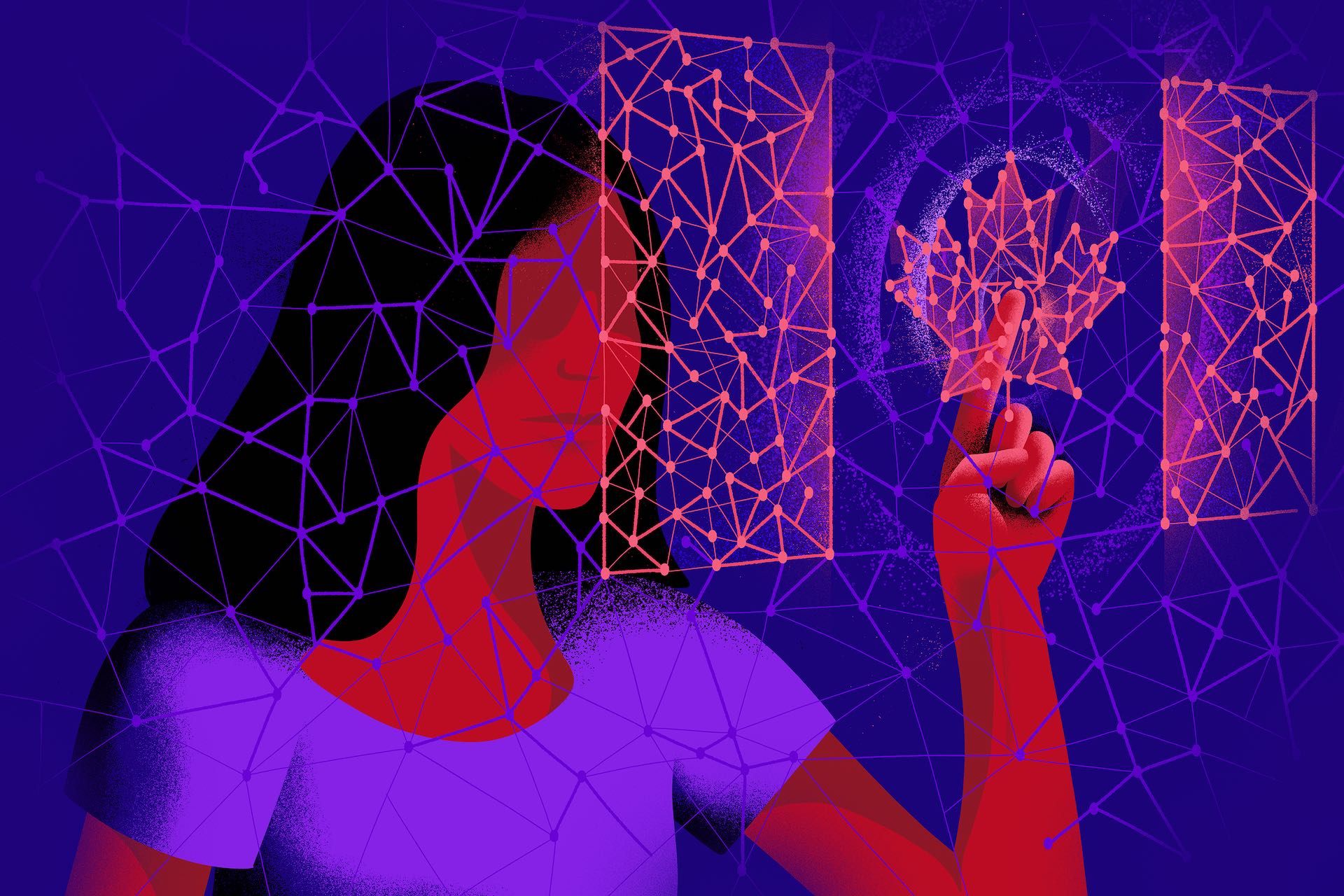
The artificial intelligence boom presents Canada with unique opportunities and risks as we seek to benefit from a technology that could reshape how we live.
In this special series, Canada’s AI Advantage, The Logic examines how Canadian companies, investors, institutions and workers can gain from the country’s early lead in AI, even as Canada’s pioneers in the field become the world’s most powerful voices of caution.
On a trip to California a few years ago, Ruslan Salakhutdinov made time to hang out with some old school chums. A decade earlier, the group had shared a lab at the University of Toronto—and a massive achievement.
Talking Points
- To benefit from the AI boom, Canada will need to do better at capitalizing on its foundational innovations in the field and of keeping the startups developing the technology
- Researchers here made many of the advances that enabled modern machine learning products and services—such as breakout hit ChatGPT—but many ended up leaving for Silicon Valley
Salakhutdinov and his labmates had studied under Geoffrey Hinton, the celebrated exponent of deep learning. With colleagues around the country and the world, the professor and his pupils ushered in a series of innovations that enabled the modern field of artificial intelligence. Together, they thawed the neural-net winter, ending a period when their preferred AI approach—based on trying to mimic the way humans think—was out of favour and funding.
In doing so, they made possible the generative AI summer that the world is basking in today, as well as applications with society-changing potential from faster drug discovery to climate solutions. AI is red hot right now, everywhere from the meetings of world leaders to those of high school teachers.
Yet by the time of the gathering in Silicon Valley, most of the assembled researchers had long left the country. At least half had headed to California. Hinton was spending half his time at Google. Salakhutdinov himself was in Pittsburgh, a professor at Carnegie Mellon University working on novel ways to structure the massive volumes of data many AI models need. “These are the drivers of that technology, and they’re all … in the U.S.,” he says.
Their story of shared vision, success and exit is an all too familiar tale for Canada. Though few here were tuned in as it was happening, Hinton’s group—along with peers in Montreal and beyond—for a time made Canada the place to build the AI that seems set to be everywhere soon.
But too few stayed. As their innovations spread through the tech world today, the missed opportunity is keenly felt. The group that gathered that day alone has done fundamental AI work at the likes of Apple, Google and OpenAI.
Take the internet’s favourite new toy: ChatGPT, which San Francisco-based OpenAI launched into the world last November. The query-response system gave many ordinary folk their first encounter with a machine that felt intelligent, signaling that everyday AI could be a fact of the present rather than a science-fiction future. “There’s almost like a pre-ChatGPT world and post-ChatGPT world,” Innovation Minister François-Philippe Champagne observed at a robot-habited AI conference this fall.
But if ChatGPT was born in California, parts of its lineage trace back to Canada. Chief scientist Ilya Sutskever—a lynchpin member of the OpenAI board that ousted CEO Sam Altman on Friday—once shared a U of T lab with Salakhutdinov. Dozens of other staff at the company are drawn from top Canadian schools. The transformer approach that puts the “T” on ChatGPT came from a June 2017 paper co-authored by a group of Google researchers, including Canadian Aidan Gomez. And the whole superstructure of text- and image-generating tools rests on the deep learning foundations laid in Canadian labs over the last two decades.
That goes for much of modern AI. Researchers in Toronto, Montreal and beyond demonstrated how the technology could work; many went on to the tech titans and challengers now putting it to work. Startups and scale-ups across the country are looking to develop AI’s next world-changing, money-spinning application.
But Canada has held, and lost, the global lead on technologies before, watching corporate champions like Nortel and BlackBerry rise and fall. To benefit from the AI boom, the country will need to do better at capitalizing on its inventions and keeping its commercial contenders on track. Policymakers will need to grapple with growing concerns in civil society about the technology’s impacts. And firms will need to compete with better resourced rivals for the people who will drive AI forward—people like the ones who once clustered around Hinton at U of T.
The technology promises, or threatens, to transform economies, societies and the way all of us live our lives. So, The Logic is launching a special series today examining the possibilities and challenges AI poses to Canadians, and to Canada.
“There are very few places in the world that produce more of this talent than Montreal and Toronto.”
We’ll meet the country’s current AI champions—and some fallen ones. We’ll examine the impact AI could have on our productivity and economy. We’ll explore why top researchers and policymakers are suddenly talking about AI posing an existential threat to humanity. We’ll look at AI’s geopolitical implications, and how Ottawa and its allies are responding. We’ll trace the ways specific AI applications are changing workplaces and sectors, like helping to develop new drug therapies and shed light on our natural world. We’ll have some fun along the way, experiencing what a future filled with AI could feel like. And throughout, we’ll tell you where Canada fits into an increasingly AI-frenzied world.
While Canada’s place in the grand AI show is far from assured, the country is hardly a poor player today. Our current champions of the technology are at centre stage.
Gomez’s startup, Toronto-headquartered Cohere, is racing against OpenAI to get tech giants, corporate behemoths and new ventures to use its large language models (LLMs) to produce content and summarize text. The firm has raised US$440 million to date, per PitchBook data, and was valued at US$3 billion in the last reported deal involving its stock. (OpenAI has landed more than US$11 billion.)
Cohere is not alone. Toronto-based Ada is using LLMs for customer-service automation tools. Quebec City-headquartered Coveo is using them for search. Toronto-based Ideogram is building models that make images.
In a symptom of the generative AI fever, retail investors can now buy the stock of a firm that worked the phrase into its name and listed on a junior exchange via reverse takeover in the second quarter—an echo of the way some micro-caps added “blockchain” to their monikers in the last hype cycle.
Cohere co-founders Ivan Zhang, Aidan Gomez, and Nick Frosst. Photo: Cohere/Handout
But there’s more to AI than LLMs. Canadian startups are applying machine learning to all sorts of applications: AbCellera, BenchSci and Congruence to drug discovery; Certn to background checks; Dcbel to home-energy management; Mindbridge to auditing; and Sanctuary AI to robots.
“The ecosystem that I’m in [is] still super nascent,” says Gomez, whose firm is arguably Canada’s current AI champion. “I want to see tens, hundreds of Toronto- or Canada-based AI companies.” In AI, Canada may not produce a Nortel or a BlackBerry—a single, world-beating company. But given how those stories ended, the economy may be better served by a portfolio of firms competing at the front of different fields.
Plenty are working to join that pack. Firms large and small are filling their offices with machine-learning engineers and data scientists from the same schools where the field’s modern methods were invented.
AI enthusiasts elsewhere are keen to join them, says Foteini Agrafioti, head of RBC’s Borealis AI lab. At the IITs, India’s network of prestige engineering schools, a class might spend an entire semester implementing a paper out of the Toronto-based Vector Institute, she says. “So they’re thinking, ‘That’s the destination.’” Salakhutdinov, for one, figures he might have stayed in Toronto had the Vector Institute existed when he exited in February 2016.
The dozens of executives, founders and researchers with whom The Logic spoke for this series cited the quality of Canada’s AI workforce as a strength. “There are very few places in the world that produce more of this talent than Montreal and Toronto,” says Steven Woods, a partner at VC firm Inovia Capital and former longtime Google executive.
But the country’s economic history provides plenty of cautionary tales of resources—human or material—ceded to other places, or simply squandered.
Take BlackBerry, and AI. In the summer of 2009, the Waterloo, Ont.-headquartered firm was still a technology titan, its clickety keyboards thumbed everywhere from Wall Street trading floors to the Oval Office. In Toronto that same season, Hinton’s students built a model to predict phonemes—the base unit of meaning in talking—from sound waves.
The result: Speech recognition better than anything the corporate world had been able to produce in three decades of R&D. But “our attempt to give it to Canadian industry failed,” recalled Hinton, speaking at an October event hosted by investor Radical Ventures.
While tech giants Microsoft and IBM hooked two of the ingenious students as interns, a third, Navdeep Jaitly, sought a Canadian post. So, professor and pupil approached the company then known as Research in Motion, and for now as BlackBerry. “We said, ‘We’ve got this new way of doing speech recognition, and it works better than the existing technology,’” recounted Hinton. “We’d like a student to come to you over the summer to show you how to use it, and then you can have the best speech recognition in your cellphone.”
RIM passed. Jaitly instead went to Google, which built the speech-recognition technology into its Android operating system to take on Apple’s smooth-toned Siri. The iPhone killed the BlackBerry. “It was a shame that Canadian industry didn’t [adopt it],” Hinton says now. “I think we might have still had BlackBerrys if that had happened.”
But such what-ifs are the stuff of speculative fiction, and we’ve just seen a cinematic chronicle of BlackBerry’s rise and fall. Canada and its AI companies hope to script a happier ending for the next tale about the country’s technology sector.
Woods, for one, is optimistic. “We have a very great story here.”