The artificial intelligence boom presents Canada with unique opportunities and risks as we seek to benefit from a technology that could reshape how we live.
In this special series, Canada’s AI Advantage, The Logic examines how Canadian companies, investors, institutions and workers can gain from the country’s early lead in AI, even as Canada’s pioneers in the field become the world’s most powerful voices of caution.
OTTAWA — Most of the supply chains that feed the growing artificial-intelligence industry run through Taiwan, whose territory is increasingly threatened by the Chinese government in Beijing that considers it a renegade province.
Talking Points
- The Taiwan Semiconductor Manufacturing Company fabricates some of the world’s most advanced chips and is a bulk supplier of less specialized ones, making it a key supplier in global artificial intelligence, precious to both China and the West
- China is striving to free itself from dependence on Taiwan, which could wreck a delicate balance and mean Canada needs to look to other sources for critical components
Voters there are to choose a new president Jan. 13, in a ballot the main opposition party says will be a choice between war and peace. Even if that’s overheated electioneering, a worsening of tensions short of that could be devastating to nearly every industry that relies on microprocessors, including AI.
“Let’s say something happens now and the entire supply chain from Taiwan is stopped,” said Arun Iyengar, chief executive of Untether AI, a Toronto-based company that designs processors for neural networks, a form of artificial intelligence.
He paused.
“Wow, I mean”—he chuckled uneasily—“that’s just horrendous to imagine.”
The possibilities for diversifying suppliers are negligible—at least over the next few years. For spinning up a domestic source, they’re even worse. But Canada could play a role in building an alternative, spread across multiple friendly countries, to one contested island about 180 kilometres from an increasingly adversarial regime.
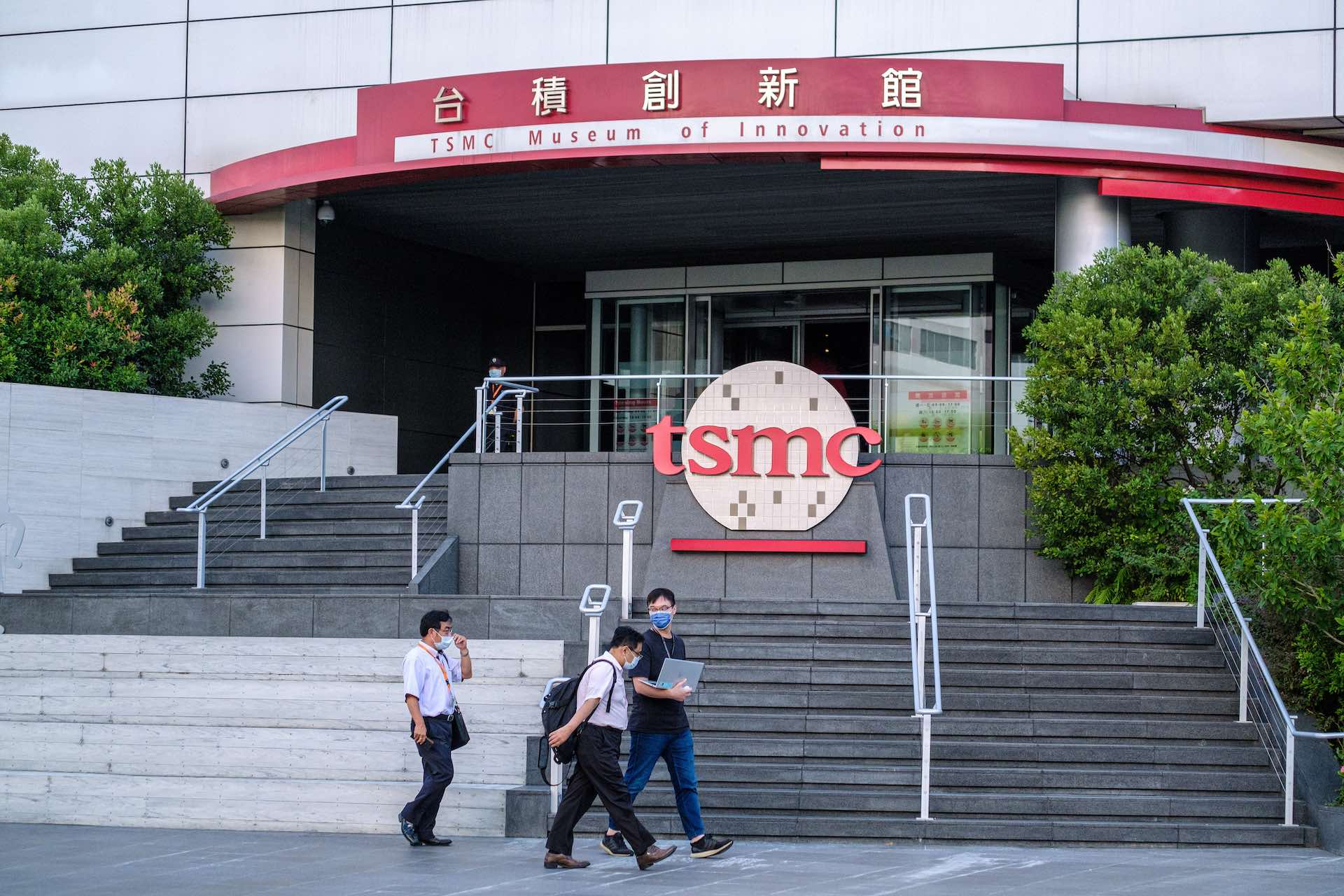
Among other semiconductor makers, Taiwan is home to TSMC, the Taiwan Semiconductor Manufacturing Company, which is both a leading-edge manufacturer and a bulk supplier. Arguably the world’s most advanced semiconductor manufacturer—only Samsung and Intel compete in the elite tier of the fabrication game—TSMC is also the dominant contract manufacturer of the parts that are critical to electronic systems of all kinds, including those that run artificial intelligence applications.
It operates a stunning 15 fabricators, or “fabs,” in Taiwan, plus two in mainland China and one in the United States.
A firm that relies on TSMC for its components, like Iyengar’s, would need at least 18 months to redesign them for another fabricator, “if you’re really, really fast,” he said. “It’s a catastrophic situation if that ever came about.”
The Jan. 13 election pits the current vice-president, Lai Ching-te of the stridently anti-Beijing Democratic Progressive Party (DPP), against Ko Wen-je of the Taiwan People’s Party and Hou Yu-ih of the Kuomintang, both of which are seen as friendlier toward mainland China.
The DPP’s Lai led narrowly in a recent poll, despite its weak record, after the opposition parties’ effort to form an alliance blew up. Beijing is officially displeased.
Thinking of any of the potential next presidents as friends or enemies of Beijing is simplistic, warned Scott Simon, an anthropology professor at the University of Ottawa who shares the university’s research chair in Taiwan studies (a post supported by the Taiwanese government).
“None of them are saying, ‘We want to be a province of the People’s Republic of China.’ None of them,” he said in an interview from Taiwan, where he’d recently landed to observe the election up close. Equally, he said, no candidate is out to cross China’s red line by declaring outright independence.
The difference among the candidates is whether they think Taiwan’s autonomy is best preserved with honey or with vinegar.
But Simon said even an administration warmer to Beijing could easily find itself in a tight spot. He pointed to a trade agreement between Taiwan and the mainland, under a Kuomintang president, that led to a 2014 occupation of Taiwan’s parliament. It ended peacefully, but Simon said a repeat might well not.
“China has this anti-secession law that they passed, and it specifically says that if there’s civil unrest in Taiwan, they can intervene,” Simon said.
“The likelihood of a direct military conflict is still very, very small,” said Jia Wang, deputy director of the University of Alberta’s China Institute, who was born and educated in Beijing. “Compared to five or 10 years ago, that probability is higher, though still very low.”
Mainland China is Taiwan’s biggest trading partner and people travel back and forth, Wang said: “Taiwan and mainland China are two sides of the Taiwan Strait. There are just very many deep and broad ties between the two places.”
Most chip companies now are trying to figure out, OK, what are their options? — Arun Iyengar, Untether
Also militating in favour of peace: China depends on Taiwan’s semiconductors, too. “Taiwan’s chips power everything, including the U.S. and Chinese militaries (China imports more chips than oil),” wrote Daniel Araya, a Canadian lawyer and technology consultant who works on AI issues and the U.S.-China rivalry, in an email to The Logic. But China is working mightily to free itself from dependence on Taiwan’s foundries.
“Eventually—say by the end of the decade—China will have a completely independent chip ecosystem which will obviously mean a very different global order. At best, it could mean a completely bifurcated tech sector,” Araya wrote.
“As for Canada, we’re just too inward-looking to appreciate how quickly things are changing.”
The People’s Republic would not have to invade, crossing a red line for the United States, to cause serious trouble. A naval blockade, for instance—even an undeclared partial one—could throttle exports, or imports of vital raw materials and fuel. China did that after Nancy Pelosi, then the Speaker of the U.S. House of Representatives, visited Taiwan in August 2022.
“The Chinese military had multiple military drills around Taiwan Island. And that almost created a blockade, because nobody would want to get close to a military exercise,” said Wang.
Canada is among the countries that have had sabre-rattling contests with China in nearby waters.
“Most chip companies now are trying to figure out, OK, what are their options?” Iyengar said. There aren’t a lot of good ones.
Hedging against the risk of trouble in Taiwan by “dual-sourcing” would mean redesigning products, because fabricators aren’t interchangeable, said Hamid Arabzadeh, the CEO of Ottawa’s Ranovus. It produces components for AI-oriented data centres and networks.
AI has sent demand for “compute” power through the roof, where it’s been hastily met as well as possible by processor companies such as AMD and Nvidia, and the quantities of data many AI systems need to store are humongous. Ranovus’s products are connectors that send data among memory and processing units optically rather than electrically.
“They’re not commodity chips. They are specialized … and the things that people like AMD and Nvidia are selling, they are not commodity chips, either,” Arabzadeh said.
Ranovus’s products are manufactured in North America, starting at a semiconductor fab in Malta, N.Y.—a strategic decision the company made in 2018—but they often hook together components that other companies have TSMC make for them in Taiwan.
Adding a second source for a TSMC-made chip could take up to two years, and you’d lose the benefits of TSMC’s advanced capabilities in the bargain unless you had two teams working on two chip designs to do the same thing, Arabzadeh said. The result would be less efficient, more expensive semiconductors—taking a step back in technological time to a lower standard.
“It’s going to be a shock to the system,” he said.
For most firms, that’s out of the question, said Iyengar of Untether.
“It costs anywhere from $50 million to $150 million, depending on the specific technology [level] you’re targeting, to go build a chip,” he said. “So even if you raise $150 million, you’re barely able to do one properly, let alone two different designs for the same chip.”
“In the short term, there’s not a ton Canada can do to beef up our own production,” said Wang. “Of course, looking at suppliers from multiple sources, it’s something we can always do.”
“It would be completely naive for Canada to go build a foundry in Canada,” Arabdzadeh said. “We don’t have the skill set.”
TSMC is building two fabs in Arizona, thanks in part to the U.S.’s CHIPS and Science Act, but the first is behind schedule and the next trick will be domestic “packaging,” the final manufacturing stage. TSMC has put the price for the two fabs at US$40 billion.
The fabricator Ranovus uses in New York state is run by GlobalFoundries, a chipmaker spun out of AMD in 2009. It’s a consequential competitor to TSMC but not on all fronts, emphasizing parts like Ranovus’s tiny optical modems over the full processing units AI relies on.
Canada has specialty manufacturing facilities it could boost, to promote its value in chip supply chains farther from China’s reach, Arabzadeh said. The National Research Council has a foundry for chips that use lasers, for instance, that could be the core of a competitively differentiated industry in “compound semiconductors.”
“It’s a different thing in the periodic table, but it is necessary—it coexists with semiconductors to enable AI workloads to be done,” he said.
Advanced manufacturing, for the packaging phase, could also be a Canadian specialty, he said.
“Look at the strengths we have and double down on it, which would complement our allies, like the U.S., because they don’t have the types of facilities that we have in Canada.”
As The Logic has reported, the same CHIPS and Science Act that subsidizes large fabricators in the United States could support packaging in Canada.
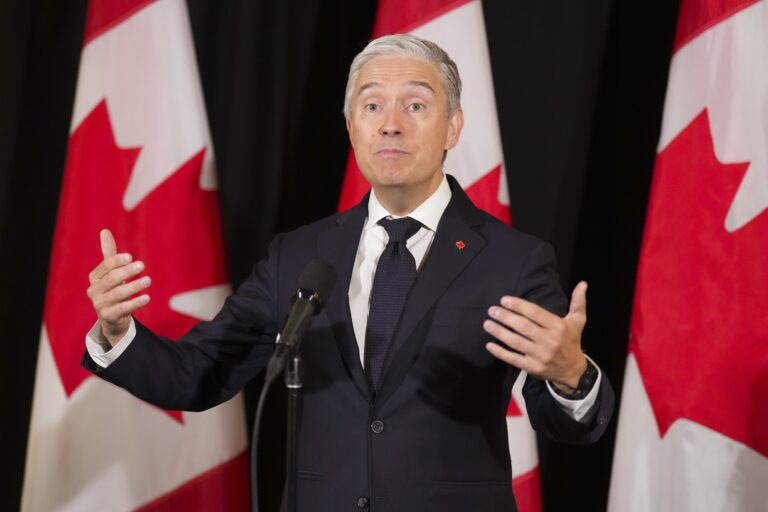
Hans Parmar, a spokesperson for Innovation Minister François-Philippe Champagne, made similar points in replying to questions about Canada’s preparedness for a possible disruption in the supply of chips from Taiwan.
“Canada is recognized as a R&D and design hub, with a reputation for world-leading expertise in high-value, specialized areas of semiconductor manufacturing such as compound semiconductor fabrication and advanced packaging,” he wrote in an email.
Global Affairs Canada, meanwhile, touted Canada’s international contribution to “critical minerals and semiconductor life-cycle value chains.” Spokesperson Jean-Pierre Godbout wrote that Canada has just finished negotiations with Taiwan on a mutual investment deal and is “committed to growing economic and people-to-people ties with Taiwan while supporting its resilience.”
That’s likely Canada’s best bet for now, said the University of Alberta’s Wang.
“We have some really cutting-edge AI research capacities and cutting-edge knowledge, but we’re not a major player in the chipmaking industry, so we do rely on other countries to supply the most advanced chips, and chips overall,” she said. “So in many ways, to have a more peaceful world is in our interest.”