In a quiet Canadian biology lab, an AI-fuelled moonshot takes shape
The artificial intelligence boom presents Canada with unique opportunities and risks as we seek to benefit from a technology that could reshape how we live.
In this special series, Canada’s AI Advantage, The Logic examines how Canadian companies, investors, institutions and workers can gain from the country’s early lead in AI, even as Canada’s pioneers in the field become the world’s most powerful voices of caution.
GUELPH, ONT. — The world’s top experts on that humblest of insects, the ant, are each conservatively outnumbered about 20 quadrillion to one by their research subjects. There are 15,700 named ant species and subspecies, and potentially just as many undiscovered. Just keeping track, never mind studying all that variety, is a job that stretches the limits of human capability—particularly in a world changing so rapidly that an estimated 1 million animal and plant species are threatened with extinction, more than ever before in human history.
With biodiversity under threat, bug scientists are hoping artificial intelligence can help solve the mysteries of the natural world scurrying beneath our feet. Biologist John Fryxell is leading one such effort.
News
In a quiet Canadian biology lab, an AI-fuelled moonshot takes shape
Armed with artificial intelligence and millions of bugs, scientists race to unravel one of the world’s toughest biodiversity challenges
The artificial intelligence boom presents Canada with unique opportunities and risks as we seek to benefit from a technology that could reshape how we live.
In this special series, Canada’s AI Advantage, The Logic examines how Canadian companies, investors, institutions and workers can gain from the country’s early lead in AI, even as Canada’s pioneers in the field become the world’s most powerful voices of caution.
GUELPH, ONT. — The world’s top experts on that humblest of insects, the ant, are each conservatively outnumbered about 20 quadrillion to one by their research subjects. There are 15,700 named ant species and subspecies, and potentially just as many undiscovered. Just keeping track, never mind studying all that variety, is a job that stretches the limits of human capability—particularly in a world changing so rapidly that an estimated 1 million animal and plant species are threatened with extinction, more than ever before in human history.
With biodiversity under threat, bug scientists are hoping artificial intelligence can help solve the mysteries of the natural world scurrying beneath our feet. Biologist John Fryxell is leading one such effort.
In a sleepy building at the University of Guelph about 100 km west of Toronto, in the hometown of the Yukon Gold potato, his team is hatching an AI program designed to bust through a bottleneck in a process their research describes as “intensive, laborious and prohibitively expensive.”
Amid the warnings about AI’s destructive potential, there is also optimism that AI could help solve some of the world’s moonshot mysteries. Fryxell’s team offers one example of how Canada’s unique expertise can play a global role.
“There is essentially nobody on the face of the planet that’s capable of sitting down and identifying every single specimen [of bug] that could be brought in, based on their knowledge. That’s beyond human capacity,” said Fryxell.
Scientists have been working over the past few decades to collect vast numbers of specimens in a comprehensive way, he said, but “that hasn’t been accompanied with armies of people to try and identify those specimens. We need to find other ways to achieve that—one is through deep learning.”
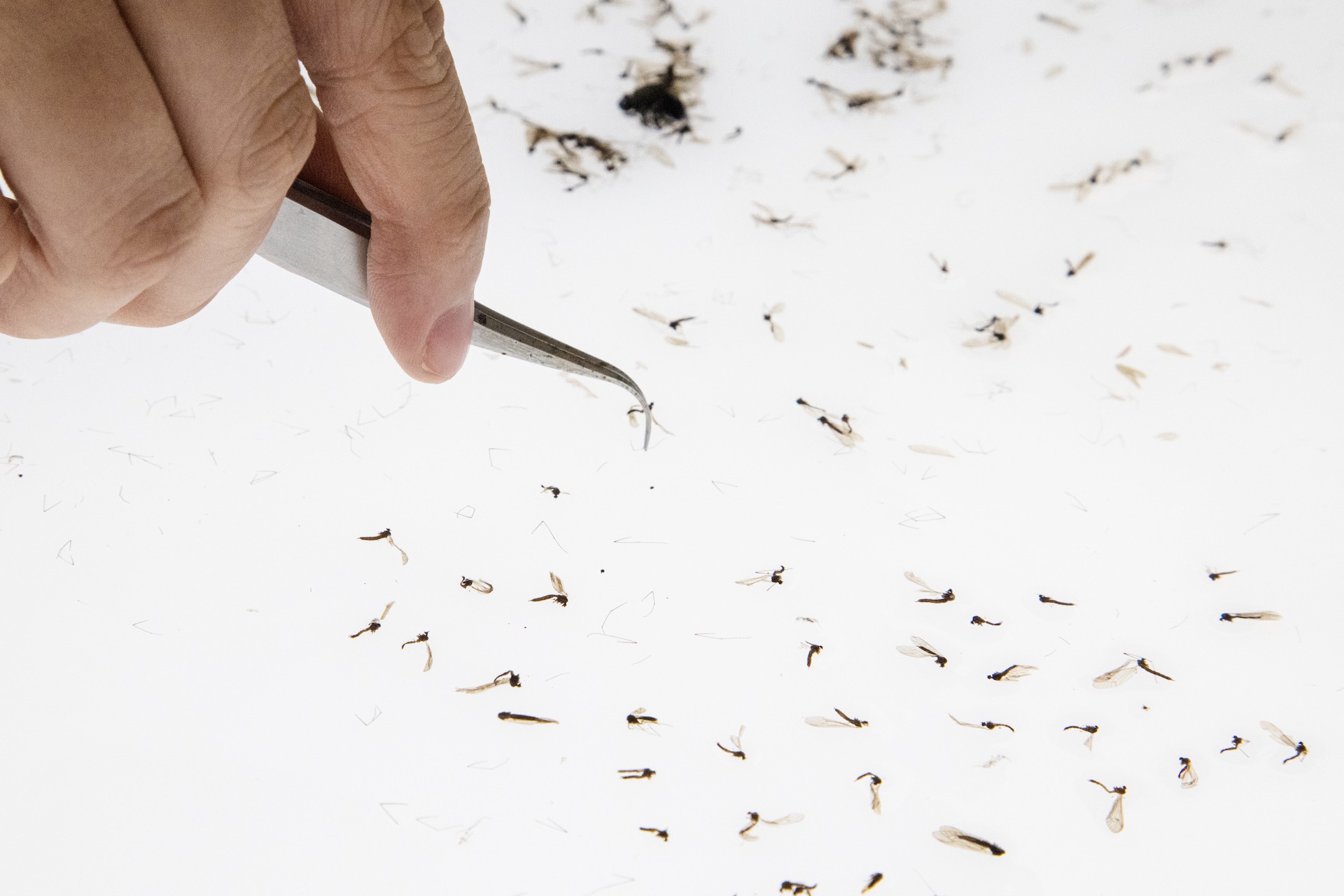
Fryxell and other researchers are working on a project called BugShot, which uses deep learning, high-definition cameras and computer vision to help identify bugs from bulk samples that would normally have to be sorted by hand—potentially cutting the process down from about a year to an hour or two. BugShot can classify over 1,000 arthropods—those are bugs with exoskeletons, from spiders to millipedes—into groupings and estimate the biomass from a single photo, Fryxell and other researchers said in a Methods in Ecology and Evolution paper.
AI has its limits, at least for now. The system focuses on identifying and grouping broad categories. While identifying bugs down to the species level would be the “gold standard,” they are still at the early stages of developing methods to get that granular, Fryxell said.
Humans also have to lend the system a helping hand.
One morning in October, co-op student Andrea Kolodziej was doing just that, readying a sample from Sweden under a rig with white screens and ring lights that looks like it belongs to a TikTok influencer, but smells like 90 per cent ethanol. Holding up a large, spider-esque creature, Kolodziej picked out the many smaller bugs entombed in its grasp that could otherwise be missed by AI. Research technician Nao Ito noted that humans must ensure the computer doesn’t try matching legs to the wrong torsos.
“From a machine-learning standpoint, the problems are actually really challenging. It’s not just, ‘Oh, apply this off-the-shelf stuff,” said Graham Taylor, a University of Guelph engineering professor and member of the Vector Institute for Artificial Intelligence.
Taylor said he’s been putting the call out for more computer scientists to pursue the project, which is both technically challenging and furthers the “more meaningful” cause of preserving biodiversity.
Co-op student Andrea Kolodziej prepares bug samples at the University of Guelph. Photo: Nick Lachance for The Logic
“It really scares me that you can take a walk and hearing all those noises that you hear in the background when you’re in the forest could just disappear.”
The technology is a leap toward a dream of bug scientists, who since the ’90s have been working on computer vision to train AI in extracting meaning from insect images the way that a scientist can. Other methods required building different algorithms for different types of bugs, or were limited to classifying a single arthropod per image, or needing human annotations.
Amid hand wringing about how Canada can best take advantage of AI’s hot moment, BugShot combines two of the country’s powerhouse projects: the Vector Institute’s AI prowess and the University of Guelph’s massive repository of biodiversity data—including its library of bug shots. Two decades ago, University of Guelph scientists pioneered an identification system for potentially every organism in the world called DNA barcoding, and the university’s BOLD database has more than 10 million specimen records, 3.5 million specimen images, and more than a million users globally. It was a breakthrough that put Canada’s biologists on the map, opening opportunities for collaboration on other biodiversity projects like BugShot.
Otso Ovaskainen, a research director of the organismal and evolutionary biology program at University of Helsinki, said Guelph’s status as a biodiversity hub, plus the presence of AI experts like Taylor helped attract him to the program.Fryxell’s Guelph lab is working with Ovaskainen on a project called Lifeplan, a worldwide effort to “generate the most ambitious, globally distributed and systematically collected dataset to date” in a bid to catalog biodiversity before it disappears.
“There is a lot of excitement about AI in biodiversity research,” said Ovaskainen. “Now, it’s really possible to do a comprehensive systematic, calibrated sampling of the world’s biodiversity…which was simply not possible, let’s say 10 years ago.”
Fryxell, whose lab conducts research projects as far-flung as the Serengeti or Norway’s Boreal reindeer habitats, said insects can play “a very large economic role” in society as well.Experts are overwhelmed not only with collecting and cataloguing the presence and prevalence of the world’s bugs in different habitats—they’re staving off “the potential threat of food web collapse,” the BugShot research paper said.
Activist campaigns to “save the bees” have raised awareness about how humans depend on insects for a massive share of the world’s crop pollination, a service that, according to one estimate, is worth US$577 billion to the global economy. Reports of a potential “insect apocalypse” document how some fish are getting smaller and some European farmland birds are starving because their insect food source is declining. Major companies like Bayer have also started working with scientists to measure how insect populations are impacted by their pesticides.
Fryxell said that while we might view some bugs as nuisances, there are many that do important jobs like pollinate food or help control the populations of worse pests.
“We all know about the importance of pollinators and making sure that our plant crops are appropriately fertilized and grow each year. A lot of our food production, for example, relies on these insect collaborators to basically do that job [of pollination] for us,” he said. “We often… have very little awareness of this armada of insect helpers.”
While AI’s growing power to solve massive problems could lead to “an intrusive, negative effect on our lives,” if misdirected or improperly regulated, Fryxell said “it’s difficult to imagine anything that would be very negative in this particular application.
“It helps emphasize that AI is not a completely negative, maligned force in the world.”
Recipients will be able to read the full text of the article after submitting their email address. They will not have access to other articles or subscriber benefits.
Photo: Nick Lachance for The Logic
Co-op student Andrea Kolodziej prepares bug samples at the University of Guelph.
Great journalism delivered straight to your inbox.
News
Cohere plans to acquire cyber startup Aisle and set up a new security division
By
Catherine McIntyre
Briefing
Banks should have kill switches, IDs for AI agents, says global finance watchdog
By Claire Brownell |
B.C. First Nations decry rushed consultations as Major Projects Office CEO promises to do better
By David Reevely |
Feds pledge $100M to back Nova Scotia’s plans for offshore wind farms
By David Reevely |
Best business newsletter in Canada
Get up to speed in minutes with insights and analysis on the most important stories of the day, every weekday.
Exclusive events
See the bigger picture with reporters and industry experts in subscriber-exclusive events.
Membership in The Logic Council
Membership provides access to our popular Slack channel, participation in subscriber surveys and invitations to exclusive events with our journalists and special guests.