MONTREAL — Major Canadian AI firms Cohere, Coveo and Ada are among the companies that have signed on to the federal government’s voluntary code of conduct for generative AI, as policymakers push to regulate the field. Participating companies are making non-binding commitments to safety measures, testing and disclosures.
Skip to content

News
Cohere, Coveo, Ada sign on to Ottawa’s voluntary code for generative AI
Companies commit to guardrails including red-teaming, watermarking, audits
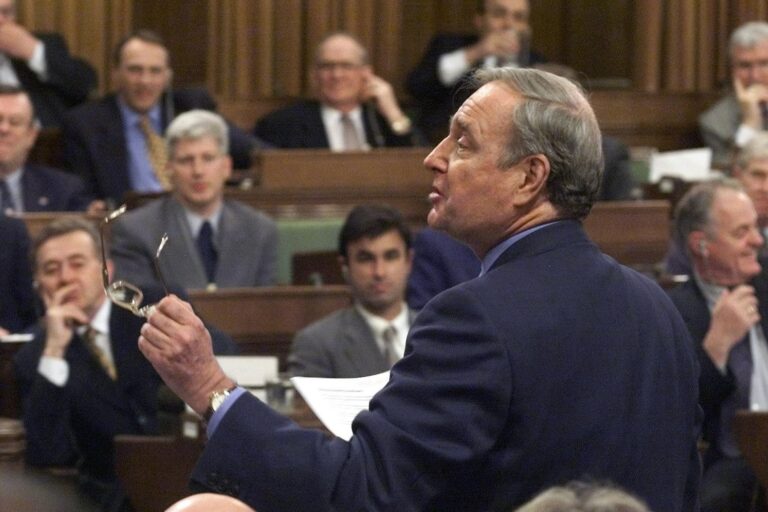
Innovation Minister François-Philippe Champagne speaks at the All In conference in Montreal on Sept. 27, 2023. Photo: Roger Lemoyne for The Logic
MONTREAL — Major Canadian AI firms Cohere, Coveo and Ada are among the companies that have signed on to the federal government’s voluntary code of conduct for generative AI, as policymakers push to regulate the field. Participating companies are making non-binding commitments to safety measures, testing and disclosures.
Innovation Minister François-Philippe Champagne unveiled the guardrails on Wednesday at Montreal’s All In conference on artificial intelligence, after closed consultations over the last month with Canadian companies, tech groups and academics.
Talking Points
- The federal government has secured commitments to guardrails on generative AI systems from major Canadian AI firms including Cohere, Coveo and Ada
- Signatories to Ottawa’s voluntary code of conduct are agreeing to assess the impacts of the tools, and in some cases to conduct third-party audits
Generative AI systems include large language models that produce text and code, as well as tools that make images. Since the debut of San Francisco-based OpenAI’s ChatGPT last November, lawmakers around the world have rushed to understand and set rules for the companies building the technology.
Developers signing the code are committing to thoroughly assess potential negative impacts of generative systems, including how the tools could be used inappropriately or maliciously, and try to curb such use. They’re also agreeing to “red-team” their products, trying to make them do things they’re not supposed to in order to identify weaknesses.
AI firms that sign the code are committing to share information with others in the sector, including guidance on appropriate usage for developers building on top of their systems, and for firms implementing them. They’re also promising to work with researchers focused on responsible AI.
Developers building publicly available generative tools are agreeing to extra measures, including conducting third-party audits before release and disclosing what kinds of training data they’ve employed. They are also committing to rolling out “a reliable and freely available method” to detect the content they generate, starting with audio and video, so it can easily be identified as AI-produced.
Related Articles


In recent months, AI-produced content like a photo of Pope Francis in a couture puffer jacket and a song “performed” by Drake and The Weeknd have spread across the Internet. Some leaders in the field have warned that new tools could be used to churn out more dangerous misinformation, and called for machine-made material to be watermarked. Similar tools for text have failed.
Canada’s code follows a similar set of voluntary guardrails implemented in the U.S. The Biden administration has secured commitments from 15 firms so far, including Amazon, OpenAI, Meta, Microsoft and Palantir. Toronto-headquartered Cohere, which develops LLMs for business applications, has signed on to both codes. Other firms participating in Canada’s version include scale-ups AlayaCare and Ranovus, as well as publicly traded firms BlackBerry, OpenText and Telus.
Notably, the country’s largest tech firm has not signed. On Wednesday morning, Shopify CEO Tobi Lütke tweeted that the code of conduct is “another case of EFRAID,” adding, “I won’t support it.” The acronym—coined by Meta chief AI scientist Yann LeCun—spells out “existential fatalistic risk from AI delusion disease.” Lütke has previously said he believes Shopify is particularly well-suited to using AI. The firm has launched features based on generative systems, including Sidekick, an AI merchant assistant.
While many of the first batch of announced signatories are AI developers, many of the code’s safety and transparency provisions could apply to companies using generative tools. Adopters are also committing to clearly identifying any AI systems that could be mistaken for humans, and monitoring for “harmful uses or impacts.”
While the code focuses on generative systems, it notes that “many of the measures are broadly applicable to a range of high-impact AI systems.” The voluntary guardrails are designed as an interim step as Parliament considers the Liberal government’s proposed AI law, which would create binding rules.
The Artificial Intelligence and Data Act—part of Bill C-27, which Champagne introduced last June—would create requirements for people developing and deploying “high-impact systems.” Innovation, Science & Economic Development Canada (ISED) will define what those are and what measures organizations must take in subsequent regulations. The House of Commons industry committee began reviewing the bill on Tuesday.
In addition to specific measures, participating firms are committing to build and roll out AI “in a manner that will drive inclusive and sustainable growth.” The code also echoes language in its U.S. counterpart about using AI to address major global challenges. Those provisions were not included in the draft version of the code circulated for consultation, on which The Logic was first to report. Innovation economy executives have previously expressed concern that Ottawa’s regulatory approach to AI does not sufficiently emphasize the technology’s potential benefits.
Earlier this month, the Council of Canadian Innovators called for the federal government to quickly roll out regulations after AIDA passes, but to offer AI firms more flexibility by recognizing industry-set standards. The lobby group, which represents over 150 scale-ups including Ada and Coveo, has also backed the voluntary code.
Digital rights advocates argue that AIDA doesn’t adequately address AI’s harms, and that the voluntary code doesn’t mitigate the act’s shortcomings. On Monday, a group of 45 organizations and academics published an open letter that compared the code to “a statement of principles,” but said it “fails to mention privacy or questionable data practices as a factor in the fairness or equity assessment.”



Loading...
Thanks for sharing!
You have shared 5 articles this month and reached the maximum amount of shares available.
CloseThis account has reached its share limit.
If you would like to purchase a sharing license please contact The Logic support at [email protected].
CloseGift the full article!
You have gifted 0 article(s) this month and have 5 remaining.
Recipients will be able to read the full text of the article after submitting their email address. They will not have access to other articles or subscriber benefits.
Photo: Roger Lemoyne for The Logic
Most Popular This Week




In-depth, agenda-setting reporting
Great journalism delivered straight to your inbox.
Commentary
Carmichael: Being boxed in will help Canada focus on what matters
Briefing
Rio Tinto gets nearly $165M in additional federal funds for Quebec aluminum
U.S. to lift tariffs on some Canadian products crucial to Maine: Collins
Carney warns of tech dependence after Starlink disruptions in Ukraine
Best business newsletter in Canada
Get up to speed in minutes with insights and analysis on the most important stories of the day, every weekday.
Exclusive events
See the bigger picture with reporters and industry experts in subscriber-exclusive events.
Membership in The Logic Council
Membership provides access to our popular Slack channel, participation in subscriber surveys and invitations to exclusive events with our journalists and special guests.






