The artificial intelligence boom presents Canada with unique opportunities and risks as we seek to benefit from a technology that could reshape how we live.
In this special series, Canada’s AI Advantage, The Logic examines how Canadian companies, investors, institutions and workers can gain from the country’s early lead in AI, even as Canada’s pioneers in the field become the world’s most powerful voices of caution.
OTTAWA — The Department of National Defence is finalizing an artificial intelligence strategy for Canada’s military, Defence Minister Bill Blair says. Observers say it can’t come soon enough.
“We recognize that artificial intelligence can enhance information analysis, speed up decision-making and optimize resource allocation,” Blair told The Logic in a written statement, responding to questions about how the Canadian Forces use AI. “Moreover, AI can strengthen logistics and supply chains; intelligence and surveillance capabilities; and training and education. We must take advantage of this opportunity.”
Talking Points
- Analysts expect AI to be key to a new age of warfare, one every military will need to be ready to use and defend against
- Canada is finalizing a military AI strategy, and it can’t come a minute too soon as Canada’s foundational lead in the technology slips away, observers say
When it’s finished, he went on, the strategy “will recognize the strategic imperative of AI in the military domain, and outline measures to ensure interoperability with key allies, and proceed with the responsible development and use of AI capabilities.”
It’s an ambitious plan. Canada’s military badly lags both its allies and potential adversaries in efforts to integrate AI. Analysts have warned for years that China sees AI development as an opportunity to leapfrog the advantages others hold in conventional weapons. A military force without artificial intelligence capabilities will have a hard time holding its own against one with them.
For Canada to catch up, it will take more than just pursuing technological advances, however. It will require a basic re-thinking of what Canada buys for its armed forces and how it buys it, and clear direction on what the Canadian military is even for.
The future of war is not the aircraft carriers and billion-dollar bombers that have dominated military thinking since the Second World War, said Eliot Pence, formerly the head of international business development for Anduril, a California-based AI-oriented defence vendor specializing in sensors, drones and the software to control them and analyze their data.
Pence offers an example of how AI-enabled weaponry can make a difference on the battlefield. “People talk about swarms of drones overwhelming [defenders’] jamming and radar, rather than specific strike missiles that are exquisite and hit a very narrow target,” Pence said.
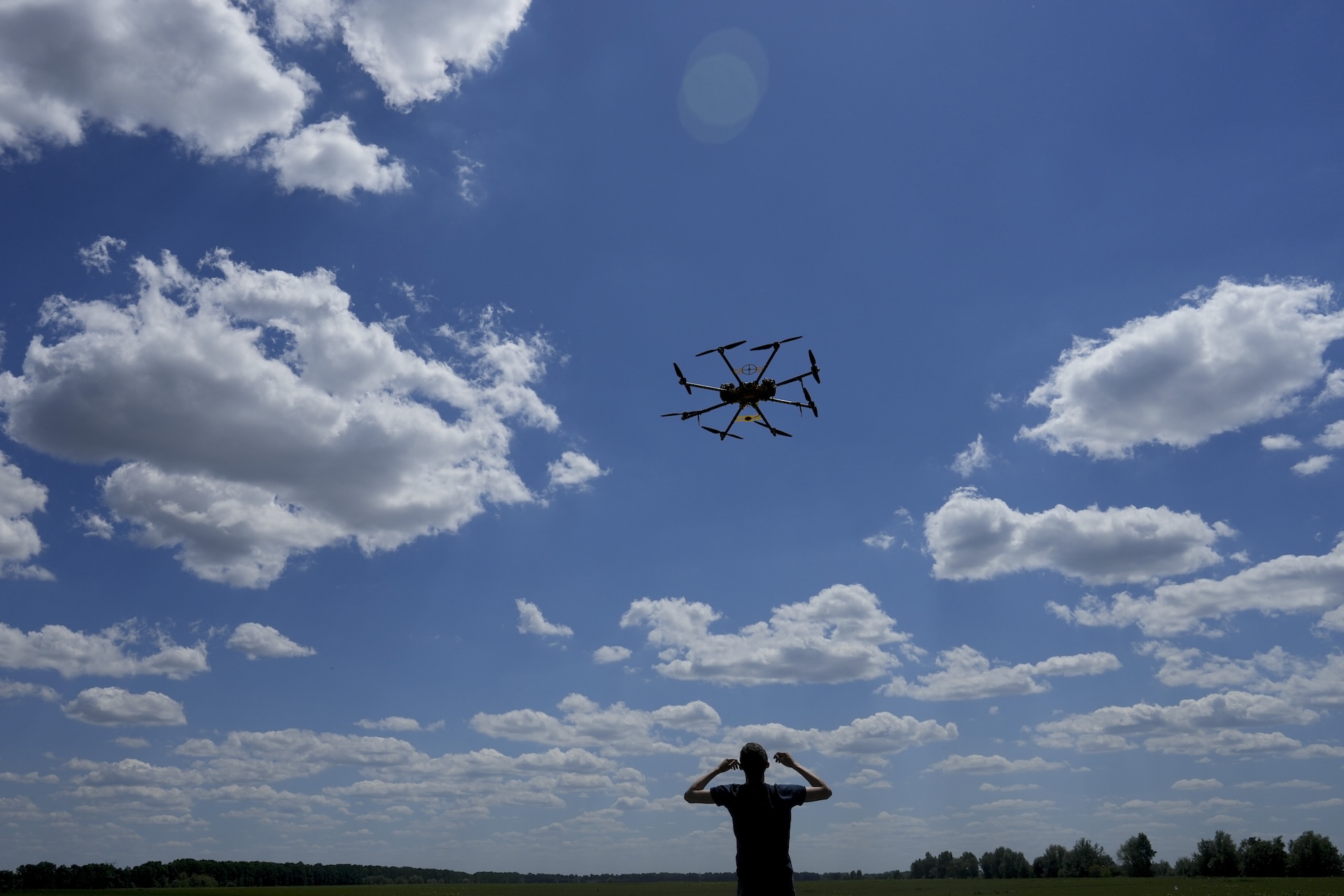
Ukraine has shown what cheap drones directly piloted by humans can do in surveillance, artillery targeting and even destroying tanks with modified grenades dropped into open hatches. The lessons are readily applied by any small force fighting a bigger, better-equipped one: Hamas has already used them against Israeli troops.
Oleg flies a drone while testing it on the outskirts of Kyiv, Ukraine, in June 2022. Photo: AP Photo/Natacha Pisarenko
Now imagine a swarm of 10 drones, collectively taking broad instructions from a person but following algorithmic rules to determine how to carry out those orders. They might not “decide” what to destroy, but they could decide for themselves how to react if one, or five, or nine of them are shot down on their way to the target they’ve been given. Devices like these will need artificial intelligence to be maximally effective.
The concept is called “autonomous, attritable mass,” said Pence. Autonomous means pieces of hardware that can navigate and carry out actions on their own, including changing course or even objectives if circumstances change around them. Attritable means you won’t be too bothered if you lose a few. Mass means a whole lot of them.
“Canada has been a leader on a lot of the underpinning technology that could be valuable in this future military state,” Pence said.
Now a venture capitalist and chief commercial officer at California-based Cambium, which aims to sell military hardware made with novel materials (like drones that can withstand flames), Pence is a Canadian, raised on Vancouver Island, and laments that Canada is behind in the field.
“We have produced the most AI researchers, in Montreal. We have the most AI startups, in Toronto. And the military is just sort of asleep at the wheel. It’s just baffling,” said Pence.
Weapons like those Pence describes aren’t even on Blair’s list of potential Canadian military uses for AI technology. Canada is officially against fully autonomous lethal weaponry, though Pence’s drone swarms wouldn’t necessarily qualify if humans assigned their targets. But there are plenty of other ways AI could make a difference in geopolitical and military conflicts.
At the level of strategy, wargaming is only beginning to incorporate artificial intelligence, according to a June roundup by researchers funded by Britain’s defence research organization.
“While many ideas are circulating on how AI could improve wargaming workflows, few real-world case studies offer concrete evidence of effectiveness,” they wrote.
Artificial intelligence is much better at quantitative work than qualitative, which means it’s more useful for, say, modelling an expeditionary force’s fuel needs than simulating specific humans’ choices, especially in unique circumstances like an international confrontation.
Which is not to say that such efforts aren’t underway: A firm called CulturePulse is working for the United Nations, creating an AI model of the people in Israel and the Palestinian territories to help predict what would happen in response to large-scale changes in things like economic prosperity or stricter security.
This is population-level work, though. Climate, not weather; macroeconomics, not financial analysis.
“I think in the near term, the greatest benefits from AI are going to be coming from logistics chains, decision-making,” said Michael Smith, the chief operating officer of One9, a venture capital fund focused on dual-use technologies. That’s tech that has both military and civilian applications.
Ottawa-based One9 is led by Canadian special-operations veteran Glenn Cowan and Shopify co-founder Daniel Weinand. Smith emphasized he does not speak for the military, but he himself is a veteran and reservist as a military lawyer who has advised on air-force targeting in operations against ISIS.
“Why wouldn’t you want to use predictive algorithms for vehicle maintenance or weapons maintenance?” he said.
Smith slipped into character as an AI keeping a digital eye on artillery pieces: “I know that generally over this amount of time, it’s probably firing X number of rounds, so I’m going to ping the armourer that he should probably check the following serial numbers to inspect the barrels or check the bearings on the trucks.”
We have produced the most AI researchers, in Montreal. We have the most AI startups, in Toronto. And the military is just sort of asleep at the wheel. It’s just baffling. — Eliot Pence
A ChatGPT-like tool could help write orders, he said. A more sophisticated one could propose tactical plans. An algorithm could scour social media feeds hunting for intelligence on a particular person, or “watch a video feed and then only ping the operator when something of relevance happens.”
The Department of National Defence’s IDEaS program, which asks Canadian companies for solutions to military challenges, has run a competition for that kind of video-feed monitor, seeking technology to “detect, recognize, and identify persons or objects of interest in a physical environment, and/or track identified persons and objects of interest using seamless information sharing across a decision network.”
Toronto-based Ecopia AI passed through multiple stages to get to a $5.8-million “test drive” of its technology for extracting meaning from images—in its commercial use, it’s generally intended to make maps made from aerial pictures.
Ecopia declined to talk about the potential military uses, with spokesperson Harneet Singh, citing “the sensitivity involved around such engagements.”
As The Logic has reported, National Defence’s own staff have observed that the IDEaS program, unlike similar ones run by our allies, doesn’t have a final stage where the military buys the technology the program fosters. Purchases would have to go through Canada’s regular military-procurement system. Which is not renowned.
“The structures for procurement are built around bullets, tanks, hardware. They’re not built around cyber, software and rapid iteration cycles,” said Daniel Araya, a senior fellow with the Centre for International Governance Innovation who studies AI governance, especially in international security.
Araya wrote a report for CIGI late last year on AI in the Canadian military, based on workshops involving the defence establishment; one of its conclusions was that the military procurement system is no longer fit for purpose.
Not that the old system has worked well for big equipment, either. “I don’t want to pooh-pooh the military too much because I really think highly of the people in it, but in many, many respects, we have a fax-machine military for a cyber era,” Araya said in an interview.
Buying new helicopters took 25 years. We’re now 13 years into a process to buy new fighter jets, hoping to take delivery of the first one in 2026, and bought more old fighter jets to supplement our decaying fleet of CF-18s.
Minister of National Defence Bill Blair speaks to the armoured combat support vehicle fleet at Garrison Petawawa in Petawawa, Ont., in October 2023. Photo: The Canadian Press/Sean Kilpatrick
We’ve revised plans for new supply ships at least six times—starting in 2010—and have extended the lease on a commercial freighter the navy has been using as a stopgap because we won’t have the new ones for years more.
We set about upgrading infantry soldiers’ communications equipment in 2005; although the department stopped updating the project website in 2021, the department told The Logic it hopes to have the gear fully in service by next March.
Apple has released 15 generations of iPhones in less time.
Blair acknowledged that the system needs reform and said the government has streamlined it to some degree already, cutting steps for low-complexity purchases and raising the threshold where a procurement requires oversight from outside the department, to $7.5 million.
The paperwork isn’t the only problem, Araya said: “It used to be that innovation was done inside the government in some form. Now, it’s mostly done outside the government in the private sector. So the question is, how do we bridge those two spaces?”
And of course, Canada’s defence budget is not large and is facing cuts, so the military can’t be a free-spending customer, even if it knew how.
Anduril, Eliot Pence’s former company, has one answer: Make what you think government buyers will want, rather than waiting for them to tell you (which was Steve Jobs’s thinking, borrowed from Henry Ford). Sustaining a company until you have a compelling product takes a great deal of capital; Anduril has raised billions from sources like Peter Thiel’s Founders Fund.
“You need the warfighter, the entrepreneur and the financier in the same room,” said Pence, “and Canada has never, as far as I know, taken an institutional approach to convening those three.”
The Canadian government has also signalled that, for military contractors, selling products from Canada is a chancy business—something else that could discourage those who might develop cutting-edge defence technology here.
An Ontario company, L3Harris Wescam (a subsidiary of U.S.-based defence conglomerate L3Harris), sold optics that Turkey, a NATO ally used in its popular Bayraktar drones; the federal government cancelled export permits based on “credible evidence” that Azerbaijan had used Bayraktars against Armenia in 2020.
That didn’t happen with billions of dollars’ worth of Canadian-made armoured vehicles bound for Saudi Arabia, but Prime Minister Justin Trudeau talked publicly about trying to find a way to stop those exports after the murder of Saudi journalist and dissident Jamal Khashoggi.
Araya pointed to one way the U.S. manages to integrate innovation into its military. In-Q-Tel, a not-for-profit venture investment agency the U.S. government launched in 1999 to find and back technologies useful for security and defence. Some call it the CIA’s venture capital arm in Silicon Valley. It’s taught the U.S. military and security services how innovation happens, Araya said.
“They’ll take in two or three developers that would otherwise work in their garage and say, ‘We’re going to deploy you inside the navy or inside the air force to help us build platforms.’ That’s just brilliant,” he said.
The broader tech sector’s qualms about working on deadly technology need to be addressed, as well, he said.
“We need to be able to justify our use of the military on ethical terms, right-values terms, and hopefully, build a relationship with a tech sector that is mutually beneficial,” he said.
The U.S. military’s massive reach and budget put it on a different plane from Canada’s, which has to be choosier. In the 2022 federal budget, the Liberals promised to revise the national defence policy they issued in 2017, to deal with a global environment changed by the COVID-19 pandemic and Russia’s full-scale invasion of Ukraine.
The defence policy is a statement about what big tasks the Canadian Forces are supposed to be ready for, and how the government intends to support those priorities. The government might make it a priority to protect the North, respond to natural disasters or reinforce NATO’s borders in Eastern Europe, for instance.
Although the 2017 document, called “Strong, Secure, Engaged,” committed to buying all sorts of new equipment, including in fields where AI is now key, like cyber and signals intelligence, the phrase “artificial intelligence” does not appear anywhere in it. The government has not produced the promised revision yet, and last summer Trudeau shuffled out Anita Anand, the minister who had been overseeing it. Blair said the work is still underway.
That update will dictate where it makes sense to invest, said Araya. Canada’s military can’t be everything, and as a NATO member with numerous allies, it doesn’t need to be. But we could pursue brilliance in specific AI technology and aim to be the go-to supplier to allies. Surveillance, reconnaissance and intelligence makes sense as a specialty, he said, given Canada’s vast geography, sparse population, and increasing competition in the Arctic.
“The Canadian military, in particular, is looking to expand in that space, to deploy drones in the Arctic, underwater,” Araya said.
The important thing is to pick something and get moving. “Whether that’s special forces or cyber or automation, or even logistics or whatever the hell it is, we should be really good at it—and probably the best at it,” Araya said.