Listen Now
0:00
A few of Canada’s most important companies reported second quarter earnings last week. All three—Shopify, Suncor and Canadian Natural Resources Limited (CNRL)—delivered great news for shareholders. But combined, they provide a snapshot of why Canada’s economy is struggling to grow.
Before the slide-by-slide-by-slide comparison, let me be more precise about what I mean by economic growth. Canadian Peter Howitt shared a Nobel Prize last year because he helped show that a healthy economy generates steady growth from the churn created by new ideas, new technologies and new entrants.
Like a garden, gross domestic product will grow from quarter to quarter for reasons that have little or nothing to do with the gardener. Canada’s gold miners have generated a lot of growth over the past year, but only because central banks and others revalued precious metals. The money spent on rebuilding Jasper National Park and other places devastated by forest fires will have contributed to GDP. Tax cuts and holidays create sugar rushes that boost growth, as do extended periods of low interest rates.
Related Articles


We’ve been trying to sustain our quality of life with the latter type of growth for the better part of two decades. The low interest rates that followed the Great Recession stoked little investment outside of housing. Rates of business creation have collapsed even as governments cut small business taxes. Venture investing has slumped despite multiple attempts by former prime ministers Stephen Harper and Justin Trudeau to conjure the magic that created Silicon Valley.
One of the many failed conjurers was Robert Asselin, who advised former finance minister Bill Morneau for the first two years of Trudeau’s tenure. He then did the same sort of work for BlackBerry and the Business Council of Canada before taking a job last year as CEO of U15, an association of the country’s biggest research-oriented universities.
Few can say their career paths have meandered through Parliament Hill, the executive ranks of one of the country’s most influential companies and the ivory towers of academia. Asselin has learned some things about how the economy works. One is why you can’t pull a lever in Ottawa and assume you’ll get the outcome you want. “An economy’s aggregate propensity to innovate is influenced by the kinds of companies it contains and the markets in which they operate,” Asselin wrote in an essay this month. “This is one underappreciated part of Canada’s innovation problem.”
Think of it this way. The country’s biggest publicly traded company is Royal Bank of Canada, a 157-year-old financial institution. America’s biggest publicly traded company is Nvidia, a 33-year-old technology company that makes the chips that power artificial intelligence. The remainder of the Toronto Stock Exchange’s Top 10 includes four other centenarian banks; Shopify; CNRL; global investment firm Brookfield, which generates 90 per cent of its revenue abroad; pipeline company Enbridge; and Agnico Eagle Mines, which owes its place at the top the charts to the price of gold.
Almost all of the 10 biggest companies in the S&P 500 Index are chipmakers or digital technology companies. Policy matters, but those companies would be investing heavily in research and development—and generating sustainable growth by advancing the technological frontier—no matter what, because they are growth companies that are driven to dominate global markets. With the exception of Shopify, none of Canada’s leading companies are wired that way. They are too old, too mature. No tax cut is going to turn RBC into Stripe.
Let’s compare those earnings reports. Shopify—the e-commerce platform that company president Harley Finkelstein describes as “probably the most AI-pilled company in the world”—spent some US$445 million on research and development in the three months ended June 30, a 13 per cent increase from the same period last year. That works out to about 12 per cent of second-quarter revenue, a number that some use to describe “R&D intensity.” That figure was actually higher a year ago (14.7 per cent), because Shopify maintained its commitment to research and development even while making less money.
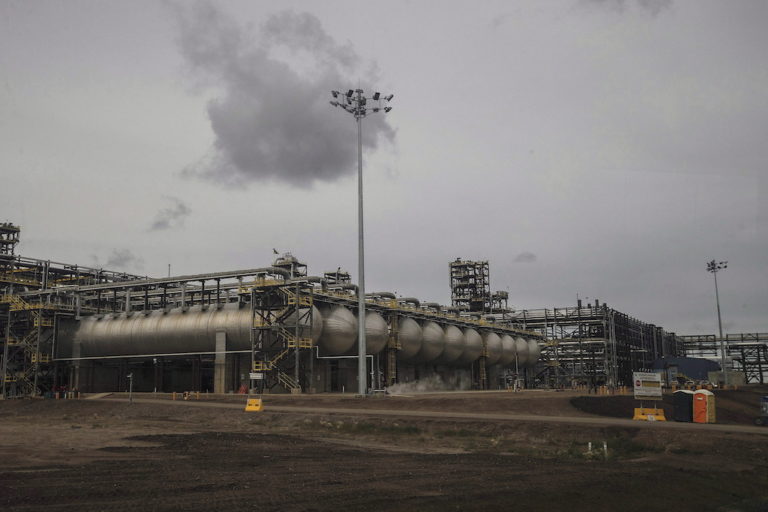
Now, let’s look at Suncor, the original oilsands giant, which said in March that it’s sitting on enough oil to last almost a century.
R&D is a line item at Shopify. At Suncor, it’s a footnote. Research is one of many items Suncor groups as “non-production costs,” which were a combined one per cent of the $9.04 billion in operating revenue the company generated from its oilsands operations in the second quarter. That beats CNRL. There’s no mention at all of research in its quarterly report.
These companies advanced the technological frontier when they were figuring out how to turn sticky bitumen into usable crude. Now, they’ve evolved into impressive money-making machines that have iterated to a point where they can break even at a global oil price of roughly US$40 per barrel. Unlike most oil companies, they don’t have to develop new ways to look for oil because they are sitting atop decades of supply. Their profit margins will stabilize the economy, but the oilsands majors won’t move it forward. That’s no longer what they do. The incentive structures of the big banks, the infrastructure companies and the established miners are similar. Canada has a productivity crisis because it has too few growth companies that feel compelled to invest in research as a matter of survival.
You can read Asselin’s essay as a letter to his younger self. Prime Minister Mark Carney’s government has spent the past year setting the foundations of an industrial policy that will deploy hundreds of billions of dollars in an attempt to reorient the economy. Asselin has no problem with that, but wants policymakers to think creatively about how they spend that money. He suggests an “offensive industrial policy” that emphasizes growth-oriented firms with internal incentives to spend on research and compete in global markets.
Some will lament that we are talking about industrial policy at all. Let them. If we’re going to spend five per cent of GDP on defence, then we might as well try to use that money to encourage more firms to explore the technological frontier. Our current crop of corporate champions is no longer up for it.
Kevin Carmichael is The Logic’s economics columnist and editor-at-large. He has spent more than two decades covering economics, business and finance for outlets including Bloomberg News, The Globe and Mail and the Financial Post, where he also served as editor-in-chief.