MILTON KEYNES, England — Innovation Minister François-Philippe Champagne is considering setting up a Canadian institute focused on AI safety, and wants to see whether allies pursue licensing regimes for the most advanced versions of the technology.
Skip to content
News
Champagne explores Canadian AI safety institute, touts country’s role on ‘transformative technology’
Innovation minister on existential worries, certifying AI and chatting with Elon Musk
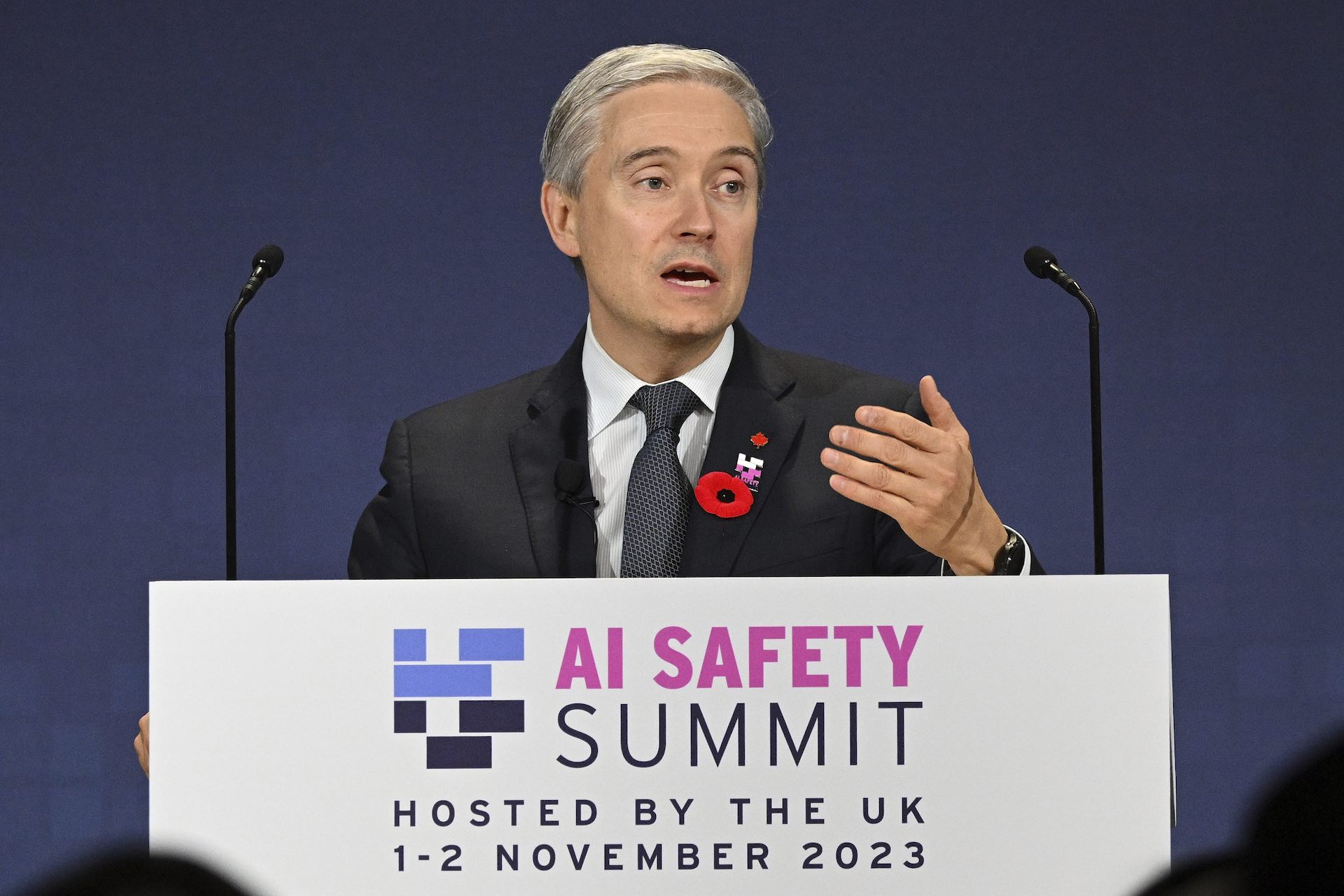
Innovation Minister François-Philippe Champagne speaking at the U.K. AI Safety Summit on Nov. 1. Photo: AP Photo/Leon Neal
MILTON KEYNES, England — Innovation Minister François-Philippe Champagne is considering setting up a Canadian institute focused on AI safety, and wants to see whether allies pursue licensing regimes for the most advanced versions of the technology.
Over the last two days at the U.K.’s AI Safety Summit at Bletchley Park, Ottawa was one of 29 governments that agreed to cooperate to identify and address the risks of so-called frontier systems, the largest models capable of the most applications. It also backed a new international initiative, led by Université de Montréal professor Yoshua Bengio, to produce a state-of-the-science report that will inform policymaking in participating countries. And Canada is one of 11 jurisdictions that will collaborate to test new models from eight leading firms in the field, including Amazon Web Services, Anthropic, Google, Meta, Microsoft and OpenAI.
Talking Points
- In an interview with The Logic, Innovation Minister François-Philippe Champagne said Ottawa is considering establishing a safety institute to assess the risks of artificial intelligence systems
- The minister did not rule out licensing regimes for AI suggested by some experts, but said the approach would require international coordination
“It’s incumbent on those who are going to be developing and deploying these systems that they are inherently safe for people,” said Champagne, in an interview with The Logic on Thursday.
The U.K. has used the summit, and its plans for a new AI Safety Institute, to position itself as a leader on governance of the technology. Canada has also sought to set the pace on responsible AI development and use, but Champagne insisted the two countries’ efforts are complementary, as are those of other allies like the U.S. and France.
The event, and the accompanying agreement between attending countries, focused on frontier AI. Those systems have also sparked some researchers’ concerns about existential risks to humanity. Other AI executives and scholars say end-of-the-world warnings are a distraction from current risks with the technology such as bias, and that a licensing regime would cement the power of large tech companies that have already built their foundational models.
On the second day of the summit, Champagne discussed the existential worries, the idea of certifying AI, Canada’s role in AI governance, his conversation with Elon Musk, and where China fits into policy efforts around the technology.
Related Articles
This interview has been edited for length and clarity.
What is the most important thing that you think came out of this summit?
The summit brought the right people at the right time. It’s pretty unique when you’re surrounded by experts. I came here very humble, and in listening mode. [In] the session yesterday, I was next to the head of MI5 [and] the CEO of Rand Corporation. There were some people in our sessions who have been thinking and acting in the field of AI since its very beginning—Yoshua Bengio, obviously.
I think we have acknowledged, broadly, the risk of AI and also the opportunity. We need to manage the risk if we want to realize the opportunities. The way to do that is to have significant guardrails that will build trust with people; without trust, it’s going to be very difficult to perceive the opportunities, whether it’s in medicine, research, education, climate change.
There’s a call for action, both domestically and internationally. I think Canada is in a good place, because we’re probably the only country which has an AI strategy; a law, which is being discussed in Parliament; and also a voluntary code of conduct. We are at the forefront of leadership when it comes to responsible AI, and regulating AI to make sure we are the most attractive jurisdiction for companies who want to build AI.
And the last thing is there’s a sense that you need to adapt. Even the experts probably can’t really see what AI could be in five, 10 years. A principles-based approach is the best one to deal with the future that AI can bring to society.
This is really a transformative technology, like we’ve seen with the World Wide Web. Anyone who is operating in the nuclear or aviation industry, it’s incumbent on them to build products that would be safe for people, as opposed to the government having to check that. It’s the role of government to have regulation, like in many sectors, but it’s incumbent on those who are going to be developing and deploying these systems that they are inherently safe for people.
The summit and the Bletchley Declaration are quite focused on frontier AI and related risks. Is frontier AI and existential risk a particular concern for you?
You cannot disregard that. When you listen to experts here, you realize that AI has the capability to accelerate the creation and deployment of these weapons. You empower malicious actors that could come from no risk to x-risk, with very limited barriers to entry. It is the responsible thing for governments to really be aware of that.
Everyone acknowledged this risk, and we are determined to take action. Then you can look at the opportunities that AI can do in so many fields. But you can’t disregard that this technology could also have significant impact on people. You need to make sure that these systems are inherently safe and without bias, and that they are properly designed.
The things you’ve just described—bias and so on—are risks today. But does the end-of-humanity risk that was talked about over the last two days concern you?
It should concern anyone who’s responsible. You cannot disregard these existential risks. But there’s also an acknowledgement that you have far more actual and current risks that you also need to prevent, because they could be destabilizing for societies and communities: disinformation; the impact on human rights or freedom; or deep fakes. There’ll be about 50 elections [in 2024] that will affect 4 billion people. We need to make sure that we have systems, rules and procedure in place to prevent these [AI] systems from having a negative impact on a very large scale. That is not some future risk that you could dream of. This is something that will be happening very shortly, so therefore we need to take action.
The U.K. is setting up an AI safety institute. The U.S. is setting up an AI safety institute. Are you going to set up an AI safety institute in Canada?
We’re looking into that. I think it’s a very interesting concept. A number of people—Elon Musk and others—have been mentioning that you want a third-party set of experts that could eventually certify these systems, to make sure that they are inherently safe for people.
There’s a distinction between studying and certifying. At Bletchley, countries agreed to a new scientific research network on frontier AI safety. But there’s also been a push for licensing regimes—some public body that says, ‘This is safe.’ Do you favor a licensing regime?
This has been discussed at the summit. I’ll be looking at what other like-minded jurisdictions are doing. Testing I find very interesting. The U.S. and U.K. institute is something that I like. Whether we need to go to licensing probably will have to be coordinated at the international level, because you can’t insulate yourself from the risks of AI.
How would you like to see Canada involved with this network of scientific research on frontier AI safety?
We’re already front and centre here in this conference. Yoshua Bengio has been appointed chair of the scientific advisors. That’s where I want to see us: thought leadership and excellence. People recognize here the leading role of Canada. They asked me to chair one of the first sessions yesterday. With GPAI [the Global Partnership on AI] and all that, we’ve been a leader not only domestically but also internationally. When Canada speaks on AI, people definitely listen and want to engage.
In the lead-up to the summit, there’s been a lot of talk about different countries jockeying for position on AI governance. Has the U.K. stolen a march on us in being seen as AI governance leaders?
No, I think their work is complementary. Canada has been at the forefront, with [GPAI], with what we have done domestically.
The U.K. has focused very much on safety. We have focused very much on responsible development of AI. With our colleagues from France and also the United States, Canada is very much in the leading pack when it comes to establishing norms and standards.
Some startups have said that all of these big AI companies are only talking about AI safety so they can corner the market—smaller companies won’t be able to handle regulations around model building, so the bigger companies that are already in place win by default. Are you concerned about that?
We’ve focused on high-impact AI systems. We don’t really care if there’s an AI system that will suggest to you which song you should be listening to, or which movie you should watch on Netflix. But if there’s an AI system that’s going to deny you a loan, an insurance policy, or even a job, we want to have a number of guardrails around that. The approach of Canada on high-impact systems keeps the competitiveness of the market.
There were a lot of big-name CEOs at the Summit. Did you talk to Demis Hassabis about Google DeepMind in Canada? You’d expressed some concerns about them exiting Alberta.
I did not see him because I was chair [of a session.] But I did see Elon Musk.
How is he feeling about Canada these days?
We talked about space. I think I piqued his interest.
Chinese Vice-Minister Wu Zhaohui was at the summit. Was the U.K. right to invite China?
We were a key player in the summit. It was the British government who decided who to invite at the summit.
But you don’t see a problem with China being involved in governance of AI?
When you engage with China, you always have to engage with eyes wide open. But in the context of having guardrails that would be applicable to AI systems, having been inclusive was the right decision. Like we’ve done with a number of treaties around the world and in other fields, you want to make sure that the key actors agree on a basic set of principles and guardrails.



Loading...
Thanks for sharing!
You have shared 5 articles this month and reached the maximum amount of shares available.
CloseThis account has reached its share limit.
If you would like to purchase a sharing license please contact The Logic support at [email protected].
CloseGift the full article!
You have gifted 0 article(s) this month and have 5 remaining.
Recipients will be able to read the full text of the article after submitting their email address. They will not have access to other articles or subscriber benefits.
Photo: AP Photo/Leon Neal
Most Popular This Week




In-depth, agenda-setting reporting
Great journalism delivered straight to your inbox.
Commentary
Carmichael: Being boxed in will help Canada focus on what matters
Briefing
Rio Tinto gets nearly $165M in additional federal funds for Quebec aluminum
U.S. to lift tariffs on some Canadian products crucial to Maine: Collins
Carney warns of tech dependence after Starlink disruptions in Ukraine
Best business newsletter in Canada
Get up to speed in minutes with insights and analysis on the most important stories of the day, every weekday.
Exclusive events
See the bigger picture with reporters and industry experts in subscriber-exclusive events.
Membership in The Logic Council
Membership provides access to our popular Slack channel, participation in subscriber surveys and invitations to exclusive events with our journalists and special guests.






