Skip to content

Canada's Business and Tech Newsroom

  • Professional Subscription
  • Partnerships & Advertising
  • Licensing & Syndication
Log In Subscribe
Welcome,
  • My Account
  • Log Out
  • Business
  • Tech
  • National
  • The Big Read
  • Briefings
  • Commentary
Search
Log In Subscribe
Welcome,
  • My Account
  • Log Out
Commentary

Carmichael: The rise of AI-powered solopreneurs could upend how the economy works

Listen Now
0:00
Commentary

Carmichael: The rise of AI-powered solopreneurs could upend how the economy works

Shopify’s leaders say we’re in the early days of an entrepreneurial revolution. The data shows they may be right.

By Kevin Carmichael
Shopify president Harley Finkelstein smiling as he sits on stage at an event, his arms crossed. He holds a microphone in his hand and wears another microphone on a headset.
Shopify president Harley Finkelstein at a Toronto Tech Week event in June 2025. On Shopify’s latest earnings call, Finkelstein said, “AI is going to accelerate entrepreneurship more than any other job.” Photo: Laura Proctor for The Logic
Aug 8, 2026
A A
A Small A Medium A Large
Share

Gift

Share

Listen Now
0:00

They called themselves “lightning slingers.” They were young men who came of age during a period of technological disruption, with the mindsets required to teach themselves how to do jobs that barely existed when they were born. Samuel Morse might have sent the first commercial telegraph message in 1844, but it was the lightning slingers who rode the wave and brought the disruption.

Morse’s message asked, “What hath God wrought?” One answer is rapacious western expansion that destroyed Indigenous nations as the United States became the most powerful country on earth. Here’s a less meta response: hundreds of entry-level jobs for men who would shape the coming century. Thomas Edison was a talented lightning slinger, as was William Van Horne, the railroad executive who oversaw the construction of the Canadian Pacific Railway.

Related Articles

Carmichael: Canada’s culture of risk aversion has created an economic doom loop

By Kevin Carmichael
Shivam Mahajan and Zaaheda Islam pose in front of their company offices.

These AI startups are making millions with tiny teams

By Catherine McIntyre
Shopify president Harley Finkelstein wears a black T-shirt and gestures with his arm as he speaks at the Elevate tech conference.

Carmichael: The 600-lb. beaver could be Canada’s national animal

By Kevin Carmichael

Who is the Samuel Morse of artificial intelligence? Sam Altman? Demis Hassabis? Before you take that question to the salon this evening, I’ll suggest a different response: Who cares? Telegraphy was an important adaptation of a general purpose technology, but not a lasting one. It’s the modern day lightning slingers who will shape the future. Some of them might even be here in risk-averse Canada, a place that trained many of the scientists who made AI possible, but lacked the deep pools of venture capital required to create a bridge from the laboratory to the real world.

David Wolfe, a professor emeritus at the University of Toronto who made a career of thinking about technology and innovation, didn’t love what I wrote last week. He thinks the business entry and exit data underpinning the Canadian Federation of Independent Business’s contention that we’re experiencing an “entrepreneurial drought” is too cyclical to form the basis of any conclusions about the state of entrepreneurship. Wolfe said he’s observed a proliferation of entrepreneurship courses and programs over his time in academia, which argues against the notion that the next generation is losing interest in starting companies. In other words, keep calm. Things are bound to get better. 

I haven’t changed my mind that there’s something about Canadian culture that restrains entrepreneurship. A nation colonized by farmers and branch plant managers will have different expectations of what’s possible than one formed by revolution or some other crisis. Institutions and narratives form around those cultural expectations. 

That’s why I’m skeptical that the small business lobby’s bid to lower an already low tax rate for smaller businesses will change the trajectory of new entrants. Former prime minister Justin Trudeau dropped the preferential rate to 10 per cent in 2018, and then to nine per cent in 2019. The number of self-employed individuals who are incorporated with paid staff collapsed anyway. Meanwhile, both public and private sector employment were about 20 per cent higher in July than at the start of 2018. 

Entrepreneurship in the U.S. has surged since the pandemic, and might partially explain that country’s inspiring levels of productivity growth. In Canada, where the central bank has characterized stagnant productivity as an emergency, self employment has only just climbed back to early 2018 levels after a prolonged slump. The contrast brings to mind a Scottish writer’s description of the difference between St. Catharine’s in Upper Canada and New York at the end of the first decade of the 19th century. “There, bustle, improvement, and animation fill every street; here dulness [sic], decay, and apathy discourage enterprise and repress exertion,” John Howison wrote in Sketches of Upper Canada, a travelogue published in Edinburgh in 1821. 
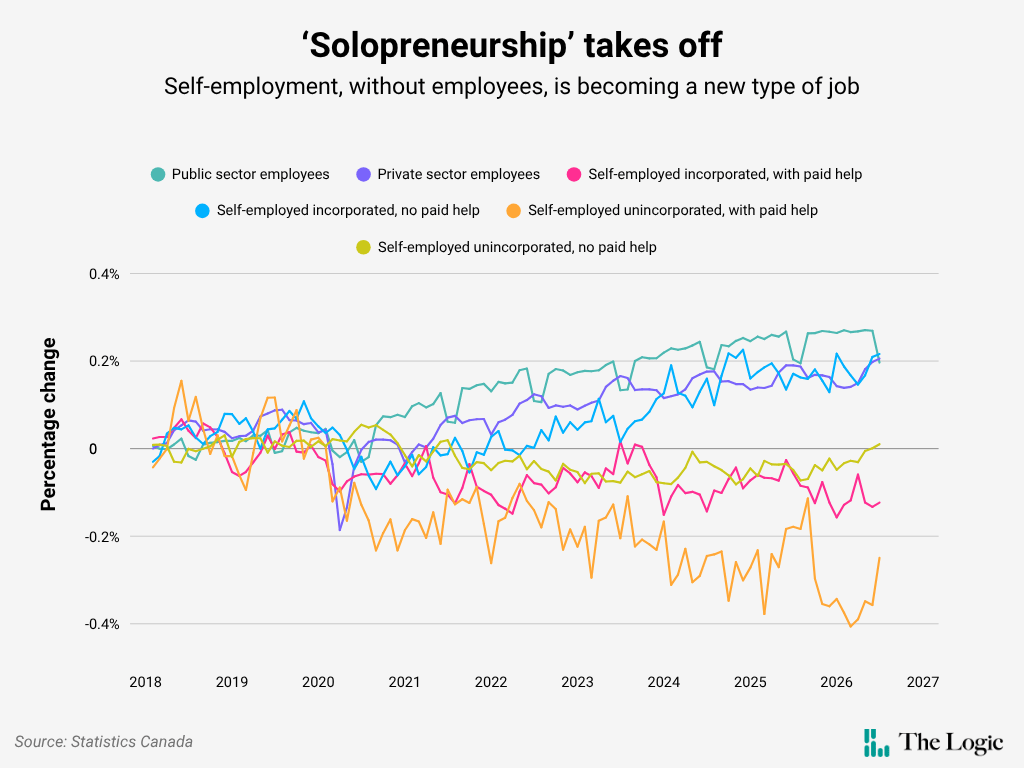
A line chart titled "'Solopreneurship' takes off: Self-employment, without employees, is becoming a new type of job." The chart depicts five lines labelled public sector employees; private sector employees; self-employed incorporated, with paid help; self-employed incorporated, no paid help; self-employed unincorporated, with paid help; and self-employed unincorporated, no paid help. The chart shows percentage change on the Y-axis and years between 2018 and 2026 on the X-axis. The data source is Statistics Canada.

But the aggregate self-employment numbers have been hiding something. The number of Canadians who have incorporated, but with no paid help, has surged since the summer of 2022. I used to dismiss this number as a proxy for accountants, marketers and other white-collar types who are gaming the tax system. But the proliferation of evidence that “solopreneurs” are exploiting AI to create value alone or with small staffs could mean there is something happening underneath those lacklustre headline numbers. My colleague Catherine McIntyre wrote about this phenomenon earlier this week, and I happened upon a couple of guys who just created a studio that will produce AI-generated films. 

The objective of Nolia Studios, said co-founder Kirk Hipkiss, is the same as any production house. The plan is to build a portfolio of their own intellectual property, shared IP, collaborations, distributions deals, and franchises, “growing into a larger studio that can bring in obviously younger artists to help tell the stories.” Hipkiss already runs a visual effects company, and his business partner, filmmaker Bob Gaudette, created a well-received AI-generated film. But technology is the reason they could start their own studio. “We are definitely opening up Nolia as a result of our ability to integrate AI,” he said. 

I first included Howison’s unflattering description of economic life in Britain’s North American colonies in an essay after Shopify president Harley Finkelstein questioned Canada’s ambition in the fall of 2024. You might remember the quotation. Finkelstein called it the “600-pound beaver in the room.”  

Much has changed since the end of 2024. For the first time since Confederation, Canada is effectively alone; the British Empire is long gone, and its relationship with the U.S. has been permanently altered by President Donald Trump’s beligerence. Artificial intelligence might be a bigger technological disruption than the internet and electricity. Anyone who speculates on how Canada might react should do so with humility because history is a very rough guide. Canadians have never faced a crisis like this one. 

Finkelstein was back with some bon mots this week. He described Shopify as “probably the most AI-pilled company in the world.” More will follow. “AI is going to accelerate entrepreneurship more than any other job,” he said on the company’s latest earnings call. “We are already seeing early signs of it happening.” 

Gift the full article

That would force a rethink of how the economy works. A solopreneur selling a niche product on Shopify’s e-commerce platform isn’t going to make the economy more productive, but they also won’t strain the welfare state if the jobs apocalypse comes to pass. 

Maybe some of them will get inspired to try something bigger. I want to see more entrepreneurs who are hiring people, but these latest employment numbers are encouraging. There’s something happening. 

Kevin Carmichael is The Logic’s economics columnist and editor-at-large. He has spent more than two decades covering economics, business and finance for outlets including Bloomberg News, The Globe and Mail and the Financial Post, where he also served as editor-in-chief. 

#commentary #economy #entrepreneurship #productivity

Sponsored Content

How to shift your workforce from AI experimentation to adoption

By Jessica Aftimus Rosa

The real-world economic offshoots of sovereign AI

By Deborah Aarts
Illustration of a plane flying above a mailbox

Increasing healthcare access across Canada

By Deborah Aarts
Paid promotional content

Loading...

Thanks for sharing!

You have shared 5 articles this month and reached the maximum amount of shares available.

Close
This account has reached its share limit.

If you would like to purchase a sharing license please contact The Logic support at [email protected].

Close
Want to share this article?

Upgrade to all-access now

Close
Gift the full article!

You have gifted 0 article(s) this month and have 5 remaining.

Copy link and gift
Copy Link
Email to a friend
Send Email
Gift on Social Media

Recipients will be able to read the full text of the article after submitting their email address. They will not have access to other articles or subscriber benefits.

Shopify president Harley Finkelstein smiling as he sits on stage at an event, his arms crossed. He holds a microphone in his hand and wears another microphone on a headset.

Photo: Laura Proctor for The Logic

A line chart titled "'Solopreneurship' takes off: Self-employment, without employees, is becoming a new type of job." The chart depicts five lines labelled public sector employees; private sector employees; self-employed incorporated, with paid help; self-employed incorporated, no paid help; self-employed unincorporated, with paid help; and self-employed unincorporated, no paid help. The chart shows percentage change on the Y-axis and years between 2018 and 2026 on the X-axis. The data source is Statistics Canada.

Most Popular This Week

Close-up of a red American roadside call box marked “Made in the U.S.A.,” with a blurred semi-truck approaching on Gordie Howe International Bridge.
News

U.S. industry leaders plead for truce as tariff fight escalates

By Anita Balakrishnan
Exterior of a University of Toronto building
News

Canadian universities are still struggling to commercialize their research, new data shows

By Catherine McIntyre
A head-on shot of Mark Carney at a lectern embossed with a maple leaf carved from wood. There is a row of Canadian flags behind him, and he's looking at the camera with a serious expression.
News

How Mark Carney plans to wage trade war against the United States

By Laura Osman and Murad Hemmadi
A shot from the bottom of a flight of red brick stairs of Dominic LeBlanc emerging from a building, with Janice Charette and Mark Wiseman in single file behind him.
News

Canada pulls out of trade talks at last moment, citing ‘unfair’ changes by U.S.

By Laura Osman

In-depth, agenda-setting reporting

Great journalism delivered straight to your inbox.

An RBC storefront sign with blue and gold lion-and-globe-logo, mounted on a dark building facade above a street in Toronto, as pedestrians pass by.
News

Canada’s Big Six shrug off the impacts of the trade war

By Chaimae Chouiekh

Briefing

Canadian contractors brace for retaliatory duties on U.S. nuts and bolts

By Joanna Smith   |   Aug 28, 2026 | 3:51 PM ET

Blue Owl leads deal to lend Iren US$2.4B to buy equipment for B.C. data centre

By Claire Brownell   |   Aug 28, 2026 | 3:23 PM ET

Rare earth firm Cyclic Materials raises US$75M for U.S. expansion

By Anita Balakrishnan   |   Aug 28, 2026 | 2:53 PM ET

Best business newsletter in Canada

Get up to speed in minutes with insights and analysis on the most important stories of the day, every weekday.

Exclusive events

See the bigger picture with reporters and industry experts in subscriber-exclusive events.

Membership in The Logic Council

Membership provides access to our popular Slack channel, participation in subscriber surveys and invitations to exclusive events with our journalists and special guests.

Recent Popular Stories

News

Canadian investors are dumping U.S. government debt for American corporate bonds

By Chaimae Chouiekh   |   Aug 24, 2026
An image of tall buildings against a cloudy blue sky.
News

Canada pulls out of trade talks at last moment, citing ‘unfair’ changes by U.S.

By Laura Osman   |   Aug 22, 2026
A shot from the bottom of a flight of red brick stairs of Dominic LeBlanc emerging from a building, with Janice Charette and Mark Wiseman in single file behind him.
News

How Mark Carney plans to wage trade war against the United States

By Laura Osman and Murad Hemmadi   |   Aug 22, 2026
A head-on shot of Mark Carney at a lectern embossed with a maple leaf carved from wood. There is a row of Canadian flags behind him, and he's looking at the camera with a serious expression.
News

Canadian universities are still struggling to commercialize their research, new data shows

By Catherine McIntyre   |   Aug 25, 2026
Exterior of a University of Toronto building
Commentary

Carmichael: America’s wobbly bonds are Canada’s advantage in the trade war. Here’s why

By Kevin Carmichael   |   Aug 24, 2026
A photo of Mark Carney on his way into a news conference, trailed by Dominic LeBlanc. There is a row of Canadian flags on stands behind the lectern Carney is approaching.
News

Thomson Reuters launches its own AI model to reduce reliance on big tech

By Anita Balakrishnan   |   Aug 24, 2026

Canada's most influential executives and policymakers are reading The Logic

  • CPP Investments
  • Sun Life Financial
  • C100
  • Amazon
  • Telus
  • Mastercard
  • bdc
  • Shopify
  • Rogers
  • RBC
  • General Motors
  • MaRS
  • Government of Canada
  • Uber
  • Loblaw Companies Limited
logic-logo

Canada's Business and Tech Newsroom

100% human-crafted journalism

Newsroom

  • News Tips
  • AI Policy
  • Editorial Disclosures
  • Story Pitches

Company

  • About Us
  • Terms of Service
  • Privacy Statement
  • Corporate Information

Contact

  • Contact Us
  • Advertise
  • FAQs
  • Work at The Logic

© 2026 The Logic Inc. All Rights Reserved.

Trusted by leaders

Error

Account creation failed.

Please email us at [email protected].

Create Account

[wppb-register form_name=”cozmo-registration-form-for-modal”]

I do have an account
Login
or

[wppb-login]

I don’t have an account