An overwhelming majority of respondents to The Logic’s latest subscriber survey said artificial intelligence has the potential to harm society, with 80 per cent saying they either strongly or somewhat agree with the statement.
“AI is not the saviour many seem to think it will be,” one subscriber said.
Despite those concerns, nearly 60 per cent said they believe Canada can maintain its standing as a world leader in AI: 42 per cent of participants said the country is somewhat well positioned, while nearly one-fifth said it’s very well positioned.
“With something as unpredictable as AI, I suspect both those intending good and those intending harm will find the results are tempered by unexpected counter-consequences,” one subscriber wrote.
About a third—31 per cent—said Canada is not well positioned to keep its edge in the field. The country’s biggest hurdle to stay competitive in AI will be ensuring the sector has enough funding to advance the ecosystem, according to 40 per cent of participants.
As The Logic has reported in its in-depth series, Canada’s AI Advantage, the country helped lay the foundations for AI’s prominence today. To benefit from the current global boom, Canada will need to capitalize on its innovations and foster an ecosystem that can keep talent and the startups developing the technology at home.
Many subscribers commented that it would take a combination of different factors for the country to remain competitive in the sector.
“Government policy must support the industry and provide guardrails, we need to fund research on impacts and outcomes, and we need the talent to make it all work,” wrote one subscriber.
“Talent, corporate adoption and government funding—without all three, as they’re all critical— Canada will not maintain our AI advantage,” said another.
But most respondents (24 per cent) said private investment and funding is key to maintaining the country’s lead in the industry. According to PitchBook data, venture capital investment in artificial intelligence companies across Canada in the third quarter of 2023 was about US$367 million, down from US$517 million in the previous quarter.
Other than attracting enough funding, 15 per cent of subscribers said regulation is Canada’s biggest challenge in staying competitive in AI, and 13 per cent said issues with retaining talent could pose a threat. Many also commented on how higher wages in the U.S. are a major hurdle for keeping AI talent in Canada.
“American cheques will lure talent south,” one subscriber wrote. Another said: “Lack of commercialization talent, will and incentive. Smart sales people work for American firms.”
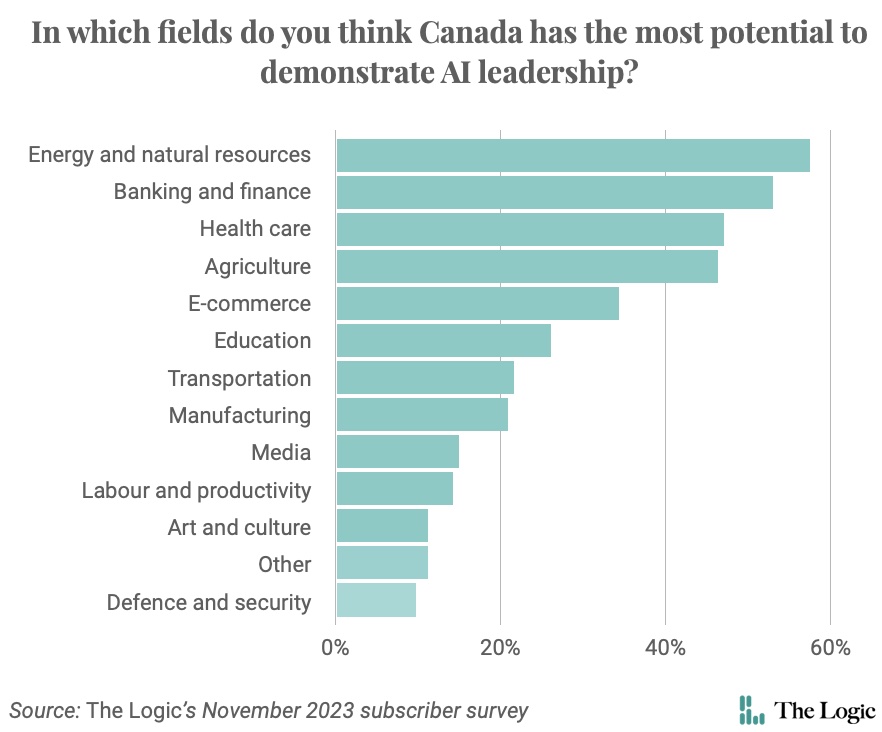
When asked which fields the country has the most potential to demonstrate AI leadership in, most respondents (57 per cent) said energy and natural resources has the strongest potential.
“Our energy sector is broad, well funded, and is an ideal area to apply AI ideas and test in-market,” said one subscriber. “Canada’s global recognition as a leader in defence and transportation technology will continue to be important as these industries evolve by incorporating AI.”
The banking and finance sector followed closely behind, with 53 per cent of subscribers saying it has the most potential, and 47 per cent said health care.
Over a third (34 per cent) of participants said e-commerce has the potential to demonstrate AI leadership, with a number of subscribers commenting on how the country already has a lead through Shopify.
Methodology
The Logic emailed subscribers a private link to an online survey on Nov. 20 and the survey closed Nov. 30. Respondents’ identities were kept anonymous. Subscribers were first asked, “How well-positioned do you think Canada is in maintaining its standing as a world leader in AI?,” and could answer “Extremely well,” “Very well,” “Somewhat well,” “Not well” or “Not at all well.” They were then asked, “In which fields do you think Canada has the most potential to demonstrate AI leadership? Select your top choices” and could select “Agriculture,” “Art and culture,” “Health care,” “Defence and security,” “E-commerce,” “Media,” “Transportation,” “Education,” “Banking or finance,” “Energy and natural resources,” “Labour and productivity,” “Manufacturing” or “Other.” Next, they were asked, “Which part of the ecosystem is most crucial for Canada to gain or maintain a competitive edge in AI?” and could choose “Government policy,” “Government funding,” “Private investment and funding,” “AI safety,” “Talent,” “Infrastructure (i.e. data storage, chips),” “Academia and research,” “Public education on AI,” “Corporate adoption,” “Accelerator/incubator programs” or “Other.” They were also asked, “What do you think will be the biggest challenge for Canada to stay competitive in AI?” and could select: “Regulation,” “Ethics/warnings of existential risk,” “Cybersecurity,” “Lack of talent,” “Lack of funding” or “Other.” Finally, respondents were asked, “How strongly do you agree with the following statement: “AI has the potential to cause harm to society.”
They could select “Strongly agree,” “Somewhat agree,” “Somewhat disagree,”
“Strongly disagree” or “Unsure.”