The Logic’s readers are split between excitement and concern about the use of AI, our latest subscriber survey suggests, but most agree that the technology is being developed too fast given the potential risks.
Skip to content
 The Logic’s readers are split between excitement and concern about the use of AI, our latest subscriber survey suggests. Photo: CFOTO/Future Publishing via Getty Images


Subscriber Survey
AI development moving too fast, say 64% of Logic survey respondents
Subscribers evenly split over AI applications—some excited, some concerned
The Logic’s readers are split between excitement and concern about the use of AI, our latest subscriber survey suggests. Photo: CFOTO/Future Publishing via Getty Images
The Logic’s readers are split between excitement and concern about the use of AI, our latest subscriber survey suggests, but most agree that the technology is being developed too fast given the potential risks.
The release of OpenAI’s ChatGPT last November has sparked giants like Google and Microsoft to race to get AI products to market, with the promise that their chatbots could do everything from web searches to producing lines of code.
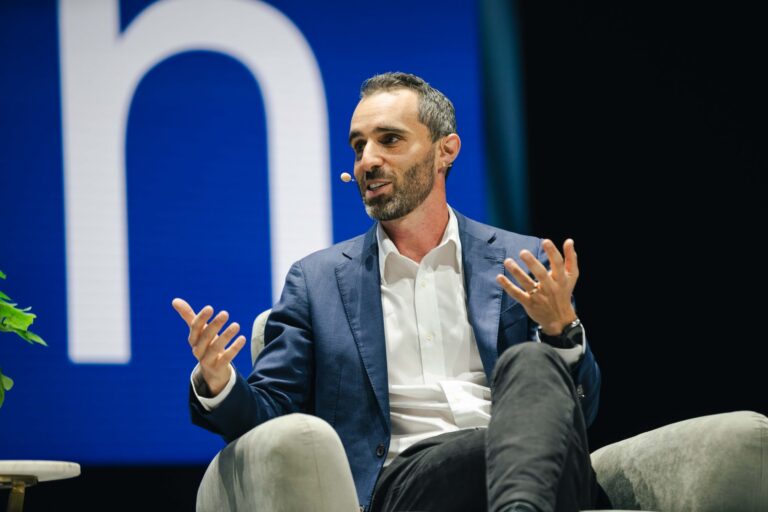
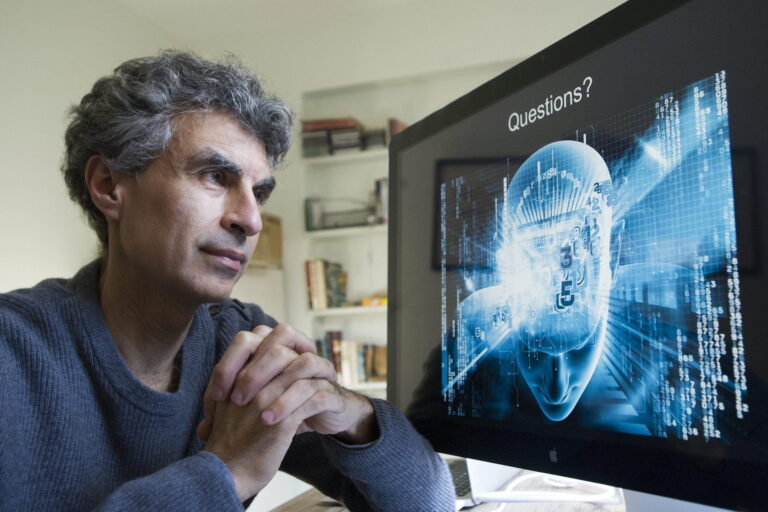
Others have expressed concerns: prominent tech figures including Mila’s scientific director Yoshua Bengio have called for a temporary halt to AI development, citing its potential to “flood our information channels with propaganda and untruth.” Canada’s privacy regulator has also begun investigating OpenAI’s use of personal information.
The Logic’s April survey asked readers how they were feeling about the pace of AI adoption, and which applications they found most exciting or worrying. Forty-nine per cent of respondents said they were “equally excited and concerned” about the use of AI at work or in daily life, while about 23 per cent said they were more concerned, and 28 per cent said they were more excited.
Related Articles
Sixty-four per cent said AI development is moving too fast. “The accessibility of AI outpaces society’s ability to understand it,” one subscriber said. Another wrote that “major AI companies have fired their AI ethics teams, and governments [and] non-profits have not expended anywhere near competitive resources on developing risk-mitigation strategies and methods.”
Thirty-one per cent of subscribers, meanwhile, said it’s going at the right speed. Only about five per cent said it’s moving too slow.
Subscribers expressed comparatively less concern that their own roles would be replaced by AI. Fewer than two per cent said they were “very concerned” that they could be replaced. About 44 per cent were “somewhat concerned” and around 54 per cent said they were not at all concerned.
Several respondents said AI is unlikely to replace positions that require human interaction or creativity. “At this stage, most AI will need to be monitored by or implemented by a human. I think people should be more worried about their jobs being replaced by someone who is familiar with and comfortable working with AI,” one subscriber wrote.
Another subscriber said, “Horses replaced human strength, the steam engine replaced the horses; log tables have been replaced by calculators. But it is still people driving the cars, and people who are creating and inventing—not machines, calculators, nor computers.”
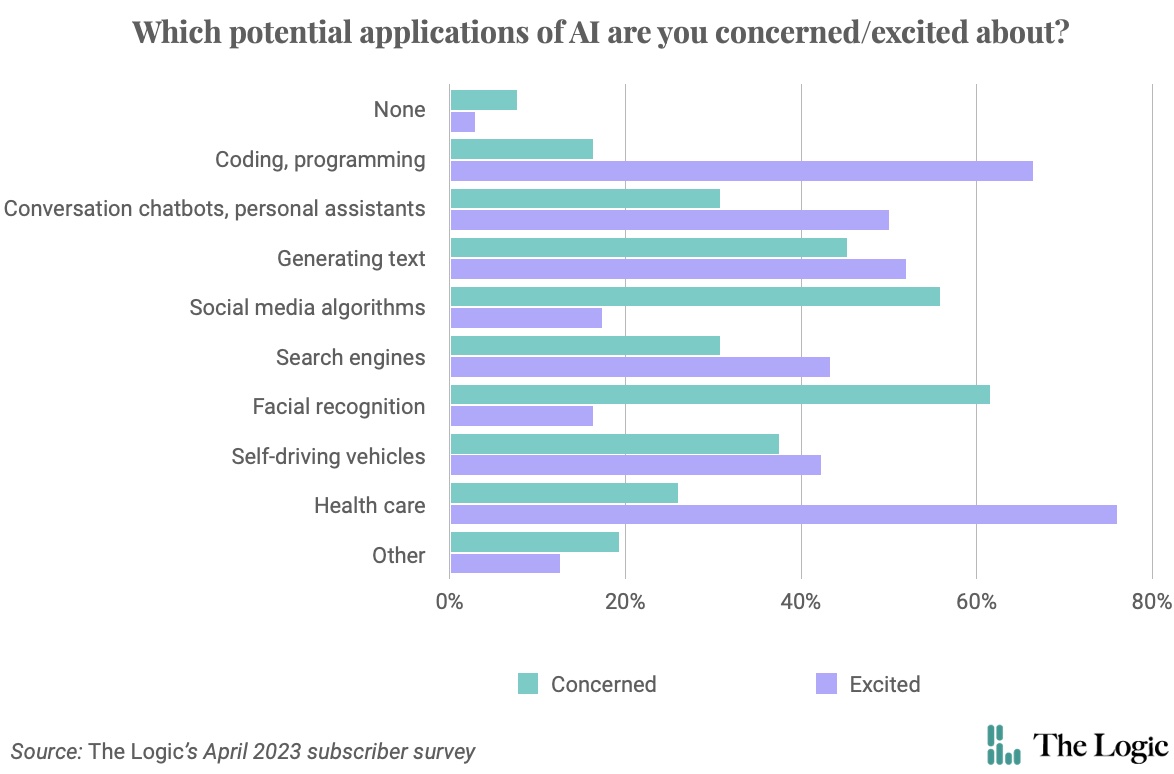
Facial recognition and social media algorithms were at the top of the list of AI applications that subscribers were concerned about, with 62 per cent and 56 per cent of votes respectively, followed by text-generating AI and self-driving vehicles (subscribers could select more than one option).
Many respondents wrote in answers about the dangers of AI-fuelled misinformation. One said deepfakes and fake audio are going to be the biggest problems: “It is already easily possible to make convincing fake videos of politicians saying statements they’ve never said, and we have no agreed-upon method of verification or fact-checking, never mind the long road to educating the public on how to use such tools.”
Readers were more excited about other applications. Uses in health care, such as identification of diseases, received 76 per cent of the votes, while 66 per cent went to the use of AI to assist with coding and programming. About half of respondents were excited about conversation chatbots and text-generating AI, at 50 per cent and 51 per cent, respectively.
Rocket designs “optimized by AI” look promising, one subscriber said, while another wrote that scientific discovery in general is an exciting area. “Crunching data is hard for humans but easy for this tech, and if it leads to advances in science that can be tested and save lives or open up new areas of exploration, that’s a huge benefit for us all.”
Methodology
The Logic emailed subscribers a private link to an online survey on April 11, and the survey closed April 13. Respondents’ identities were kept anonymous. Subscribers were asked “Broadly speaking, which best describes how you feel about potential use of AI at work and/or in daily life?” with the following options: “More excited than concerned,” “Equally excited and concerned” and “More concerned than excited.”
They were then asked, “Thinking about potential risks and benefits, how do you view the speed at which AI features and products are being released?” with the options: “Too fast, given potential risks,” “The right speed, balancing risks and benefits” and “Too slow, given potential benefits.”
The next question was “Are you concerned about whether your own profession or part of your role could be replaced by AI?” with the option to answer as “Very concerned,” “Somewhat concerned” and “Not at all concerned.”
Subscribers were then asked “What potential applications of AI are you most concerned about? Check all that apply.” (They could select more than one, unless they chose “None.”) The options were:
- Coding/programming assistance
- Conversation chatbots and personal assistants
- Generating text, such as emails, documents and social media posts
- Social media algorithms
- Search engines
- Facial recognition
- Self-driving vehicles
- Use in health care, such as identification of diseases
- Other (explain below)
- None
Finally, they were asked, “What potential applications of AI are you excited about? Check all that apply.” They were given the same list of options as listed above.



Loading...
Thanks for sharing!
You have shared 5 articles this month and reached the maximum amount of shares available.
CloseThis account has reached its share limit.
If you would like to purchase a sharing license please contact The Logic support at [email protected].
CloseGift the full article!
You have gifted 0 article(s) this month and have 5 remaining.
Recipients will be able to read the full text of the article after submitting their email address. They will not have access to other articles or subscriber benefits.
Photo: CFOTO/Future Publishing via Getty Images
Most Popular This Week




In-depth, agenda-setting reporting
Great journalism delivered straight to your inbox.
News
Ottawa is softening its ban on stablecoin yield
Briefing
Rio Tinto gets nearly $165M in additional federal funds for Quebec aluminum
U.S. to lift tariffs on some Canadian products crucial to Maine: Collins
Carney warns of tech dependence after Starlink disruptions in Ukraine
Best business newsletter in Canada
Get up to speed in minutes with insights and analysis on the most important stories of the day, every weekday.
Exclusive events
See the bigger picture with reporters and industry experts in subscriber-exclusive events.
Membership in The Logic Council
Membership provides access to our popular Slack channel, participation in subscriber surveys and invitations to exclusive events with our journalists and special guests.






