The artificial intelligence boom presents Canada with unique opportunities and risks as we seek to benefit from a technology that could reshape how we live.
In this special series, Canada’s AI Advantage, The Logic examines how Canadian companies, investors, institutions and workers can gain from the country’s early lead in AI, even as Canada’s pioneers in the field become the world’s most powerful voices of caution.
MONTREAL — As supervisor of what he calls the “boots-on-the-ground squad,” Luca Mascetti oversees the upkeep of McGill University’s more than 100 buildings, along with the 32-hectare downtown campus where they sit. The job is a farrago of work orders, equipment breakdowns, shift schedules and constant wonder as to what Mother Nature has in store. Mascetti loves it—as he loves that his job is the most secure against the work-saving, job-disrupting, AI-assisted tide barreling toward us.
Talking Points
- Organized labour is becoming a powerful voice expressing Canadian workers’ anxieties about AI, with union leaders warning of job loss and surveillance of workers, among other concerns
- Their skepticism is becoming a formidable obstacle to employers racing to make use of the technology, and could slow its adoption in Canada
Only one per cent of groundskeeping and maintenance workers are exposed to automation by AI, according to a recent Goldman Sachs report. That’s good news to the nearly 327,000 such employees Statistics Canada reports are working in the country, Mascetti and his crew included. The least secure, according to Goldman Sachs: the roughly 164,000 office and administrative support workers, whom the report says nearly half of which will see AI disrupt their job—if it doesn’t eliminate the job altogether.
Increasingly, organized labour is becoming a powerful voice expressing anxieties surrounding AI adoption in the workplace, and a potentially formidable bulwark against the spread of the technology.
FTQ, the union federation representing the groundskeepers and other employees at McGill, has said AI has the potential “to attack certain fundamental rights.” The Canadian Union of Public Employees (CUPE) says “the rapid emergence of artificial intelligence … represents a growing and evolving threat to many of our fields of work.” The union, the county’s largest, has pledged to protect the livelihood of its 740,000 members “where AI and technology threatens jobs and livelihoods.”
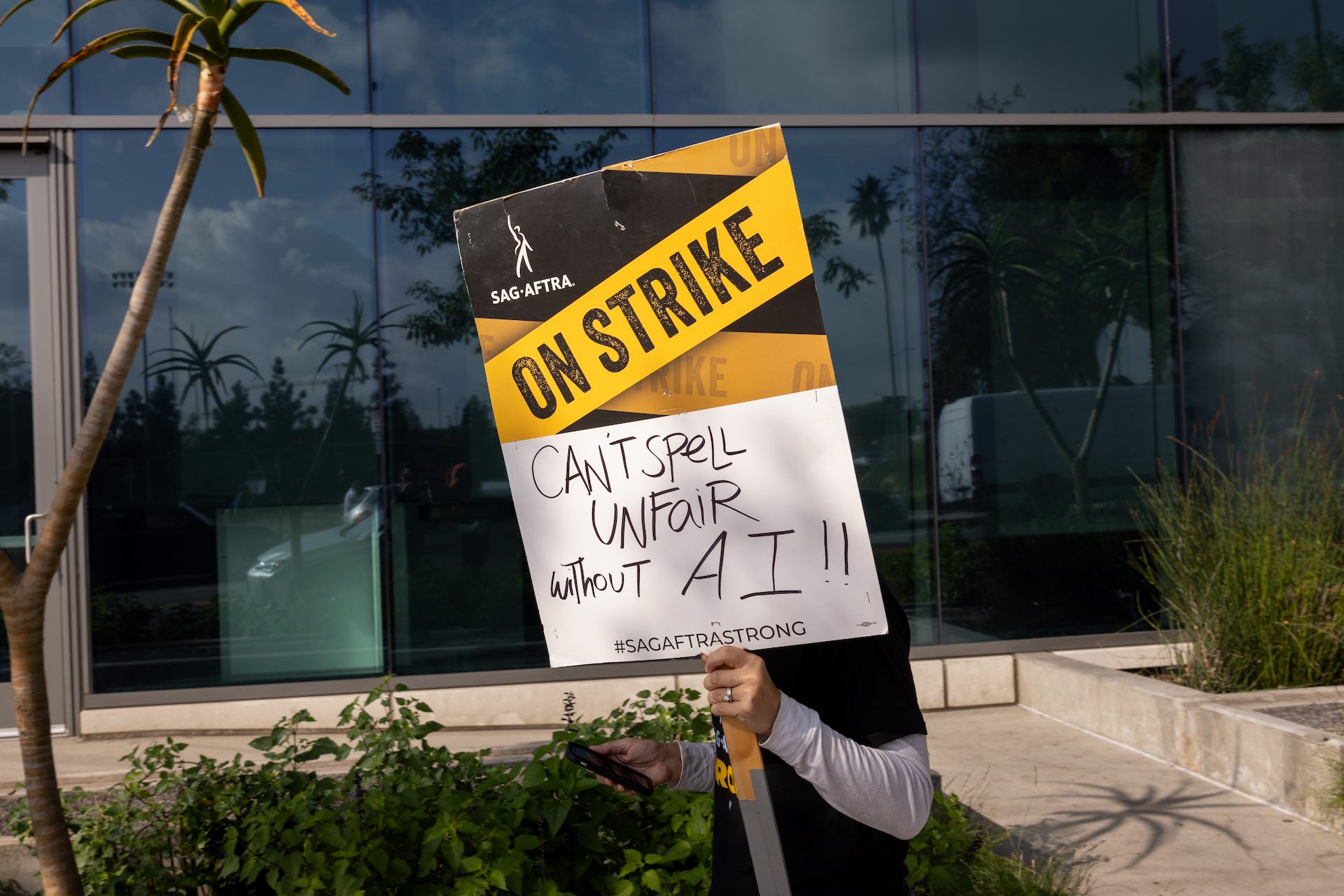
In September, the Alliance of Canadian Cinema Television and Radio Artists (ACTRA) said AI poses an “existential threat” to the industry. The union, which represents 28,000 performers across the country, negotiated some protections for its members in the video-game industry. The Screen Actors Guild-American Federation of Television and Radio Artists (SAG-AFTRA) ended a nearly four-month strike after securing a contract with Hollywood studios that, among other things, promised “lengthy and detailed AI guardrails.”
Canadians are among the fastest-growing adopters of AI in the world, according to a 2023 LinkedIn Future of Work Report. Yet language like CUPE’S has some worried that organized labour will stifle Canada’s coveted AI head start. “Fear” is the biggest hindrance to AI adoption in the Canadian workplace, said Nicole Janssen, co-CEO of the Edmonton-based AI solutions company AltaML. “Unions and organized labour getting behind that messaging is just going to keep it around.”
A video-game worker at the Ubisoft headquarters in Montreal in October 2017. Photo: The Canadian Press/Mario Beauregard
Nearly 30 per cent of Canadian jobs are unionized, meaning there is potential for a lot of pushback. And employees are only starting to grasp how AI might affect their careers. In a PwC survey of Canadian workers published in July, less than half of respondents had a good sense of how the skills their jobs require will change in the next few years; yet nearly a third said they doubted artificial intelligence will have an impact on their jobs. Many may be underestimating the impact of the technology, the authors concluded.
A closer look, however, reminds us that the workforce—including the part made up of unionized employees—is not a monolith. Rather, a sizable chunk of the labour movement has embraced the work-enhancing benefits of the technology, and seeks only to curb its potentially exploitative effects on its members.
In 2018, Unifor, the country’s largest private-sector union, produced a report addressing for the first time how it would approach the use of AI. While it outlined AI’s potential pitfalls for workers, including job losses and increased surveillance, the report was candid about AI’s inevitability and its potential upsides.
“Reading the headlines, one cannot be blamed for thinking that artificial intelligence is going to take over the world—imminently. However, the general consensus among researchers and AI experts suggests that humans are far more likely to be working alongside machines during their future work than being entirely replaced, though what one’s job looks like could change dramatically in the process,” read the report.
Five years later, Unifor’s view hasn’t changed much. With AI, “there will be tasks that will be replaced more than whole jobs,” said Kaylie Tiessen, a research analyst with the union. “What we need to do as workers is mitigate the risks and seize the opportunity, recognizing that there are opportunities to potentially make jobs higher quality. But that requires transparency between workers and employers with lots of consultation and discussion on technological change.”
Surveillance counts among Tiessen’s chief concerns. While remote tracking of employee activity existed before COVID-19 triggered a mass departure from offices, the use of AI has only increased the practice, particularly in the trucking industry, said Tiessen.
“There are programs that are constantly listening to and watching you. You may be training an AI that is going to replace you.”
The worry is that employers will use AI-derived data to discipline workers, something Amazon has already done with its drivers. The other (very real) concern is perhaps more insidious: employers using the data gathered by surveillance systems to automate certain jobs out of existence. “There are programs that are constantly listening to you and watching you to provide advice on how a customer service agent should be interacting with a customer. At the same time, you may be training an AI that is going to eventually replace you,” said Tiessen.
Still others worry about AI’s potentially destructive effects on the social safety net should the technology be used to replace human decisions. In 2021, the Quebec government launched a five-year strategy to integrate AI into the province’s public sector. Government Administration Minister Sonia LeBel said AI has “invaluable potential to public administration,” though not everyone is convinced.
“One of the things that preoccupies us the most is in welfare,” said Isaïe-Nicolas Dubois-Sénéchal, a researcher with the SFPQ, which represents public and parapublic service workers in Quebec. Dubois-Sénéchal said many frontline SFPQ members will be trained to use an “algorithm system” for social assistance applicants. He worries AI will eventually usurp his members’ decision-making power. “This involves people with extremely complex cases which are extremely varied. So to have this managed by artificial intelligence is something that is excessively dangerous for us.”
There is a lot at stake. Generative AI alone could raise labour productivity by 0.1 to 0.6 per cent annually until 2040, according to a recent McKinsey report. Already, big Canadian employers are incorporating AI into their business models, in the hope that the technology will streamline existing systems and open new data streams. Canadian Tire is using AI to help determine store layouts and stocking models. The company has also experimented at its Mark’s and Sport Chek stores with an AI-powered robot that can learn rudimentary tasks like tagging products and folding clothes. During the pandemic, grocery store giant Loblaw’s hoovered up AI experts and data technicians in anticipation of the transition to come.
Whether those projects succeed hangs on any number of variables, from the design of the technology to companies’ tolerance for failure. But the greatest hurdle, said Janssen, may be overcoming workers’ collective worry. “Somewhere between 20 and 30 per cent of AI models built actually get implemented,” she said. “There’s a lot of factors to adoption, and why that happens. But probably the biggest is fear.”