VANCOUVER — Earlier this year, staff at two stores—a Mark’s and Sport Chek in B.C.’s Lower Mainland—met a co-worker who looked different than any they had worked with before. Their new colleague had snow-white skin made of plastic and metal, with sensors on its hands and a camera attached to its face.
Skip to content

 Phoenix performed tests at a Mark's store and a Sport Chek earlier this year. Photo: Handout/Sanctuary AI
 The design and construction of Phoenix began with its hands. Photo: Handout/Sanctuary AI]

The Big Read
Sanctuary AI’s quest to build a handy robot
How do you make a humanoid machine driven by artificial intelligence? Start with the fingers
Sanctuary AI CEO Geordie Rose with Phoenix at the company's testing facility in Vancouver, in July 2023. Photo: Handout/Sanctuary AI
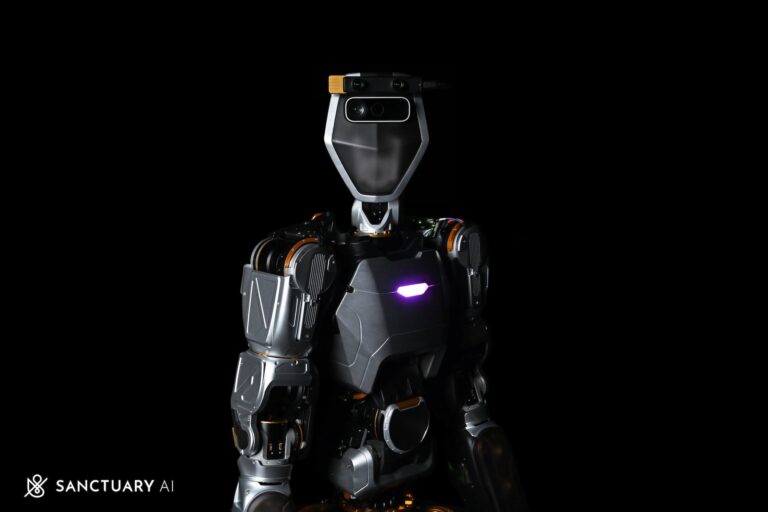
VANCOUVER — Earlier this year, staff at two stores—a Mark’s and Sport Chek in B.C.’s Lower Mainland—met a co-worker who looked different than any they had worked with before. Their new colleague had snow-white skin made of plastic and metal, with sensors on its hands and a camera attached to its face.
But Phoenix, a robot from Vancouver-based Sanctuary AI, shared one feature with staff at the stores where it would attempt to fold clothes, clean, tag products and complete other jobs it had learned to do in a laboratory. Its two hands came complete with fingers and thumbs, which let the machine execute the sort of mundane-yet-fussy tasks normally left to humans.
Talking Points
- Vancouver’s Sanctuary AI recently unveiled the latest iteration of its humanoid robot, a machine equipped with human-like hands and powered by artificial intelligence to help it complete seemingly mundane tasks
- The company has attracted venture-capital and government investment as it works to make Phoenix mostly autonomous and capable of real-world jobs currently filled by humans
Those 10 digits set Phoenix apart from most humanoid robots. Most have, at best, grippers—pincer-like hands that can perform rudimentary jobs like picking up boxes and moving them. More remarkable still, though, is the application of artificial intelligence that controls Phoenix’s hands. More than building a system capable of rote tasks, Sanctuary aims to develop a human-like intelligence that would put those fingers to work in the ways a person’s brain would. That means recognizing conditions in the real world and adapting to them as they shift. More importantly, it means learning and improving with each job done.
“This is the world’s hardest technological problem,” CEO Geordie Rose told The Logic in an interview. “Building human-like intelligence in machines is a more than 70-year quest in the artificial-intelligence community.”
With Phoenix, Sanctuary is a step closer. Founded in 2018, the firm recently unveiled the five-foot seven-inch contraption it hopes will usher in an era when robots fill jobs there aren’t enough people to do. The current iteration of Phoenix is powered by an AI control system called Carbon, which helps the robot to perform jobs and learn as it completes them, providing a complement to the humans in its orbit. “All it cares about is accomplishing work tasks,” said Rose.
Related Articles

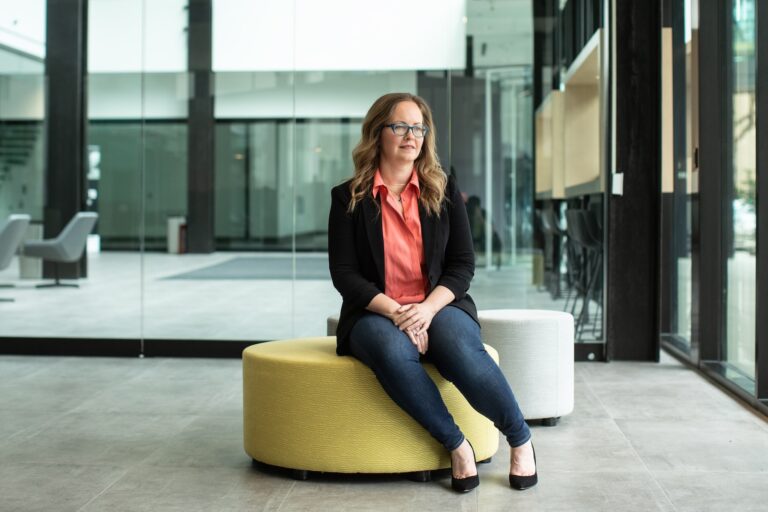
Rose first became interested in AI while working at a startup he founded, D-Wave, a Burnaby, B.C.-based quantum computing firm. Many of its customers were at the forefront of AI research, he said, including Montreal’s Yoshua Bengio, a pioneer in the field. Rose and some of his colleagues believed AI would become a powerful force in the world and were particularly interested in how it could be used to control machines.
One of those colleagues, Suzanne Gildert went on to start Kindred Systems, a robotics firm she recruited Rose to help lead as CEO. While there, they split the company into two parts, the first of which focused on Kindred’s robotic product and was later acquired by Sobeys’s e-commerce partner Ocado Group for US$262 million. The second operated under the public radar, and explored a more ambitious, long-term problem of creating general intelligence for robots. Sanctuary started with five staff and has since grown to about 120.
Investors bought into Sanctuary’s ambition early on. The company has raised more than $100 million in funding, including a $30-million investment from the federal government’s Strategic Innovation Fund last November.
VCs bet on the company due largely to its leaders’ track record of successful startups that solve difficult problems. “Rose essentially invented quantum computing,” said Patrick Lor, a managing partner at Panache Ventures, an early investor in the firm.
He was also impressed by their vision. “They were talking about stuff which was just beyond what any other company has pitched us.” In 2019, when Panache first invested, Lor accepted that Sanctuary likely wouldn’t have a mass-market product within five years. But he bet that when it did in, say, a decade, it would have the potential to change the world.
In building Phoenix, Sanctuary started with hands, which Rose stressed is not as simple as it sounds. The enormous complexity of a human appendage is eclipsed, after all, only by that of the mind required to operate it, which has limited the capabilities of existing machines.
“We’d try something and I’d say, ‘There’s no way in hell we’re going to be able to do this.’ And there was.”
Digit, an autonomous robot developed by Oregon-based Agility Robotics, can do warehouse work alongside human colleagues, moving boxes and bins with its grippers. Atlas, a robot built by Boston Dynamics, recently demonstrated that it can interact with obstacles in its environment to do what it needs to.
But these types of systems can only accomplish things that don’t require hands, a range that Rose noted “is actually quite small.”
Sanctuary’s aspirations for Phoenix are higher, but so are the technical challenges. When a human picks up a pen, Rose explained, their brain is driving an action that, thanks to evolution, requires relatively little thought. The robot’s mind has to learn to do that from scratch. It must hold a model of the world in its head, have object recognition and understand the world well enough to act within it. “All of these things are necessary to do something as simple as reliably picking up a pen,” said Rose.
In 2019, when it first built a working hand and operating system, Sanctuary had the model perform basic gestures, simply moving around in free space. Researchers then ran it through a long list of basic manipulation tasks using “pilot” mode, where a human rigged out with wearable controls moves the hands. Rose was surprised by how much they could accomplish. The early model was able to open a Ziploc bag and use a pair of tweezers. “We would try something and I would say, ‘There’s no way in hell we’re ever going to be able to do this,” he remembered. “And, there was.”
The product has come a long way from those early demonstrations, said Marty Reed, a partner at Evok Innovations, who led Evok’s investment in Sanctuary and now sits on its board. “It’s gone from a PowerPoint and concept to something that you can go see and touch and watch in action,” he said. “We’re not too far from getting that out in the fields at customer sites.”
The earlier generation of the robot completed its first commercial deployment at Mark’s this past March. The long-term vision is to have Phoenix working for various clients in a number of industries, including retail, defence, health care and logistics.
“To maintain the standard of living and basic human services, we’re going to be dependent on these general-purpose robots.”
To be employed thus, Phoenix will first need legs. It currently sits on a wheelbase that doesn’t suit certain types of work. By the time the company is ready to mass-manufacture Phoenix, it will be capable of walking, Sanctuary said.
There is also work to be done on how the robot is controlled. During its stints at Mark’s and Sport Chek, Phoenix operated in pilot mode. But it can function autonomously, or in a hybrid mode where a person can override autonomous control. Over time, the ratio of how many robots a human controls widens, said Rose. “So the steady state in the future will largely be one person with a flotilla of robots.”
Building a hyper-focused robotic worker on an AI platform that mimics the human mind and supports independent learning naturally raises concerns.
Automation always sparks questions about possible job loss, though predictions of widespread replacement of human workers with robots have largely not played out. Rose calls declining birth rates possibly “the world’s biggest problem,” saying Phoenix may help fill the gap. Some countries—such as South Korea, Italy and Japan—are already experiencing labour shortages, agreed Reed. “In order for us to maintain the standard of living and get basic human services done,” he said, “we’re going to be dependent on all these general-purpose robots.”
Rose acknowledges robots like Phoenix may take some jobs away, but he’s not convinced that’s a bad thing. Much of the work people do now is “soul destroying,” and automation could free them up to pursue other things, he said.
Meanwhile, Sanctuary remains focused on the difficult problem of building human-like intelligence for a robot, with a sense of mission that goes beyond the technological challenge. “Who ends up solving this is going to be a very important factor to the future of human civilization,” said Rose.
A humanoid will inherit cultural principles from its birthplace, he said. “So it’s fully my intention that this most powerful of all technologies will be born in Canada, and I’m working very hard to make that happen.”



Loading...
Thanks for sharing!
You have shared 5 articles this month and reached the maximum amount of shares available.
CloseThis account has reached its share limit.
If you would like to purchase a sharing license please contact The Logic support at [email protected].
CloseGift the full article!
You have gifted 0 article(s) this month and have 5 remaining.
Recipients will be able to read the full text of the article after submitting their email address. They will not have access to other articles or subscriber benefits.
Photo: Handout/Sanctuary AI
Phoenix performed tests at a Mark's store and a Sport Chek earlier this year.
The design and construction of Phoenix began with its hands.
Most Popular This Week




In-depth, agenda-setting reporting
Great journalism delivered straight to your inbox.
Commentary
Carmichael: Canadian ignorance about India is a strategic weakness
Briefing
Aritzia shares pop after earnings rise 204%
First Nation in Alberta goes to court over fast-tracked oil pipeline
Chinese EV maker Geely Auto Group to launch in Canadian market in 2027
Best business newsletter in Canada
Get up to speed in minutes with insights and analysis on the most important stories of the day, every weekday.
Exclusive events
See the bigger picture with reporters and industry experts in subscriber-exclusive events.
Membership in The Logic Council
Membership provides access to our popular Slack channel, participation in subscriber surveys and invitations to exclusive events with our journalists and special guests.





