Listen Now
0:00
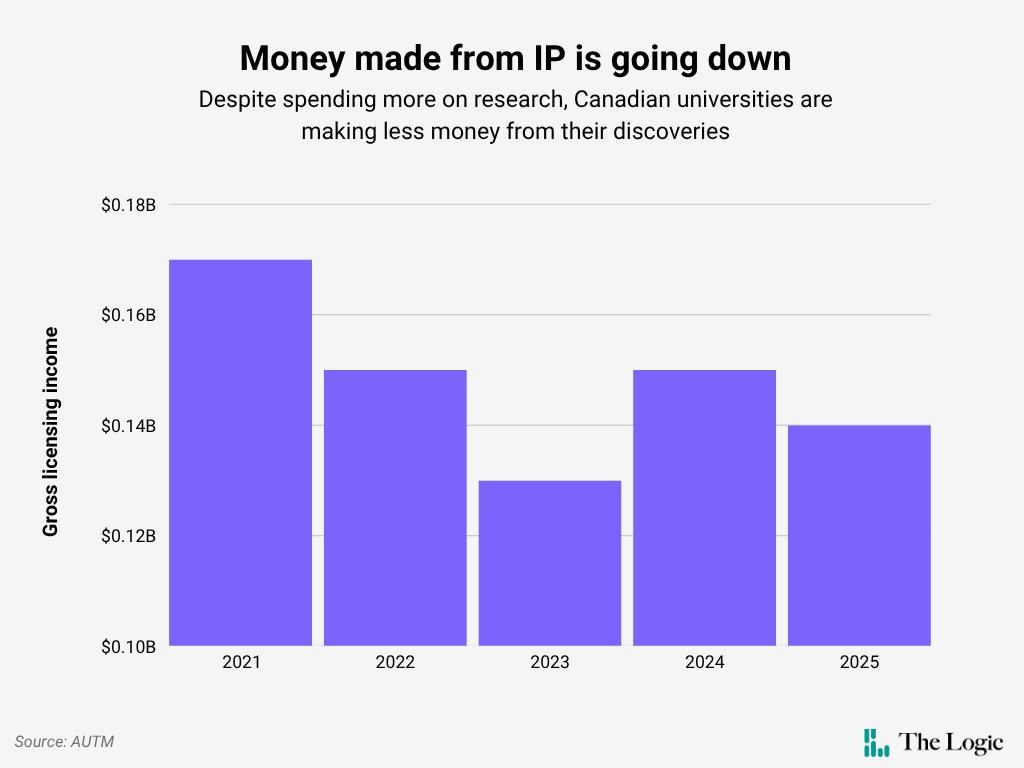
Canadian universities and research institutions generated less money from their discoveries in 2025, even as research spending and patent filings increase, new data shows.
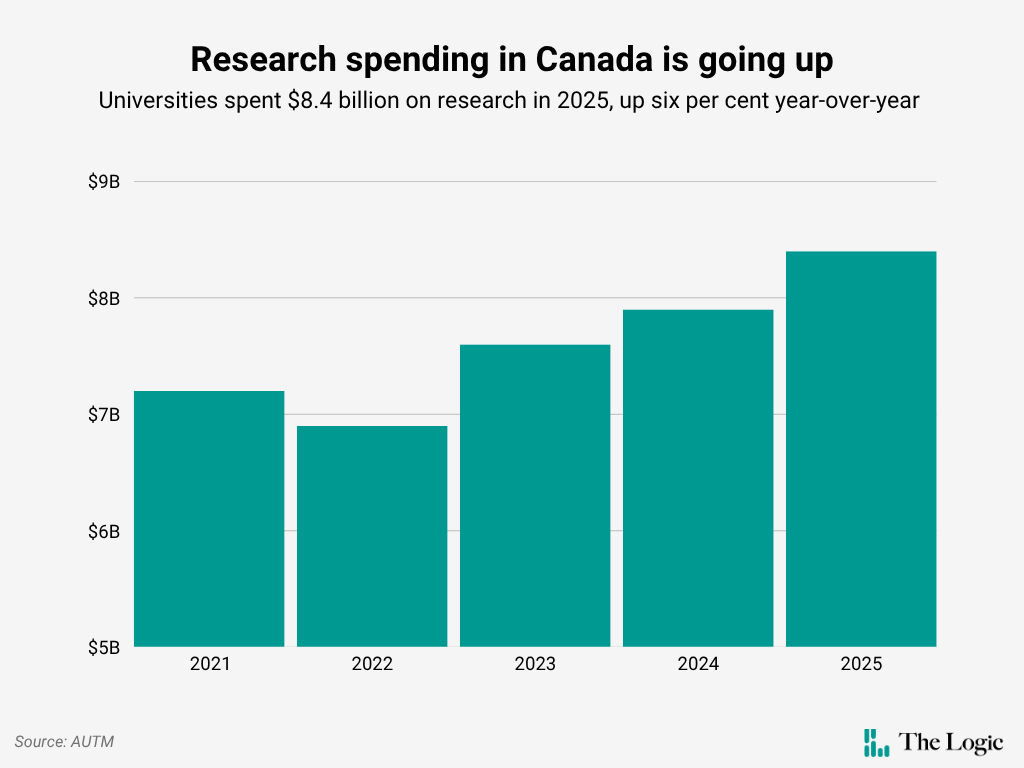
Research spending rose nearly six per cent year-over-year to $8.4 billion in 2025, according to a survey by the non-profit Association of University Technology Managers (AUTM). Invention disclosures—new discoveries that researchers formally report to their institutions—also increased among Canadian institutions that participated in the survey. New patent applications rose more than 20 per cent, and the number of startups created from academic research increased six per cent, from 117 in 2024 to 124 last year.
Talking Points
- Research spending and patent filings rose in 2025, but gross licensing income fell and university-linked startup failures jumped 65 per cent
- Five years of data show little progress in commercializing university research, despite government efforts to improve Canada’s IP performance
The financial results from this activity, though, have moved in the other direction. Licensing income from intellectual property before expenses fell about four per cent year-over-year to $143.7 million, according to AUTM. That’s about $171,000 in income for every $10 million spent on research last year, the data shows, down from about $233,000 per $10 million of research spending in 2021.
At the same time, more university-linked startups founded in Canada failed, with the number of companies that ceased operations jumping 65 per cent last year. And the number of active licences declined eight per cent. Those results point to the “challenging environment for technology-based ventures,” Olivia Novac, chair of the AUTM Canada licensing survey, said in the report, “as companies faced greater difficulty securing financing, achieving commercial traction or advancing technologies toward commercial development.”
Jim Hinton, an intellectual property lawyer and senior fellow at the Centre for International Governance Innovation, said the numbers suggest Canada is failing to improve its record of turning academic research into commercial value, despite recent measures from governments. “I don’t see any meaningful change,” he said. “It’s business as usual.”
In 2018, Ottawa launched a national Intellectual Property Strategy, which included several government-backed programs meant to help businesses develop patent strategies, protect their intellectual property and access IP from institutions such as universities.
In 2022, the Ontario government created an agency called Intellectual Property Ontario (IPON) to help university researchers and companies protect and commercialize their ideas, and introduced a framework requiring publicly funded colleges and universities to develop policies and annual plans aimed at improving commercialization. The province has also funded universities to add commercialization expertise and has been developing common measures for what happens to IP after it is created, including whether companies license and use it.
Related Articles


Dan Herman, who helped design what became IPON, said the dip in licensing income relative to research spending suggests universities may either be producing fewer “commercially relevant outcomes” or that demand for their innovations may be drying up.
Either way, he said, Canada needs to do a better job connecting universities and research labs with companies that can commercialize their discoveries.
The AUTM report is a voluntary survey that tracks R&D spending, IP filings and startup creation at Canada’s universities, hospitals and other public research institutes. The organization shared five years’ worth of data with The Logic, which shows little-to-no progress on key metrics, such as patent applications, licensing income and startup creation, even as research spending has grown.
There were some signs of increased commercial activity last year. Survey respondents signed 178 new deals to license their IP, up from 154 in 2024, and the number of options—which give companies time to assess a technology before deciding whether to license it—rose from 45 to 68. However, Hinton described those data points as a “blip,” and said it would take a much larger and sustained increase to indicate that Canada is getting better at protecting and commercializing university research.
He said the report also misses what he considers the most important measure of success: whether university research ends up in the hands of Canadian companies that can commercialize it. Hinton co-authored research in 2023 examining Canada’s 15 largest research universities that found more than half of the industry-directed IP they generated was assigned to foreign companies. “Where is the IP getting into the hands of Canadian firms and then being commercialized?” he said. “That’s where it has the most impact, and that’s not even being measured.”
Licensing income itself provides only a partial picture of the value university research generates. Some research is meant to advance scientific knowledge rather than produce marketable inventions, for example. Technologies that are commercialized can also take years to move from the lab through patenting and licensing processes to becoming products that generate royalties. Annual income from patents and other IP can also be heavily influenced by a small number of successful technologies.
That concentration is apparent in the latest data. The University of Toronto generated $81.3 million in licensing income in 2025—more than half of the $143.7 million reported by survey respondents. About $80 million of U of T’s total came from running royalties, or continuing payments on technologies that had already been licensed.
Herman said universities could up their IP income by shifting focus from producing more patents to getting discoveries into the hands of companies that can use them. He pointed to Quebec’s Axelys, which works with public research institutions to identify discoveries with commercial potential and connect them with companies that can bring them to market. “It’s a model that should be replicated on a national scale,” he said.