
Listen Now
0:00
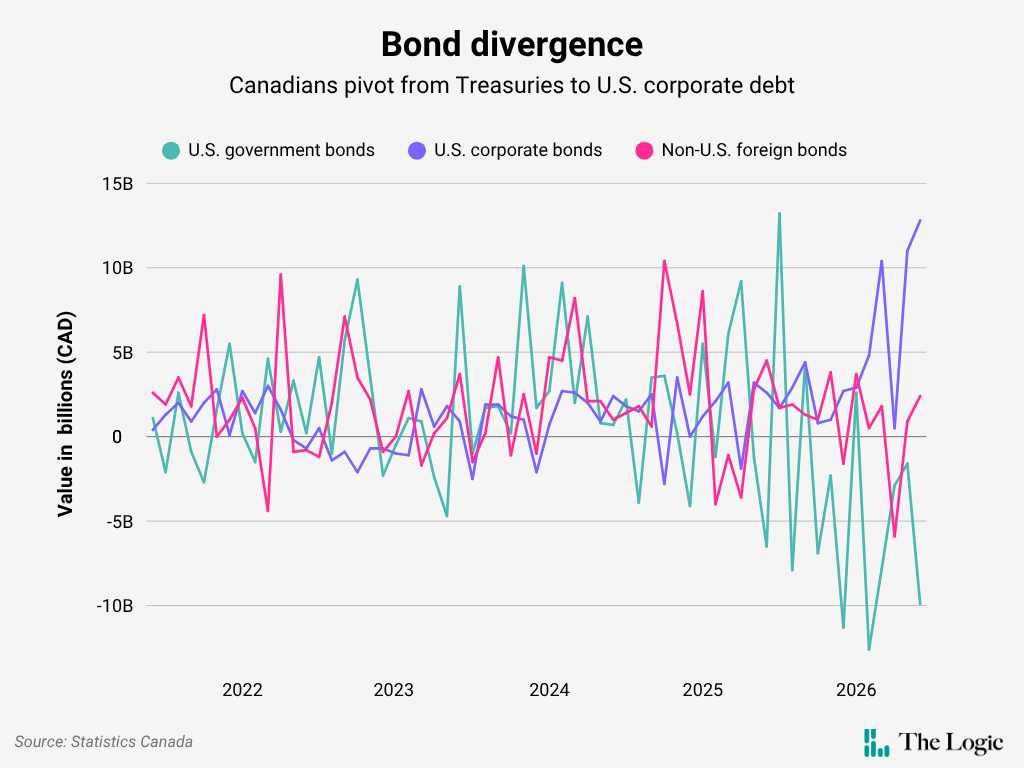
Canadian investors are shedding U.S. government bonds at a record pace, even as they pile into U.S. corporate debt to capitalize on the AI boom.
Canadians sold $9.9 billion in U.S. government bonds through June, making them net sellers every month since January, according to Statistics Canada data. The retreat was sharpest in February, when investors offloaded a record $12.6 billion, the biggest monthly pullback since records began in 1988.
Talking Points
- Canadian investors sold a net $9.9 billion of U.S. government bonds through June, including a record $12.57-billion in February, the largest monthly outflow since Statistics Canada records began in 1988
- At the same time, Canadians bought $12.82 billion worth of U.S. corporate bonds in June, the highest monthly total recorded
Ali Jaffery, chief economist and partner at KPMG Canada, said Canadian institutional investors are following the global shift away from U.S. government bonds, after previously holding more of them than many other advanced economies.
Investors are increasingly concerned not only about inflation caused by the Iran war and energy market shocks, but also about the Federal Reserve’s credibility and the prospect of greater volatility in the U.S. dollar, Jaffery said in an interview.
“We’re going to live with higher long-term yields, pretty much unless and until we can solve some of these big challenges,” he said.
The shift comes as global bond markets come under pressure from growing concerns over inflation and the ballooning U.S. fiscal deficit. A sharp sell-off last week pushed long-term yields higher, raising borrowing costs for governments and households.
Canadian 30-year bond yields reached 4.15 per cent, their highest level since 2010, while the 30-year Treasury yield rose above 5.3 per cent last week, the highest point since 2007. Similar pressure has rippled across other global markets: 30-year bond yields in France and Germany last week hit levels not seen since 2008 and 2011, respectively. Japan’s 10-year yield hit its highest level in three decades.
Last Wednesday, the Treasury department said it would “at least double” its purchases of long-term government bonds in a bid to support the market. Bond prices initially rallied following the announcement, but gains quickly faded as yields returned to their all time highs.
Despite the retreat from government bonds, Canadians bought a record $12.82 billion worth of U.S. corporate bonds in June, according to Statistics Canada. The surge came as tech companies ramped up borrowing to finance data centres and other AI infrastructure, competing with government bonds for investor capital.
Companies issued about $84.5 billion in Canadian-dollar bonds in the first half of this year, according to LSEG data, up nearly 70 per cent from the $49.9 billion issued during the same period of 2025. Alphabet and Amazon set records with bond issuances of nearly $8.5 billion and $14 billion in May and June, respectively, accounting for 26.5 per cent of the total.
Tiago Figueiredo, a macro strategist at Desjardins, said U.S. hyperscalers are issuing Canadian-dollar bonds as part of a broader strategy to diversify funding across currencies and avoid putting too much pressure on any one market. Issuing in Canada can also lower borrowing costs if companies can swap the proceeds back into U.S. dollars at favourable rates, he said.
Karl Schamotta, chief market strategist at Corpay Cross-Border Solutions, said the move into corporate debt is a reason not to interpret Canadians’ Treasury sales as a broader loss of confidence in the U.S.
If investors were pulling back because of concerns about the country’s fiscal outlook, political institutions or growth prospects, he said, they would be unlikely to move into U.S. corporate bonds, which carry many of the same currency and political risks as Treasuries, plus additional credit risk.
“They are simply being choosier about where on the risk spectrum they get paid,” Schamotta said in an email.
There are, however, growing concerns about the scale of AI-related borrowing. S&P Global Ratings has warned that disappointing AI-related returns could potentially amplify market stress, with advanced tech accounting for nearly 38 per cent of U.S. non-financial corporate issuance in the first half of this year. The Bank of England, meanwhile, warned that companies are issuing long-term debt to finance AI assets that could quickly become obsolete, creating what it called a “potential source of fragility.”
Despite the uncertainty, Figueiredo said corporate bonds offer investors a safer way to gain AI exposure than equities, while the sheer size of hyperscaler issuance has made those bonds increasingly difficult for institutional investors to ignore.
Jaffery said markets may be underpricing the risks because the returns on massive AI investments remain uncertain. But hyperscalers’ strong balance sheets and investors’ willingness to wait for the technology to mature could help cushion any shock, he said.
“If there is a major correction in equities or [bond] yields rise, I don’t think it’s the end of the world,” he added. “It’ll slow growth for sure, and slow [AI companies’] expansion plans, and we will all be poorer for it, but I don’t know if there’s a major financial stability risk that’s very present yet.”
Economists interviewed by The Logic expect the shift away from government bonds and toward other fixed-income assets to continue through the rest of the year.
What could accelerate the retreat from American bonds, Jaffery said, is further fiscal stimulus ahead of the 2028 U.S. election. Such a move could be the “straw that breaks the camel’s back,” reinforcing concerns that Washington lacks a credible plan to stabilize its fiscal outlook.
But that pivot could prove a net positive for Canadian fixed income. Figueiredo said investors are still increasing their allocations to domestic bonds, with Statistics Canada data showing Canadians have invested more than six times as much in domestic bonds as they have in foreign ones this June.
Still, he said a wholesale move away from U.S. bonds remains unlikely.
“You don’t have a market that’s big enough to be able to absorb a full rotation away from the U.S.,” Figueiredo said. “[Yet], the marginal dollar is clearly going to Canada.”