OTTAWA — Even before Donald Trump takes office in the United States, his tariff threats have shown how easily he can dominate politics and policymaking in Canada. Much of 2025 promises to be a series of reactions to his presidency.
That includes the decision Canadian voters will make about who will run the federal government in an election due no later than October. It could come a lot sooner, if the NDP vote to bring down the Liberals as they say they will.
Trump hasn’t even taken office yet, but a single Truth Social post kicked off a Canadian crisis that has not abated. Disagreement over how to prepare split the seemingly ironclad partnership of Prime Minister Justin Trudeau and his former deputy, Chrystia Freeland.
Meanwhile, overhauls to competition, broadcasting and telecom policies and the increasing role of artificial intelligence are having major consequences for corporate Canada.
Beyond the obvious ex officio figures like Trudeau and Innovation Minister François-Philippe Champagne, here’s a look at some of the key Ottawa players—politicians, public servants, regulators and others—who will matter this year to Canadian business and the innovation economy.
Special Report
The people to watch in Ottawa in 2025
Trump, trade and Tories dominate the talk as an election year begins
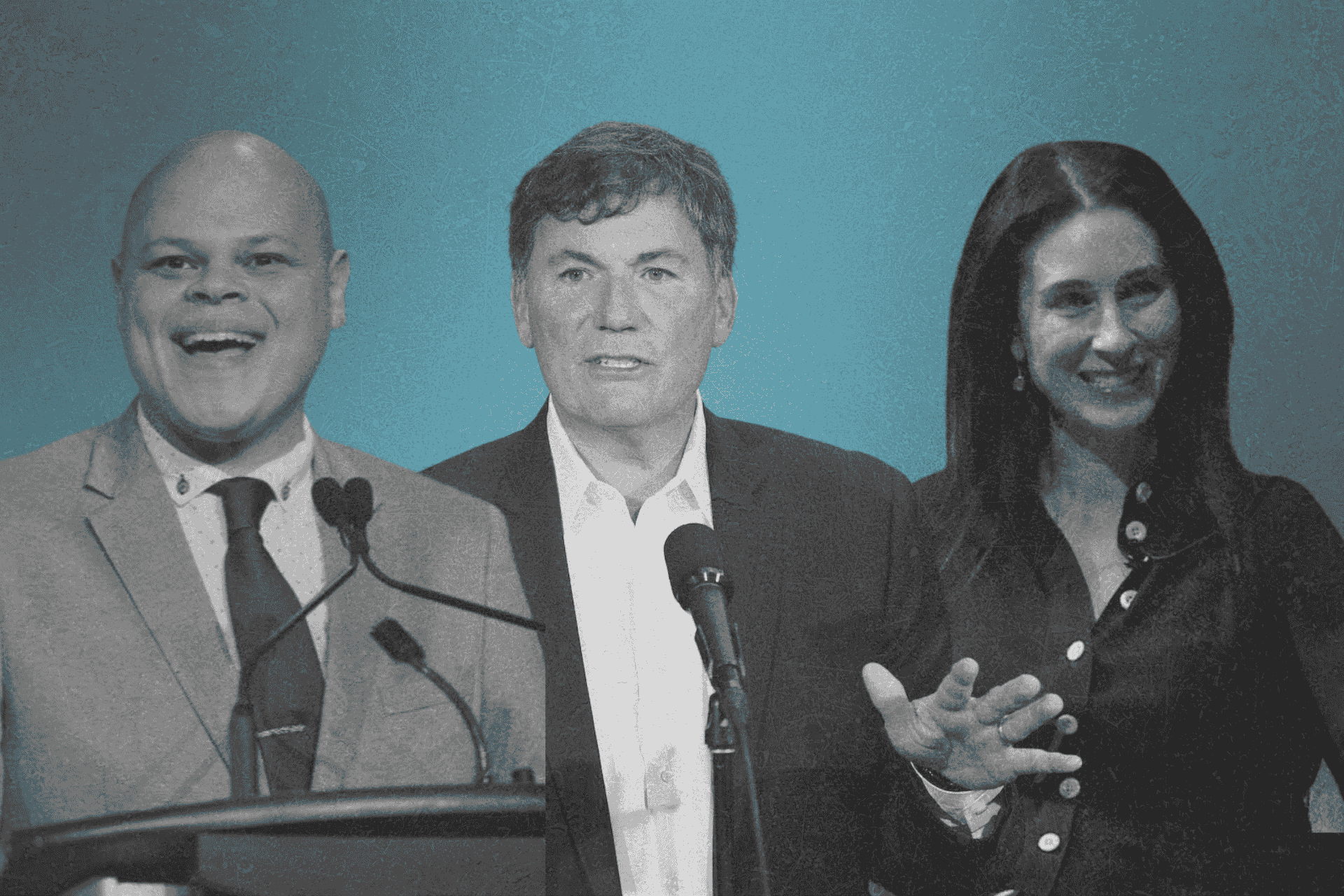
Photo: Jamil Jivani photo: LinkedIn; Vicky Eatrides photo: Government of Canada/Handout; Dominic LeBlanc photo: The Canadian Press/Darren Calabrese; Photo illustration by Sumaiya Kamani for The Logic
Photo: Jamil Jivani photo: LinkedIn; Vicky Eatrides photo: Government of Canada/Handout; Dominic LeBlanc photo: The Canadian Press/Darren Calabrese; Photo illustration by Sumaiya Kamani for The Logic
OTTAWA — Even before Donald Trump takes office in the United States, his tariff threats have shown how easily he can dominate politics and policymaking in Canada. Much of 2025 promises to be a series of reactions to his presidency.
That includes the decision Canadian voters will make about who will run the federal government in an election due no later than October. It could come a lot sooner, if the NDP vote to bring down the Liberals as they say they will.
Trump hasn’t even taken office yet, but a single Truth Social post kicked off a Canadian crisis that has not abated. Disagreement over how to prepare split the seemingly ironclad partnership of Prime Minister Justin Trudeau and his former deputy, Chrystia Freeland.
Meanwhile, overhauls to competition, broadcasting and telecom policies and the increasing role of artificial intelligence are having major consequences for corporate Canada.
Beyond the obvious ex officio figures like Trudeau and Innovation Minister François-Philippe Champagne, here’s a look at some of the key Ottawa players—politicians, public servants, regulators and others—who will matter this year to Canadian business and the innovation economy.
Talking Points
Responding to the demands of Donald Trump’s presidency will likely dominate the agenda in Ottawa in 2025, with massive implications for international trade, the domestic economy and defence
Meanwhile, the Conservative party is slavering for an election that seems set to make Pierre Poilievre prime minister and rearrange Canada’s national priorities
The VP’s BFF
Jamil Jivani
A flurry of phone calls and text messages swept Ottawa on Nov. 5 as votes were counted south of the border. Once it became clear Donald Trump was headed back to the White House—and even more so once he threatened sweeping tariffs on imports from Canada—cabinet ministers, politicians, bureaucrats and insiders of every stripe ramped up efforts to build bridges with important members of Trump’s inner circle.
One man was 15 years ahead of them. Just a week after the election, Conservative MP and parliamentary newcomer Jamil Jivani was spotted in the dining room of the U.S. Senate with his old friend from Yale law school: Trump’s running mate, vice president-elect J.D. Vance.
Jivani won his Toronto-area seat in a March byelection, but has been an up-and-coming figure in the conservative movement for years. He previously headed the Canada Strong and Free Network, a think tank previously known as the Manning Centre, and moderated one of several debates held as part of the Conservative leadership race that saw Pierre Poilievre take over the party in 2022.
Long before all that, he met Vance at a wine-and-cheese reception where both felt out of place during their orientation at Yale University. The two forged a lasting bond. Jivani read a Bible verse at Vance’s wedding and even ran Vance’s short-lived charitable foundation.
The two met up again last month for dinner with British Conservative Party Leader Kemi Badenoch outside Washington, D.C. Jivani said they spoke about the friendship between their three countries, and what a reliable trade and security partner Canada has been.
Poilievre’s Conservatives have been quiet about how they might make use of Jivani’s connection to Vance as part of their strategy to manage Trump and the crucial trade file. Neither has there been any indication that he would play a part in the governing Liberals’ efforts to build a unified Team Canada response to Trump. But he could be a key weapon in Canada’s arsenal.
Ottawa’s AI brain
Mark Schaan
The federal government is obsessed with artificial intelligence. Ottawa has put up hundreds of millions to fund research and commercialization of the technology, and billions to finance the data centres that will power it. It’s also trying to regulate AI, and to stake out a leadership position in the field globally. And it’s planning to roll the technology out across its own operations.
That’s a lot of moving parts. It falls to Mark Schaan to coordinate many of them, and to help ensure that Canada doesn’t lose its AI advantage. In July, the government named him the first secretary to the cabinet for AI in the Privy Council Office, the public service’s top unit.
His short-term to-do list includes getting departments to use the technology in their day-to-day work, particularly in text-heavy tasks like translating files into the other official language or preparing access to information requests for disclosure. Schaan’s secretariat has also been tapped to lead a new review of how AI can make the public service more efficient, as the government looks to pare what it spends on its own operations.
That’s the inside job. But Schaan will also be looking abroad as Canada prepares to assume the presidency of the G7 in 2025, with Ottawa keen to make AI a major part of its agenda.
Schaan set up the secretariat after spending the previous eight years at the federal innovation department. There, he oversaw the unit that wrote Bill C-27, which includes the proposed Artificial Intelligence and Data Act, fronting hours of parliamentary hearings on the legislation. (It’s currently stalled in the face of opposition from some techfirms and digital rights advocates). Schaan was also responsible for Canada’s AI engagements at international groups like the G7, G20 and the Global Partnership on Artificial Intelligence.
Federal policymakers have emphasized the need to balance the technology’s potential productivity and innovation benefits with allaying the worries of a Canadian public that’s notably skeptical of AI. “On the one hand we need to get to trust,” Schaan said at an Ottawa policy event last month. “On the other hand, we absolutely also need to seize our opportunity [to be] the drivers of the application and adoption of a technology that I think we can credibly say we played an important role in developing.”
Schaan’s job is to help ensure Ottawa somehow does both.
Trade chief
TBD
On the questionable grounds that Canada is not currently engaged in trade talks with the United States, the federal government has not yet named a chief negotiator to oversee the renewal of the United States-Mexico-Canada Agreement, which is due in 2026. The job exists in the federal org chart but nobody holds it. That person will inherit the mantle once borne by Simon Reisman, John Weekes and Steve Verheul, each of whom led the Canadian side in previous major trade talks with the United States.
The Canadian will likely be sitting across tables from Jamieson Greer, whom Trump has said will be his nominee for U.S. trade representative. Greer was chief of staff to Trump’s previous trade rep, Robert Lighthizer, so he has more of a background on his file than do some of Trump’s otherappointees. But he’s also not Lighthizer, whom Canada invested a lot of time cultivating.
The new challenge is the degree to which Trump sees trade as an instrument for wider foreign policy, so that talks over dairy supply management, say, are really about security in the Arctic rather than quotas and cheese tariffs.
The minister for everything
Dominic LeBlanc
In times of trouble, we often turn to our friends to help carry the load. Unfortunately for Trudeau, he has fewer and fewer of those on Parliament Hill. Friends, that is—he has plenty of troubles.
After Freeland’s stunning resignation on the day she was supposed to announce a big increase to the federal deficit, Trudeau turned to his lifelong pal and close political ally.
Already responsible for border security and intergovernmental affairs, Dominic LeBlanc agreed to add the government’s finances to his already long list of responsibilities. He also took up the mantle of chair of the cabinet committee on U.S.-Canada relations, placing him at the head of the government’s vanguard for the trade war ahead.
With this major new promotion, LeBlanc will have considerable political power and sway over the Liberal government, however long it lasts.
In his new job, LeBlanc will implement the fall economic statement that Freeland drafted but wouldn’t present to Parliament. He will also try to come up with a spring budget that satisfies the political aspirations of the prime minister while improving affordability for Canadians and dealing with a fiscal situation that, in his words, “isn’t terrific.”
That’s all without any formal background in finance or economics.
While he figures all that out, he’ll also be in charge of negotiating with Trump in the hopes of averting sweeping 25 per cent tariffs on Canadian exports to the U.S., securing Canada’s border, and wrangling the provinces.
Suffice to say, if the Liberal government makes any big moves in the next few months, LeBlanc will probably have a hand in them.
Defence bosses
Gen. Jennie Carignan and Stefanie Beck
Canada is under intense pressure from its allies to increase defence spending to meet its NATO commitments and pull closer to its weight in protecting itself and its allies. As economic and security concerns intertwine, this is a problem for trade relationships and for domestic industry and innovation. National Defence officials have warned that Canada’s allies are leaving it out of efforts to develop new technologies.
If this is to be solved, Gen. Jennie Carignan, Canada’s top military officer as chief of the defence staff, and deputy minister of defence Stefanie Beck will be big players. Both new in their posts, they’re key to deciding what the military needs, putting it to use when it arrives and ensuring the Armed Forces are fit for purpose.
A Parliamentary Budget Office report in 2022 said Canada needed to spend $13 billion to $18 billion more every year to meet its NATO promise. That’s an enormous amount of money by any standard, but especially for a country that can’t recruit the military members it wants and whose capacity to procure new gear is notoriously poor (as is the kit it has).
Canada treats military procurement partly as industrial policy, demanding that foreign vendors deliver major benefits to Canadian industry. The auditor general reported in early December that reaching those agreements keeps the military from getting the goods it needs and the benefits are barely monitored: “Both the specific benefits and the full costs of the Industrial and Technological Benefits Policy were unknown,” said Karen Hogan’s assessment.
MPs were formally complaining about underspending on an understrength military more than 20 years ago, and there’s plenty of responsibility to go around.
Buying major gear is Public Services and Procurement Canada’s bailiwick; to the extent anybody oversees the industrial benefits policy, it’s Innovation, Science and Economic Development. But National Defence’s own participation in programs meant to boost domestic innovation has beenfeeble, too. A former jewel of Canadian defence research, a lab at CFB Suffield in Alberta, is rotting.
Carignan has said publicly that new threats, including technological ones, will be real within five years. Drone warfare has revolutionized battle, to a degree western militaries haven’t grappled with yet; Canada rushed to buy anti-drone equipment to protect troops in Latvia in early 2024.
The general, a trailblazing officer and military engineer, starts with a digitalization plan launched by her predecessor, Gen. Wayne Eyre, and a long-awaited new national defence policy. Beck is a former diplomat who has worked both in line departments and the Privy Council Office. They have a lot to do.
Pierre Poilievre’s political general
Jenni Byrne
Conservative Leader Poilievre is spoiling for an election, and when it comes time to bring the fight to Justin Trudeau it’s all but certain long-time Conservative loyalist Jenni Byrne will lead the charge.
Once regarded as one of the most powerful women in Ottawa, the veteran campaign manager delivered a long-awaited Conservative majority in 2011 and was a regular in the halls of power in both Ottawa and Toronto under former prime minister Stephen Harper and Ontario Premier Doug Ford. She was also the mastermind behind Poilievre’s resounding Conservative leadership win in 2022.
Byrne doesn’t have a formal role in the Opposition leader’s office, but she’s a fixture in Poilievre’s inner circle as a “key advisor.” As she’s demonstrated consistently over the years, she doesn’t need a fancy title to wield power.
Empowered regulators
Vicky Eatrides and Matthew Boswell
Competition commissioner Matthew Boswell at the federal Competition Bureau's offices in Gatineau, Que., on Oct. 23, 2024. Photo: Justin Tang for The Logic
The heads of the Canadian Radio-television and Telecommunications Commission and the Competition Bureau have acquired new powers lately, and seem keen to use them.
By the end of 2025, Boswell will be nearly at the end of an extended term as competition commissioner. He’s gone to court to try to break up Google’s advertising business, is investigating exclusivity provisions in grocery store leases that keep competitors away. He’s also pursuing Leon’s and The Brick over online sales tactics, as well as legaltech giant Dye & Durham over possible anti-competitive behaviour in real estate work.
That’s just from the last half of 2024, the fruits of years of work to build up the Competition Bureau’s capacity in digital markets.
Under Eatrides, a former lawyer and executive at the bureau, the CRTC is in the middle of overhauling the rules for Canadian broadcasting, thanks to the Online Streaming Act’s measure putting streaming services under the commission’s supervision and Canadian content requirements. It’s asking questions as fundamental as What even is Canadian broadcasting these days? Meanwhile, it’s also trying to boost consumers’ power in dealing with cellphone and internet providers. It’s also proposing something like a nutrition label for home internet plans, to make comparison shopping easier.
All the major federal parties are trying to outdo each other in championing consumers: Rogers chief executive Tony Staffieri, one of the biggest names in a highly regulated sector, testified to a committee of MPs in December and they mainly took turns scolding him. If any politician wants to rein in the regulators, they’re not showing it.
Hon. mentions
Jagmeet Singh — Singh’s letter announcing his party will seek to bring down the government was categorical: “No matter who is leading the Liberal party, this government’s time is up.” A non-confidence vote isn’t over till it’s over, though, and the NDP’s weakness in polls means a new uneasy entente between a new Liberal leader and another party can’t be completely ruled out. Nevertheless, Singh will almost certainly be the one to decide when the Liberal government (and his own party) needs to submit to the judgment of the people.
Chrystia Freeland — The former finance minister took a wrecking ball to the Liberal government’s recent fiscal philosophy on her way out the cabinet-room door in mid-December. She remains a popular figure in the party and said she intends to run in the next election. Freeland can be a reminder in caucus of Trudeau’s history, like Banquo’s ghost at Macbeth’s banquet. She can be a leadership contender. She can be a critic of a Tory government. She can’t be ignored.
Danielle Smith and Doug Ford — The premier of Alberta was handily re-elected in 2023. If the premier of Ontario goes for an early election this year, polls suggest that despite Ford’s personal unpopularity, his Progressive Conservatives will win handily against divided opposition. Smith has fought multiple federal policies and scored a political win on clean energy regulations. Ford has been out in front on dealings with Trump, floating the idea of cutting Mexico out of trade deals before federal politicians mused about it and making Canada’s case in American media. The leaders representing Canada’s oil and gas heartland and its industrial powerhouse will have influence in Ottawa, regardless of who’s in power in the nation’s capital.
Recipients will be able to read the full text of the article after submitting their email address. They will not have access to other articles or subscriber benefits.
Photo: Jamil Jivani photo: LinkedIn; Vicky Eatrides photo: Government of Canada/Handout; Dominic LeBlanc photo: The Canadian Press/Darren Calabrese; Photo illustration by Sumaiya Kamani for The Logic
Competition commissioner Matthew Boswell at the federal Competition Bureau's offices in Gatineau, Que., on Oct. 23, 2024.
Great journalism delivered straight to your inbox.
Commentary
Carmichael: Being boxed in will help Canada focus on what matters
By
Kevin Carmichael
Briefing
Rio Tinto gets nearly $165M in additional federal funds for Quebec aluminum
By Anita Balakrishnan |
U.S. to lift tariffs on some Canadian products crucial to Maine: Collins
By Joanna Smith |
Carney warns of tech dependence after Starlink disruptions in Ukraine
By Catherine McIntyre |
Best business newsletter in Canada
Get up to speed in minutes with insights and analysis on the most important stories of the day, every weekday.
Exclusive events
See the bigger picture with reporters and industry experts in subscriber-exclusive events.
Membership in The Logic Council
Membership provides access to our popular Slack channel, participation in subscriber surveys and invitations to exclusive events with our journalists and special guests.