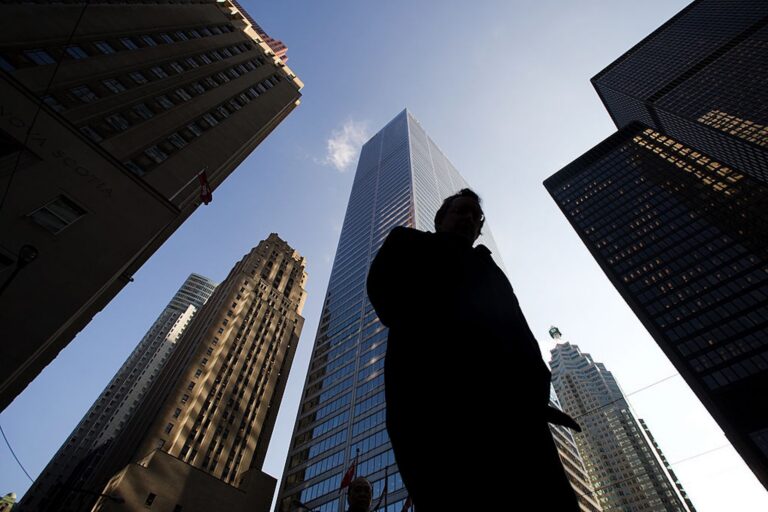
OTTAWA — The Liberals’ fall economic statement tries to deal with president-elect Donald Trump in two ways at once, investing in deepening ties between Canada and the United States while also preparing for those ties to rupture.
Skip to content


News
Economic statement offers a Team Canada plan for the economy, minus a star player
Chrystia Freeland’s abrupt departure from cabinet casts doubt on Ottawa’s plans
Prime Minister Justin Trudeau and then U.S. president Donald Trump in Watford, Hertfordshire, England, on Dec. 4, 2019. Photo: The Canadian Press/Sean Kilpatrick
OTTAWA — The Liberals’ fall economic statement tries to deal with president-elect Donald Trump in two ways at once, investing in deepening ties between Canada and the United States while also preparing for those ties to rupture.
Talking Points
- Eclipsed by the resignation of federal finance minister Chrystia Freeland, Monday’s fall economic statement takes a two-track approach to dealing with the incoming Donald Trump administration, investing in Canada’s ties to the United States while also preparing for those ties to rupture
- It includes things that have nothing to do with Trump, though, including details on a long-awaited open banking framework and promises to revamp the country’s flagship scientific research and development program
“We are taking a Team Canada approach in our defence of the national economic interest, and are confident that by being strong, smart and united, Canada will be successful,” the statement says. When they were written, those words were intended to come from Chrystia Freeland.
Now, after her shock resignation from the cabinet on the morning she was to deliver them, Prime Minister Justin Trudeau has his own rupture to contend with.
The statement, at the cost of an expected budget deficit of $48.3 billion in 2024-25, includes many things aimed at strengthening Canada’s economy regardless of who occupies the White House. One of those is an “Invest in Canada” summit, to sell the country’s “competitive advantages, strong economic fundamentals and investment incentives,” to global investors. The Liberals have expended a lot of rhetoric on trying to “crowd in” foreign dollars to Canadian causes and they intend to try again.
(This is one of the few places in the statement that clearly show Freeland traces: “The summit will be chaired by the deputy prime minister and minister of finance, who will further her work to strengthen partnerships with international and domestic investors,” it says.)
Related Articles
The statement offers new details on a long-awaited framework for open banking, which is supposed to promote competition among banks and fintech challengers. Larger banks will be mandated to go first, followed by smaller institutions and new players that want to join. Participants will have to be accredited, and be held to security and privacy standards—possibly a response to a major investment in Calgary-base Neo Financial by China’s Tencent.
This will be all-or-nothing, the framework says, with no “tiered accreditation,” at least at first. The finance minister will also have the authority to cut institutions out of the system for national-security reasons. Building and administering the system is expected to cost $43 million between now and 2030, with the first applications for accreditation likely in early 2026.
As previously revealed by The Logic, the statement includes a promise to extend a tax break on business investments from 2025 to 2030, followed by a four-year phaseout. The cost to 2030 is projected at $17.4 billion. It includes promises to revamp the Scientific Research and Experimental Development program and to entice more investment in Canada from Canadian pension funds (especially in AI-oriented data centres, but with specifics on that punted to the next full budget).
The statement also adds details on automatic tax filing—eligible Canadians will get a tax form filled out by the Canada Revenue Agency and can approve it, modify or opt out. It has further restrictions on payday loans and promises to crack down on predatory debt advisers—people who pretend to be licensed bankruptcy trustees but aren’t.
But then an entire section of the statement is devoted to “bolstering continental growth.” Donald Trump’s name appears in the document only once, in a reference to the new free-trade deal Canada reached with his first administration. But these are very much the Trump pages.
Canada and the United States can work more closely together and to our mutual benefit, the statement says. We have deep and lucrative trade ties, Canada supplies essential raw materials (including wood for housing), electricity and autos.
The two countries, together, can be a “beacon of stability in an increasingly dangerous and unpredictable world,” it says.
To brighten that beacon, the economic statement promises Trump-friendly measures against China, including tariffs on solar products and critical minerals in early 2025—with further levies to be applied to semiconductors, permanent magnets and natural graphite in 2026.
Another passage says the government intends to give itself more power over imports and exports, to be used “in response to actions of another country that harm Canada or to create more secure and reliable supply chains.”
Answering Trump’s public complaint about migrants and fentanyl entering the U.S. through Canada, the statement promises $1.3 billion in spending on border security—but spread over five years, and across the Canada Border Services Agency (CBSA), the RCMP and the Communications Security Establishment.
The answer is vague, however. Exactly what the money is to buy, the government does not say. The spending is also not immediate, with the bulk of it starting only in 2026.
A measure ostensibly about fighting auto theft includes plans for legislation requiring operators of export warehouses to “provide adequate accommodations for CBSA officers to carry out their mandate.”
But if the beacon dims, if Canada and the United States “choose to damage the most successful trading relationship in history, and hurt ourselves and each other,” the Liberals want the government to have more tools with which to respond, the statement says.
Besides restricting trade with countries that somehow harm Canada, the statement says Canada will enforce reciprocity rules on government procurements—if other countries restrict Canadians’ right to bid on government contracts, Canada will do the same, starting this coming spring. It will also consider domestic-content conditions on foreign companies that bid on Canadian infrastructure projects.
Canada’s relationship with its closest ally and trading partner is the fall economic statement’s dominant theme. The dominant question, now that it’s out, is how much of this agenda the Liberals will be willing or able to implement.



Loading...
Thanks for sharing!
You have shared 5 articles this month and reached the maximum amount of shares available.
CloseThis account has reached its share limit.
If you would like to purchase a sharing license please contact The Logic support at [email protected].
CloseGift the full article!
You have gifted 0 article(s) this month and have 5 remaining.
Recipients will be able to read the full text of the article after submitting their email address. They will not have access to other articles or subscriber benefits.
Photo: The Canadian Press/Sean Kilpatrick
Most Popular This Week


In-depth, agenda-setting reporting
Great journalism delivered straight to your inbox.
News
AI could help invent new materials. First, firms must figure out how to make them
Briefing
Businesses should expect AI to get better, but not necessarily cheaper
Weston family and Fairfax agree to buy drugstore Boots for US$8.9B
Canadian target M&A suffers steepest drop since 2022
Best business newsletter in Canada
Get up to speed in minutes with insights and analysis on the most important stories of the day, every weekday.
Exclusive events
See the bigger picture with reporters and industry experts in subscriber-exclusive events.
Membership in The Logic Council
Membership provides access to our popular Slack channel, participation in subscriber surveys and invitations to exclusive events with our journalists and special guests.