OTTAWA — As Canada’s key research site for chemical and biological weapons defences continued rotting out, the Department of National Defence curtailed work there in summer 2023 so it could get a handle on safety at the decades-old facility.
Skip to content

News
Defence Department curtailed research at key chemical-weapons site for months over safety failures
Power failures, lack of backup measures among concerns at decades-old lab complex in Alberta
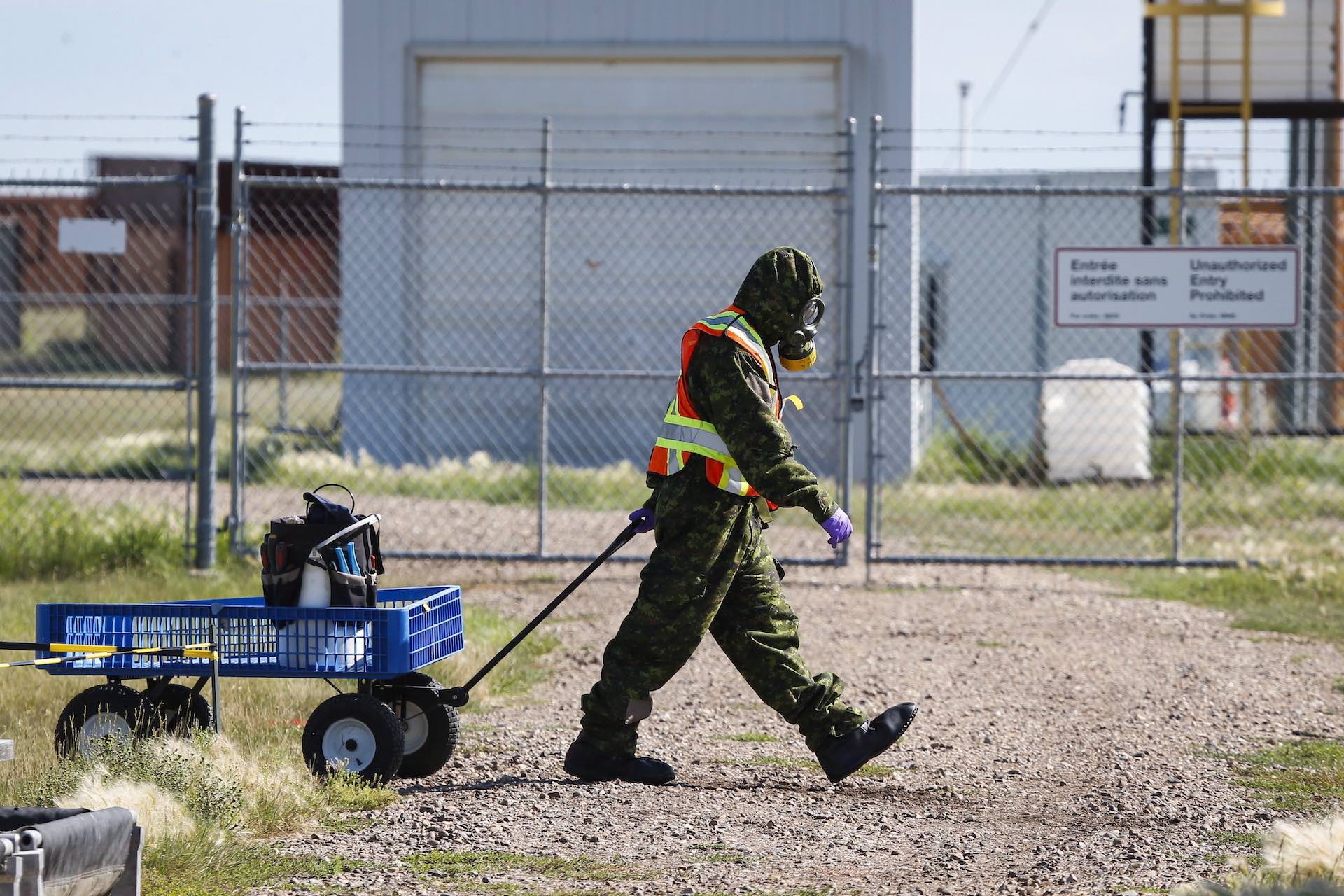
A soldier walks through the "hot zone" during a NATO biological and chemical weapons exercise at CFB Suffield in July 2016. Photo: The Canadian Press/Jeff McIntosh
OTTAWA — As Canada’s key research site for chemical and biological weapons defences continued rotting out, the Department of National Defence curtailed work there in summer 2023 so it could get a handle on safety at the decades-old facility.
As of September, 13 months later, the lab complex at Canadian Forces Base Suffield was still not back to full speed, says a newly released report from outside reviewers who check in on Canada’s chemical and biological weapons work each year. According to Defence Department spokesperson Cheryl Forrest, the labs that do the most dangerous work there are now fully operational again.
Talking Points
- The mounting decrepitude of the chemical and biological defence research labs at CFB Suffield has been chronicled for years and reached a critical state in 2023, when the National Defence official in charge said important work had to be suspended or restricted for at least four months
- The site’s most delicate labs are up and running again, says the department, and a much-delayed plan for a new building should move into the design phase early in 2025
The Suffield Research Centre (or SRC) hosts some of the most delicate research done for the military. It has high-security laboratories and a small factory for synthesizing things like nerve gas for research and training. Troops from Canada’s NATO allies gather at the base every year to practise how to respond to attacks, using real poisons, and work there has produced innovations like anti-chemical lotions that have become common military kit around the world.
Citing the senior defence official who decided on the shutdown, the report says powering down work at the site “challenges Canada’s chemical defence program, including international commitments in this realm,” but had to be done “to prevent further erosion of safety with potentially catastrophic consequence.”
That was the right call, wrote the reviewers, a three-person team of professors specializing in chemistry, microbiology and neuroscience whose assignment is to make sure Canada’s work on these dangerous weapons is defensive in nature and carried out safely. They praised Jaspinder Komal, the assistant deputy minister in charge of Defence Research and Development Canada and a veterinarian trained in microbiology, for recognizing “the seriousness of unmediated health and safety risks that we and others have repeatedly identified.”
Related Articles


The members of the Biological and Chemical Defence Review Committee visited the southeastern Alberta site in May 2023 and found “a significant decrease in SRC employees’ confidence in their ability to safely accomplish their duties given the current state of the facilities in which they are required to work.”
That confidence had been weak for some time. The main building at the centre is nearly 70 years old and its perilous state has been documented over years of the review committee’s reports.
Scheduled maintenance shutdowns have gotten longer and longer, morale is in the toilet, staff attrition has been worrying and even procurement of necessities had a 600-order backlog last year.
The inventories of potentially dangerous pathogens and toxins don’t fully match the material in storage. For some of that stuff, it’s not clear any current researcher “owns” it.
The inspectors reviewed a list of 11 hazardous incidents since the previous year. Nearly all were minor; the reviewers praised the safety-mindedness of staff who reported even episodes like a worker who got a cut while cleaning a fan.
But then there was the time an outsider (who’d been brought in because there weren’t enough SRC staff for a training exercise) left a dummy bomb with “high-toxicity” cyanide salt in a locker and nobody reported it until three months later. That was “a major concern and a timely reminder that a strong ‘safety culture’ cannot be taken for granted,” the report said.
The government is working on a replacement lab building but it isn’t expected to be ready before the 2030s. The review committee has warned that a “catastrophic failure” at CFB Suffield is likely before then.
In the latest report, the reviewers laid out staff worries about engineering controls—physical protections like barriers and ventilation—and a lack of real-time monitoring of potential leaks.
The scientists working with potentially lethal materials said the protections, inadequate even on their own, lacked backups. And sometimes the power would die during “critical laboratory procedures,” causing the safety measures to fail.
An occupational hygienist, a specialist in handling dangerous materials in workplaces, had rated the dangers to workers at the site as low to medium the previous year, the report said. Take away the engineering protections, though, the risks would shoot up to “very high.”
By the end of July, Komal decided to “suspend or restrict” some of the centre’s chemical defence research and training, for at least four months, while officials came up with a plan for making the place safer.
Devising and carrying out that plan took much longer than four months, though. As of this past September, “a conditions-based resumption plan [was] being executed for implementation,” according to comments from the Defence Department in an appendix to the report.
The department “took the time required to develop this plan according to its ongoing rigorous and comprehensive safety culture and environment for its staff,” Forrest, the Defence Department spokesperson, wrote in an email.
Some chemical-lab equipment has been connected to an uninterrupted electrical supply to answer the concern about power failures, she wrote. The SRC has also “implemented significant adjustments to administrative controls, including standard operating procedures and techniques,” meaning that staff work differently now.
The tender for a designer and builder for the replacement facility at Suffield should be done by the end of the fiscal year—which is in March, for the federal government—and design work should start that month, Forrest wrote.



Loading...
Thanks for sharing!
You have shared 5 articles this month and reached the maximum amount of shares available.
CloseThis account has reached its share limit.
If you would like to purchase a sharing license please contact The Logic support at [email protected].
CloseGift the full article!
You have gifted 0 article(s) this month and have 5 remaining.
Recipients will be able to read the full text of the article after submitting their email address. They will not have access to other articles or subscriber benefits.
Photo: The Canadian Press/Jeff McIntosh
Most Popular This Week




In-depth, agenda-setting reporting
Great journalism delivered straight to your inbox.
News
Ottawa is softening its ban on stablecoin yield
Briefing
Rio Tinto gets nearly $165M in additional federal funds for Quebec aluminum
U.S. to lift tariffs on some Canadian products crucial to Maine: Collins
Carney warns of tech dependence after Starlink disruptions in Ukraine
Best business newsletter in Canada
Get up to speed in minutes with insights and analysis on the most important stories of the day, every weekday.
Exclusive events
See the bigger picture with reporters and industry experts in subscriber-exclusive events.
Membership in The Logic Council
Membership provides access to our popular Slack channel, participation in subscriber surveys and invitations to exclusive events with our journalists and special guests.






