The Canadian public is deeply skeptical of innovative technologies like gene-based medicines and artificial intelligence, a new survey suggests, with trust in AI in particular registering lower than in other countries.
Skip to content


News
Distrust of AI significantly higher in Canada than other countries, survey finds
Edelman Trust Barometer suggests serious qualms about certain innovations and government’s ability to regulate them
AMECA, an AI robot, on display at the All In artificial intelligence conference in Montreal in September 2023. Photo: The Canadian Press/Ryan Remiorz
The Canadian public is deeply skeptical of innovative technologies like gene-based medicines and artificial intelligence, a new survey suggests, with trust in AI in particular registering lower than in other countries.
Talking Points
- The Edelman Trust Barometer, an annual survey of public confidence in institutions and professionals, found low levels of trust in several emerging technologies
- Chief among those technologies was AI, where Canadian respondents had significantly lower levels of trust than the global average
In a survey of more than 32,000 respondents across 28 countries, the 2024 Edelman Trust Barometer shows strikingly low levels of confidence among Canadians in critical institutions and the professional class that populate them. Respondents indicated distrust toward the media, government leaders, CEOs and emerging technologies in particular.
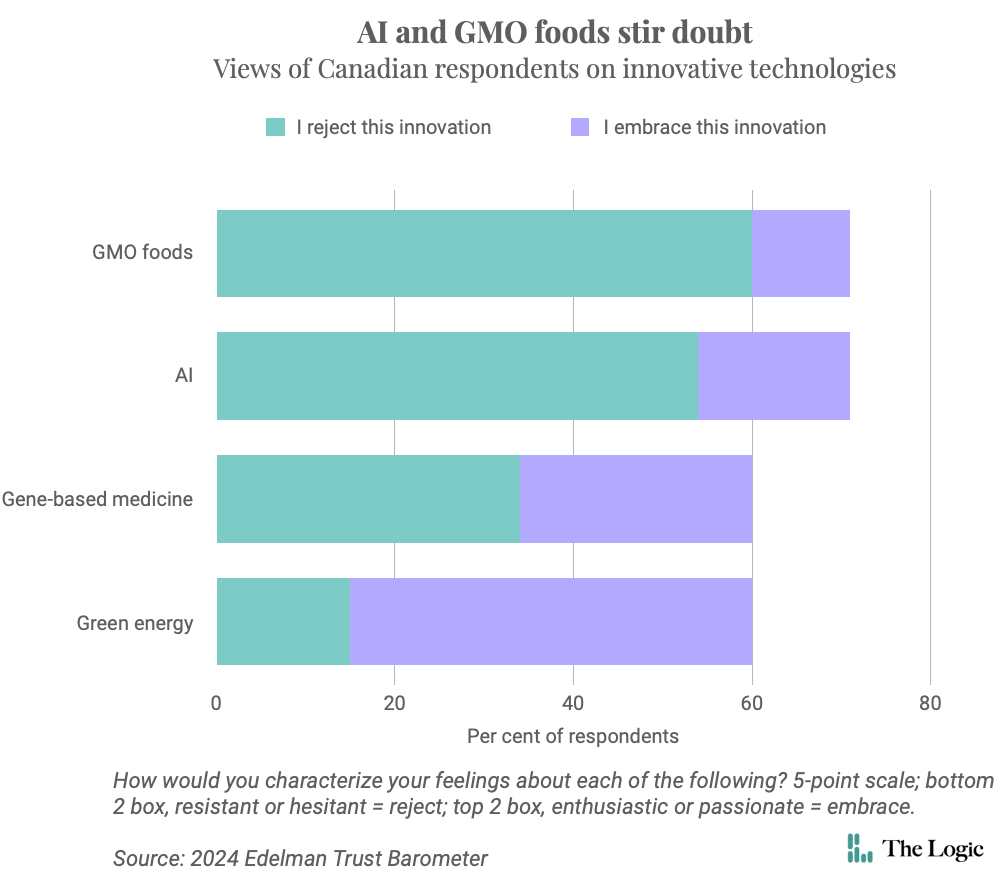
Asked about AI specifically, just 31 per cent of Canadian survey respondents said they trusted the technology; total trust in AI was 19 percentage points lower in this country than the global average. Trust in genetically modified foods was the lowest, at 28 per cent of respondents in Canada. Gene-based medicines like mRNA vaccines and gene therapy was neutral, at 50 per cent trust.
Asked whether they “reject” or “embrace” a given technology, 54 per cent of Canadian respondents rejected AI while just 17 per cent embraced it. Green energy had the highest level of trust, with 45 per cent embracing and just 15 rejecting it.
The Edelman findings mirror earlier reports that point to a hesitancy around AI adoption, as some of the most prominent voices in the sector warn about the potentially catastrophic risks of rapid AI advancement. Among them are renowned AI researchers like Yoshua Bengio and Geoffrey Hinton, who are based in Canada, and whose views on the issue have been closely followed by the domestic media. Fully 80 per cent of respondents to The Logic’s own subscriber survey in December said artificial intelligence has the potential to harm society.
Vass Bednar, the executive director of McMaster University’s public policy program, said AI technology is often associated with job loss or the replacement of human labour. Perhaps adding to those anxieties, she said, is that AI technology such as large language models can seem in their current form more repetitive or even faulty than genuinely revolutionary.
Related Articles



“When your boss is an algorithm, when we’re using algorithms to treat people like robots, and [to] push and push and push them, that’s not a system that seems very trustworthy,” she said.
As for Canada’s major institutions, trust in both the government’s and the private sector’s ability to integrate new innovations was the highest, at 49 per cent. Media was the lowest at 46 per cent. Yet 63 per cent of respondents agreed that “government regulators lack adequate understanding of emerging technologies to regulate them effectively.”
In a comparison of professional classes in the survey, CEOs had the lowest level of trust, with 39 per cent. (Asked if they trust their own CEOs, respondents were much more positive, with a majority 64 per cent having trust.) Government leaders were the next lowest with 43 per cent trust, followed by journalists with 58 per cent. Scientists were the highest at 77 per cent.
Bednar, who studies the impacts of technology on public policy, said she has seen waning trust in the private sector in recent years—a trend borne out in last year’s Edelman survey, which showed public trust in CEOs had dropped more than any other profession. This year’s barometer found a marginal rise in trust in CEOs, while faith in business gained five points, to 57 per cent. (Government lost the most among institutions—two points—settling at 49 per cent.)
“I’ve observed a loss of trust in business from the citizenry [due to] all the ways we’re dinged: price gouging, shrinkflation concerns, concentration,” Bednar said. “So I was surprised by that.”
Asked what businesses could do to restore trust, respondents said companies must hear out public concern, accept questions, make sure innovations remain affordable and fully test new technologies before releasing them in the market.
The report also found an appetite among respondents for institutions to clearly explain how technologies work and how they’ll be implemented, and for scientists to explain the research behind emerging technologies like AI.



Loading...
Thanks for sharing!
You have shared 5 articles this month and reached the maximum amount of shares available.
CloseThis account has reached its share limit.
If you would like to purchase a sharing license please contact The Logic support at [email protected].
CloseGift the full article!
You have gifted 0 article(s) this month and have 5 remaining.
Recipients will be able to read the full text of the article after submitting their email address. They will not have access to other articles or subscriber benefits.
Photo: The Canadian Press/Ryan Remiorz
Most Popular This Week




In-depth, agenda-setting reporting
Great journalism delivered straight to your inbox.
Commentary
Carmichael: Canadian ignorance about India is a strategic weakness
Briefing
Aritzia shares pop after earnings rise 204%
First Nation in Alberta goes to court over fast-tracked oil pipeline
Chinese EV maker Geely Auto Group to launch in Canadian market in 2027
Best business newsletter in Canada
Get up to speed in minutes with insights and analysis on the most important stories of the day, every weekday.
Exclusive events
See the bigger picture with reporters and industry experts in subscriber-exclusive events.
Membership in The Logic Council
Membership provides access to our popular Slack channel, participation in subscriber surveys and invitations to exclusive events with our journalists and special guests.





