OTTAWA — Chrystia Freeland resigned as deputy prime minister and finance minister Monday morning, rocking Justin Trudeau’s Liberal government on the day she was scheduled to deliver a long-awaited fall economic update.
Skip to content

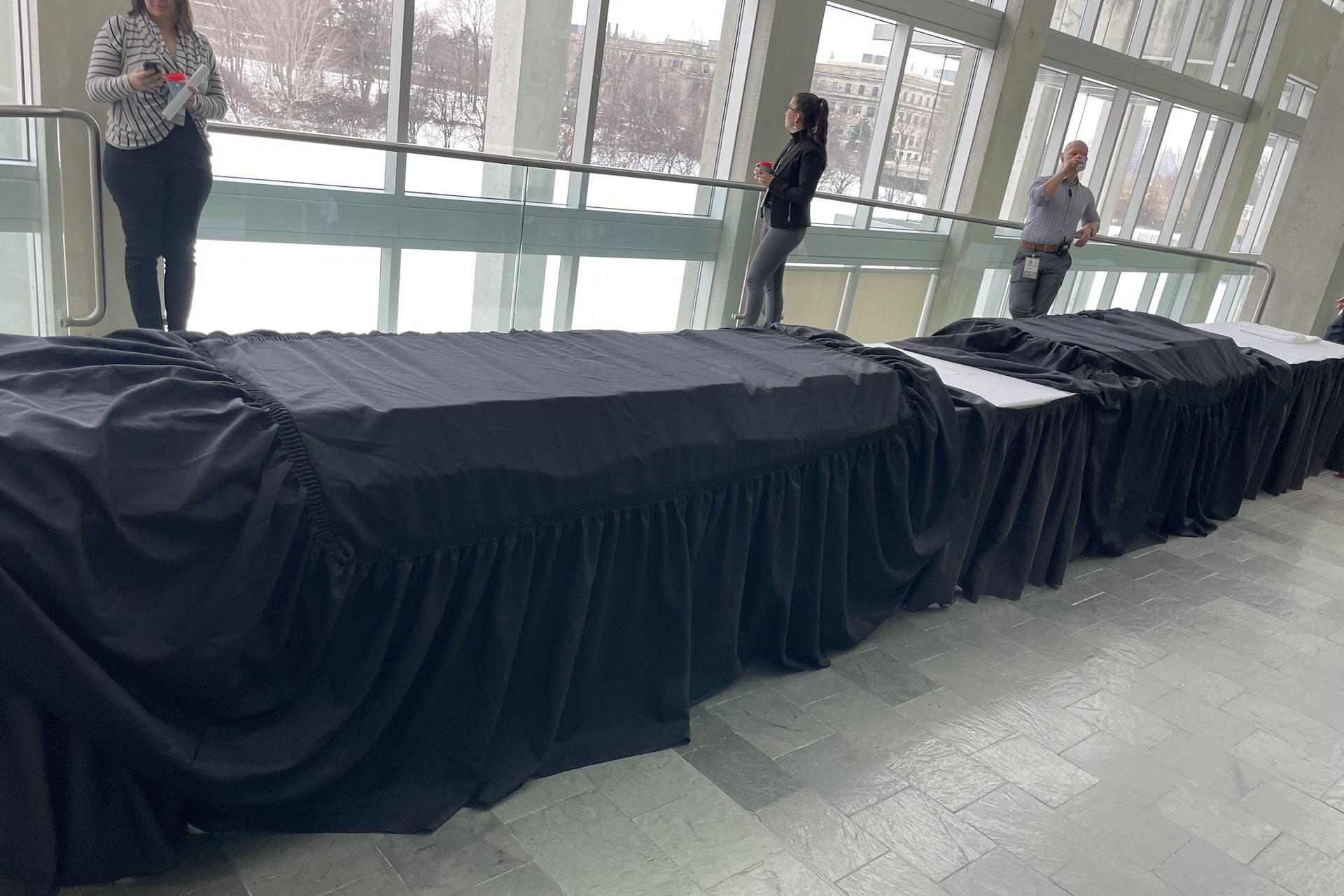 Printed copies of the fall economic statement concealed beneath black cloth at John G. Diefenbaker Building in Ottawa, site of the embargoed reading and briefing for media. Photo: The Logic

News
Freeland resigns from cabinet hours before fall economic statement
Trudeau and ex-finance minister ‘at odds about the best path forward for Canada’
Deputy Prime Minister and Minister of Finance Chrystia Freeland in Ottawa in Nov. 2024. Photo: The Canadian Press/Sean Kilpatrick
OTTAWA — Chrystia Freeland resigned as deputy prime minister and finance minister Monday morning, rocking Justin Trudeau’s Liberal government on the day she was scheduled to deliver a long-awaited fall economic update.
Her abrupt departure sparked calls for Trudeau’s resignation from opposition parties who say infighting in the governing Liberal Party is distracting from Canada’s ability to fight the threat of trade tariffs from incoming U.S. president Donald Trump.
Public Safety Minister and longtime Trudeau ally Dominic LeBlanc was sworn in as finance minister shortly before 5 p.m., filling one of the roles Freeland left vacant. He remains minister of intergovernmental affairs and of public safety as well.
Previously, he and Freeland shared cabinet responsibilities in dealing with Trump. They have appeared together after recent meetings with premiers on border issues, for instance.
“I guess I’ll start early in the morning and work late at night, and probably won’t take a lot of weekends off. It’s an exciting time to have those responsibilities,” LeBlanc said after being sworn in.
Related Articles


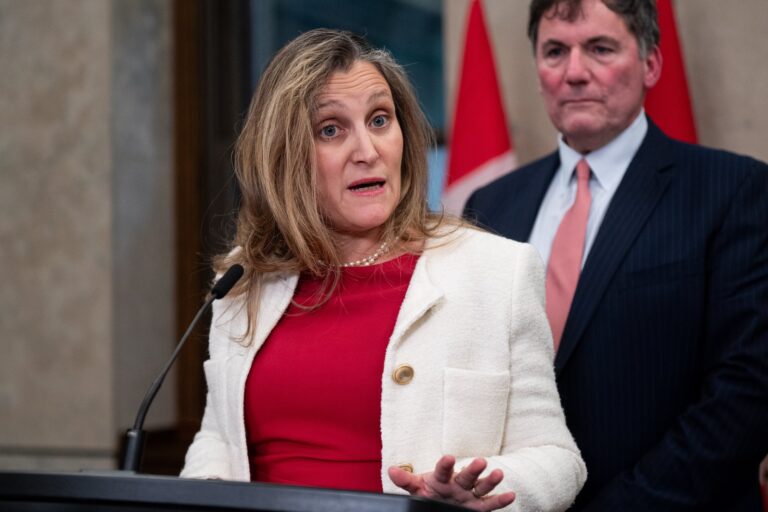
Freeland is the first of Trudeau’s ministers to break ranks and openly criticize him, after defending him for months against calls from members of his caucus and Liberal party faithful for his resignation.
In a letter addressed to Trudeau and posted to X, Freeland said the prime minister had offered her a different position in the cabinet on Friday, which “made clear that I no longer credibly enjoy [your] confidence and possess the authority that comes with it.”
The two have been “at odds about the best path forward for Canada,” she wrote.
The letter concluded saying that Freeland intends to stay on as an MP and to run in the next election.
The fall economic statement, which Freeland was scheduled to deliver in the House of Commons at about 4 p.m. EST, was instead tabled by Liberal House leader Karina Gould, giving MPs and the public a look at the federal books.
It included significant measures to boost business investment, including extending a tax break and a venture capital program that were due to expire, reforming and broadening the Scientific Research and Experimental Development program (SR&ED) and efforts to get Canadian pension funds to invest more in Canadian startups and scale-ups.
Freeland’s resignation came just days after The Globe and Mail reported the prime minister had renewed efforts to recruit former Bank of Canada governor Mark Carney to join his government. Her move came as a shock to the rest of Trudeau’s cabinet, who spent nearly six hours huddled in a closed-door meeting in his office, and threw plans for the long-awaited fall economic statement into disarray.
The planned lockup for journalists to report on the statement was delayed for hours. In a building away from Parliament Hill, members of the media waited for news about whether the statement would be delivered, even as printed copies of it sat on nearby tables, concealed by black tablecloths. The lockup eventually began shortly before 2 p.m.
In her letter, Freeland wrote that the incoming Trump administration is a serious threat and Canada needs to keep its fiscal powder dry. “That means eschewing costly political gimmicks, which we can ill afford and which make Canadians doubt that we recognize the gravity of the moment,” she wrote.
She didn’t spell out what she meant, but in recent weeks the government has passed a federal sales-tax holiday into law (exasperating some small businesses) and attempted to send $250 cheques to Canadians who made up to $150,000 in earned income last year. It has not, however, found a legislative partner to help push the cheque offering through Parliament.
Freeland defended those moves publicly as efforts to fight a “vibecession”—a term for the popular sense that the economy is weak despite a falling inflation rate and other positive indicators, which Freeland said could be a self-fulfilling prophecy.
Asked about Freeland’s written criticisms, LeBlanc said only that Freeland is a friend and he’s proud of her record as a minister, including at Finance.
Both Trudeau and Freeland skipped Monday afternoon’s question period, where opposition members peppered the Liberals with questions about who will take charge of the government’s finances.
In comments to reporters Monday, Conservative Leader Pierre Poilievre said Canada can’t afford the disorder Freeland’s resignation exposed in the government’s ranks. He renewed his calls for a federal election, ideally before Trump returns to the White House in January.
“We cannot accept this kind of chaos, division, weakness, while we’re staring down the barrel of a 25 per cent tariff from our biggest trading partner and closest ally,” Poilievre said.
He said Trump was elected on a strong mandate, and “can spot weakness from a mile away.”
Polls suggest Poilievre is expected to win the next election, but the timing of the vote largely depends on the New Democrats, who hold the balance of power in the House of Commons and who have been voting to prop up the Liberal minority government. NDP Leader Jagmeet Singh called on Trudeau to resign Monday, but would not commit to triggering an election.
“Justin Trudeau has to go, he has to resign,” Singh said. “All options are on the table.”
Freeland’s letter suggested she believes the Liberals’ prospects in the next election are dim but that they have an important duty as they move toward their exit from power: uniting the provinces and Canadians as a whole to face Trump’s demands.
Canadians “know when we are working for them, and they equally know when we are focused on ourselves,” she wrote. “Inevitably, our time in government will come to an end. But how we deal with the threat our country currently faces will define us for a generation.”
Provincial premiers, who were meeting in Toronto Monday when news broke of Freeland’s resignation, projected a united front.
“The federal government needs to do better engaging premiers as it deals with the threat [of] tariffs, with regular meetings with the prime minister—and whoever is on his team,” Ontario Premier Doug Ford said.
Freeland announced her departure shortly after Housing Minister Sean Fraser—a young minister widely seen as one of the Liberals’ most effective—said he would quit federal politics at the next election.
– With files from Aimée Look in Toronto



Loading...
Thanks for sharing!
You have shared 5 articles this month and reached the maximum amount of shares available.
CloseThis account has reached its share limit.
If you would like to purchase a sharing license please contact The Logic support at [email protected].
CloseGift the full article!
You have gifted 0 article(s) this month and have 5 remaining.
Recipients will be able to read the full text of the article after submitting their email address. They will not have access to other articles or subscriber benefits.
Photo: The Canadian Press/Sean Kilpatrick
Printed copies of the fall economic statement concealed beneath black cloth at John G. Diefenbaker Building in Ottawa, site of the embargoed reading and briefing for media.
Most Popular This Week



In-depth, agenda-setting reporting
Great journalism delivered straight to your inbox.
The Big Read
Beacon is building an AI empire by fixing Main Street’s software
Briefing
Inovia raises US$200M for new VC fund as it eyes AI’s impact
43% of eligible Albertans voted ahead of Monday’s referendum
AI chip company Tenstorrent raises US$1.5B, valuing it at US$6.2B
Best business newsletter in Canada
Get up to speed in minutes with insights and analysis on the most important stories of the day, every weekday.
Exclusive events
See the bigger picture with reporters and industry experts in subscriber-exclusive events.
Membership in The Logic Council
Membership provides access to our popular Slack channel, participation in subscriber surveys and invitations to exclusive events with our journalists and special guests.