Listen Now
0:00
CALGARY — The day Prime Minister Mark Carney and Premier Danielle Smith unveiled the route of Alberta’s proposed West Coast oil pipeline, the agreement that made the entire project possible—a memorandum of understanding with the country’s largest oilsands producers—did not yet officially exist. The breakthrough was so fresh that, according to two people familiar with the negotiations, on the day it was announced there wasn’t even a final draft of the deal, let alone one ready to be formally signed.
“We had, by that point, agreed to agree. We just still had to do the paperwork attached to it,” recalled one government source.
Talking Points
- For the first time, Ottawa, Alberta and Canada’s largest oilsands companies have signed onto a plan linking a new West Coast oil pipeline to a scaled-back version of the Pathways carbon capture project after months of intense negotiations
- The new trilateral MOU lays out the broad strokes of a financing arrangement for the multibillion-dollar Pathways project, but not the final bill. A definitive cost-sharing agreement is still under negotiation and is targeted to be signed by Nov. 15.
- Canada’s oil majors and their investors now face a decision about whether to greenlight a new oilsands production boom after prioritizing shareholder returns for the last decade
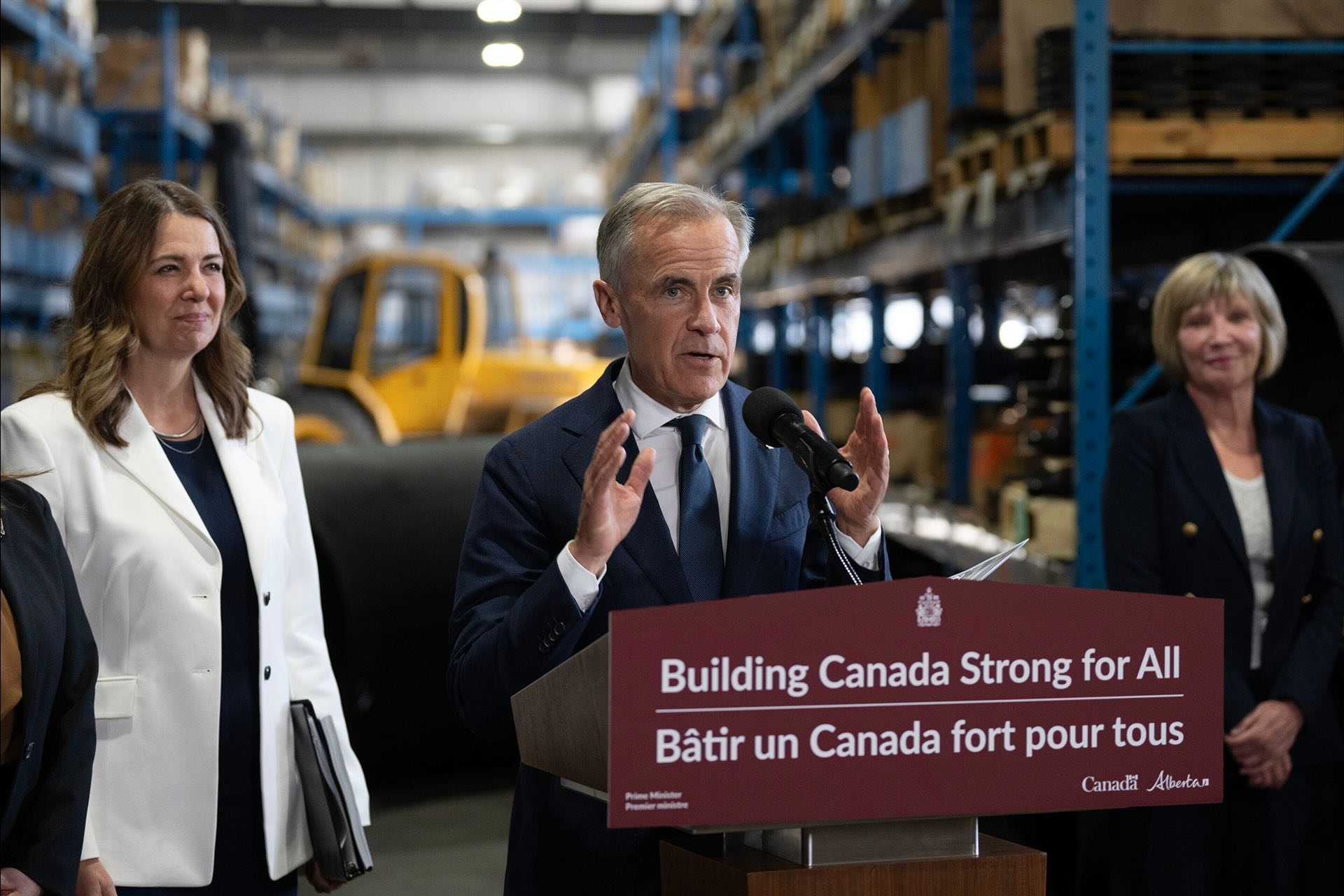
Nevertheless, on July 2 Carney and Smith met the cameras at a piping parts warehouse in a southeast Calgary industrial park to announce the landmark agreement.
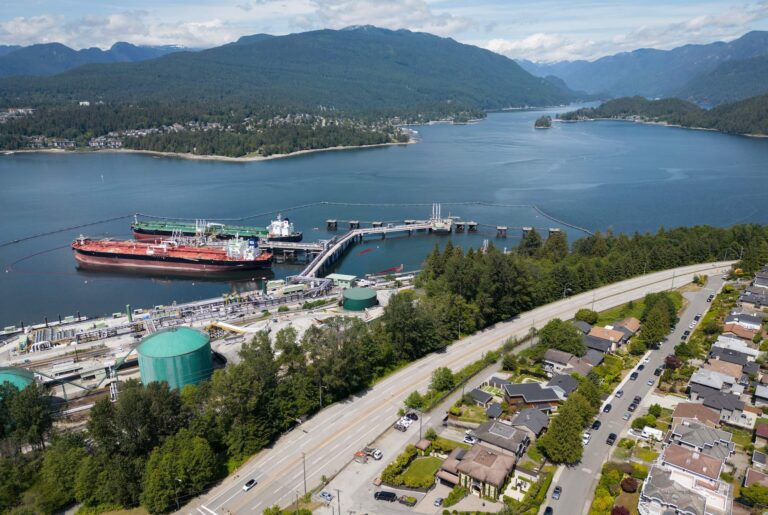
They revealed Alberta had settled on a southbound route through British Columbia and found a private-sector partner for its proposed one-million-barrel-per-day heavy oil pipeline.
The bigger development, however, was that Ottawa and Alberta had reached an agreement in principle with the Oil Sands Alliance (OSA), made up of Canadian Natural Resources Ltd., Cenovus Energy, ConocoPhillips Canada, Imperial Oil and Suncor Energy, to move forward on the long-delayed Pathways carbon capture project.
The federal government has made the energy industry’s commitment to Pathways a prerequisite for approving the West Coast oil pipeline. Projected to be one of the world’s largest carbon capture and storage projects, at a cost of tens of billions of dollars, Pathways will capture carbon dioxide emissions from the oilsands and move them hundreds of kilometres via pipeline to an underground storage hub in northeastern Alberta. The Pathways deal was the culmination of eight months of negotiations that, in the two frantic weeks leading up to the announcement, had accelerated into daily meetings and phone calls between industry and government negotiators, according to three people familiar with the talks. (The Logic agreed not to name some sources in this story so they could speak freely about private negotiations.)
Related Articles
The decision to announce the Pathways deal alongside the oil pipeline route at the July 2 press conference came so late that some Oil Sands Alliance CEOs weren’t in the country and couldn’t attend. The alliance’s president Kendall Dilling stood in for them, with its chief negotiators, Cenovus executive Jeff Lawson and former Suncor CFO Kris Smith, looking on from the sidelines of the press conference. The press conference itself, originally scheduled for June 30, was postponed until the morning of July 2 as last-minute negotiations continued behind the scenes. Then, hours before it was set to begin, it was delayed again after what Carney called “biblical weather” in Ottawa disrupted his flight west the previous day.
“Our oilsands partners will have the incentives they need to launch a super cycle of production growth in Canada’s most valuable deposit of natural resources,” Smith said as the press conference finally got underway at nearly 7 p.m. MST. “We’ve certainly come a long way from talk of phasing out Alberta’s oil and gas, haven’t we?”
“It’s an important milestone because up until the deal, it was only governments agreeing. Now industry is at the table.”
The last-minute scramble underscores the urgency with which Ottawa has moved to assemble a political and commercial “grand bargain” intended to unleash oil and gas development in Canada without completely abandoning Canada’s climate goals. Confirming industry’s commitment to the Pathways project was the final piece of the puzzle.
“It’s an important milestone because up until [the deal], it was only governments agreeing,” said energy economist Peter Tertzakian, the day after the signed agreement was finally released. “Now industry—which has to be an active participant and bring capital and expertise to grow fairly aggressively—is at the table.”
With the federal and Alberta governments and the Oil Sands Alliance committed, attention is already turning to the enormous practical and financial challenges the bargain poses. How much money will it take? Who will shoulder the costs? And will Canada’s energy industry and its investors be willing to back another oilsands production boom?
The capital cost of the new West Coast oil pipeline is an estimated $35 billion to $44 billion, but it could take another $100 billion to develop the upstream oil production required to fill the pipeline, Tertzakian said, citing figures from a joint analysis by Studio.Energy and ATB Economics. Government estimates suggest the total upstream investment figure rises to roughly $200 billion when factoring in other pipeline projects in development, including South Bow’s Prairie Connector and expansions of the existing Trans Mountain pipeline and Enbridge’s Mainline.

Roughly another $20 billion or more could be required to build the Pathways project: the industry’s long-awaited answer for containing its substantial CO2 emissions, via a major carbon capture network including a costly 650-kilometre pipeline to ferry emissions to a deep underground storage hub in northeastern Alberta.
As recently as June, Cenovus CEO Jon McKenzie had called a brand-new West Coast oil pipeline tied to Pathways “unfinanceable” by the private sector. It appears, however, that industry has come around since then: the memorandum commits the oilsands firms to building a significantly scaled-back version of Pathways, with help from a suite of tax incentives and regulatory concessions.
The federal government is counting on the project to put a big dent in oilsands emissions, capturing and storing six million tonnes of carbon dioxide per year by 2035, and up to 16 million tonnes per year by 2045—though far less than the 22 million tonnes per year initially promised when the project was first unveiled. It represents either a pragmatic acknowledgement of the high cost of carbon capture or a disappointing retreat in environmental policy, depending on whom you ask.
Even a scaled-back project will be costly, experts warn, in part due to the fact that oilsands facilities don’t have the geology nearby for CO2 sequestration and so emissions must be transported by pipeline to a storage hub hundreds of kilometres away.
“It is going to consume a lot of public dollars,” said Sanjay Bishnoi, CEO of carbon tech firm Entropy, who nonetheless said he believes the new memorandum is “very positive” for both the energy industry and for carbon markets.
There are much cheaper opportunities to reduce emissions across the oil and gas sector, Bishnoi argued, warning that a project like Pathways is going after “the most expensive tonnes” of emissions in the industry.
So why are governments so focused on the emissions of five companies? They aren’t just the companies that emit the most CO2, Bishnoi said, they are the companies that control the vast majority of the country’s production—the ones who must be at the table if governments hope to increase energy exports.
“The most positive thing is that there’s agreement that demonstrates that the industry is willing to take on a project to reduce their emissions—as long as they’re given a path to grow,” he said.
“It’s the best outcome for everybody.”
“It is going to consume a lot of public dollars.”
The country’s biggest oil producers are poised to report one of their strongest quarters in years, with higher oil prices triggered by the Iran war driving massive returns. “Expect big numbers, very big numbers,” RBC Capital Markets analyst Greg Pardy wrote in a recent note, estimating Canadian Natural Resources, Cenovus, Imperial and Suncor alone will generate a combined $13.2 billion in free-funds flow in the second quarter—even after paying a combined $11.3 billion in Crown royalties and taxes.
However, oilsands companies will also be bracing for questions from analysts and investors about the memorandum and what it will mean for industry—including whether companies will deviate from more than a decade of prioritizing shareholder returns over capital investment.
Kicking off second-quarter earnings in the oilpatch Wednesday, McKenzie struck a markedly different tone from earlier this year—calling the new trilateral MOU “meaningful progress” towards improving Canada’s investment climate.
“What’s been discussed and agreed on unlocks this business in terms of its investability,” he said.
The comments mark a sharp shift in sentiment for an industry that has spent more than a decade pulling back from spending on major expansion projects.
Upstream investment has been flat or declining in the Canadian oilpatch since 2014—with no new oilsands megaprojects since the startup of Suncor’s Fort Hills mine in 2018. (International Petroleum Corp.’s new Blackrod project—which began producing barrels at the end of May—is a rare new greenfield development in the oilsands, but it’s relatively small.)
Alberta’s proposed West Coast oil pipeline, together with other projects under development, would add more than two million barrels a day of new export capacity. Filling it would require a production boom on a scale not seen in almost two decades—with profound spinoff benefits and implications for Canada’s economy. Despite some bullish signals, there is not yet proof that Canada’s oil majors, and their investors, have an appetite to chase growth.
Some institutional investors may be happy for the oilpatch to spend more capital on growth—so long as they do not stray too far from the shareholder return models that have dominated in recent years.
“There’s pipe coming and the market’s sniffing that out,” said Cole Smead, head of Phoenix-based investment firm Smead Capital Management, which recently set up a Canadian subsidiary.
“We’re bullish,” Smead said. “I give a lot of credit to the Carney government.
“There’s a dialogue. That dialogue was not present not that long ago. It shows you how the temperature in the room is totally different. There’s pragmatism. There’s capitalism.”
The Major Projects Office is now poring through Alberta’s plans and consulting with potentially affected Indigenous communities—consultations that will inform a decision the federal cabinet will make by Oct. 1 about whether to declare it a project in the national interest. Such a designation would mean speedier federal reviews and permitting for the megaproject.
Despite the memorandum, oilsands producers say there’s still more work to do before they’re prepared to officially greenlight spending on either Pathways or the new oil projects necessary to fill a West Coast pipeline. And negotiations are continuing between industry and government over the fine print of a binding deal expected by Nov. 15 that will clarify how Pathways will be paid for—as well as new fiscal measures that could include temporarily lower royalty rates or accelerated capital cost writeoffs aimed at driving investment.
Asked why the public should accept the concessions, Dilling said the measures are designed to solve a “timing” problem that has made it harder for major oilsands projects to compete for capital.
“It can be 10 years from the time you invest until you’ve recovered your costs,” Dilling said. “It’s a question of deferring a bit of the benefit.
“If you don’t do that, then the investment never happens,” he said. “So there’s nothing to harvest.”
Tax breaks for the oilpatch may not be popular with some Canadians who are uncomfortable with the federal government’s change of approach on climate and energy issues, and who fear Canada is backsliding on its climate commitments. Royalty breaks and tax measures aren’t unprecedented, however, as similar investment incentives were deployed to spur the last major buildout of the oilsands in the late 1990s and early 2000s, and similar measures have been used to incent some mining and manufacturing projects in other parts of Canada.
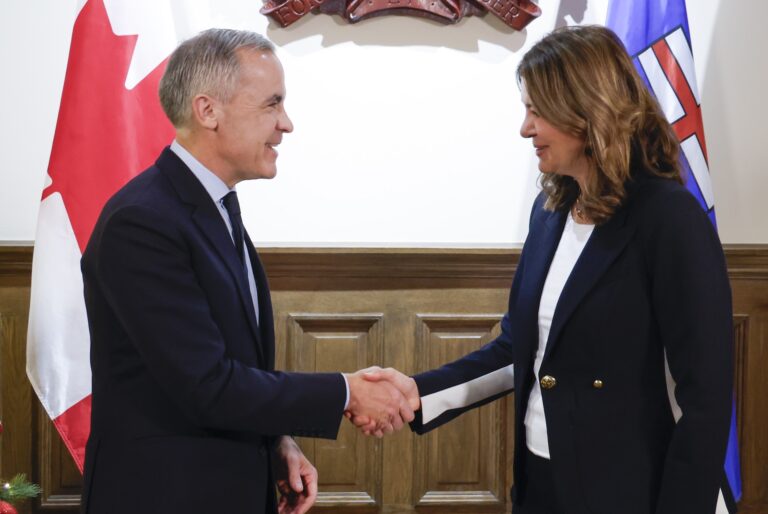
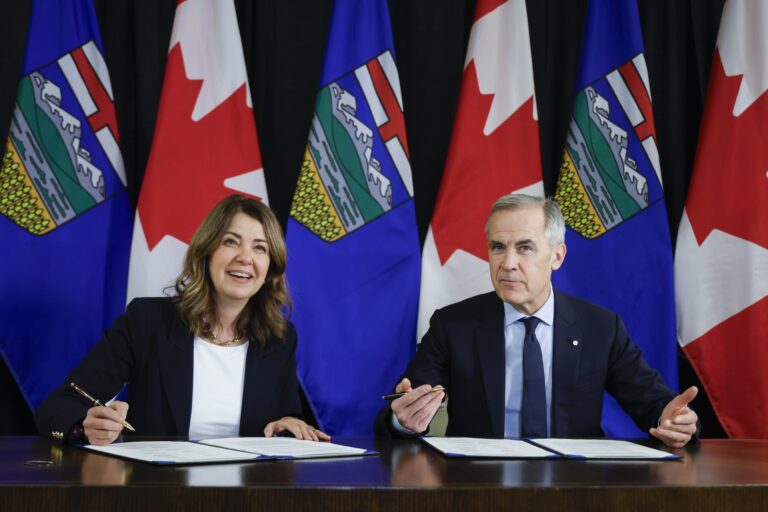
Even with some details still being finalized, the memorandum completes the “last leg” of the three-legged stool Carney and Smith began assembling eight months ago with the first Alberta-Ottawa energy accord last November, said S&P Global chief analyst Kevin Birn.
“These are significant steps and the speed at which governments have [reached] agreements with each other—and now with industry—is impressive, and it [speaks] to the momentum Canada is trying to seize,” Birn said.
It’s also a departure from the “schizophrenic” signals that federal and provincial governments were sending to capital markets over the last decade, he added.
“The message they’re [getting] is Canada actually wants to compete. They want to attract this capital. That’s a different message.”













