U.S. President Donald Trump’s tariffs will hit the Canadian economy hard. From the auto industry to oil to critical minerals to manufacturing, the U.S. and Canada rely on each other as trading partners. Tariffs will put a huge strain on that relationship, economists warn.
Skip to content



News
These numbers show how Trump’s tariffs will hit Canada
The auto parts industry is a ‘poster child’ for how tariffs will affect supply chains across North America, economists warn
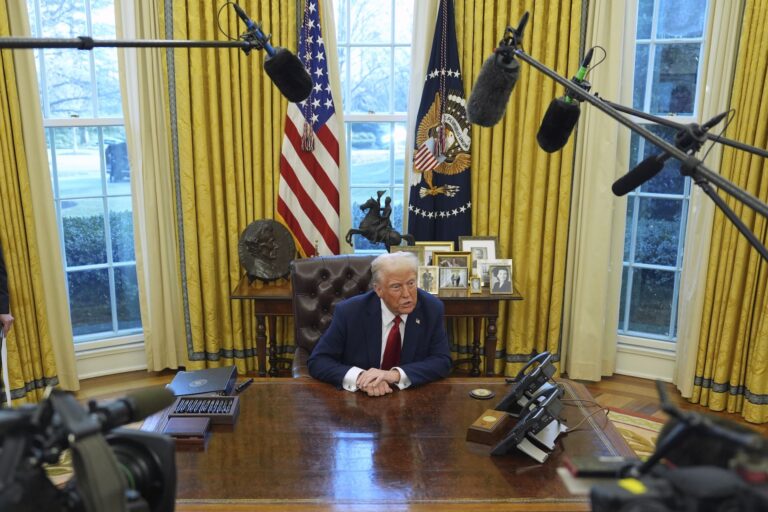
The tariffs imposed by U.S. President Donald Trump are ostensibly aimed at tackling illegal migration and drug smuggling at the U.S.-Canada border. Photo: AP Photo/Alex Brandon
U.S. President Donald Trump’s tariffs will hit the Canadian economy hard. From the auto industry to oil to critical minerals to manufacturing, the U.S. and Canada rely on each other as trading partners. Tariffs will put a huge strain on that relationship, economists warn.
Talking Points
- Canada exports US$377 billion of goods to the U.S. each year. Each industry will fare differently when faced with tariffs imposed by U.S. President Donald Trump.
- From aerospace to critical minerals, industries across Canada and the U.S. will both face major challenges, data shows
Which sectors will face the worst effects? And how much damage might the tariffs cause? Here’s what the numbers reveal.
Canada’s trade with the U.S.
Canada exported US$377.2 billion of goods to the U.S., between December 2023 and November 2024, the most recent period for which data is available. Tariffs imposed by the U.S.—10 per cent on energy, and 25 per cent across the board—will significantly impact Canadian exports.
Cars and manufacturing
Auto parts typically shuttle across the Canadian, U.S. and Mexican border up to eight times as the vehicle is constructed, according to industry representatives in a report from the U.S. Congressional Research Service. The movement of parts across borders make it a “poster child” for how tariffs will hit supply chains across North America, according to TD economists Marc Ercolao and Andrew Foran.
Related Articles

Final auto assemblies are just a small part of what the tariffs will affect. Canada supplies around eight per cent of finished cars to the U.S, and Mexico around 20 per cent, with U.S. domestic production making up around 50 per cent.
The auto sector in North America would be crippled by tariffs, sending prices soaring. TD’s research estimates that average U.S. retail prices for cars could increase US$3,000. Retaliatory tariffs from both Mexico and Canada could hike prices even further across North America.
Tariffs could also scupper North America’s hopes of competing with the auto sectors in Asia and Europe, RBC’s chief economist Frances Donald and assistant chief economist Nathan Janzen wrote in a report.
Auto manufacturing in Canada is particularly vulnerable to tariffs because it has the highest trade to GDP ratio. Simply put, this is the sum of imports and exports in the industry, divided by its market value. The higher the percentage, the bigger the impact tariffs could have on the sector.
Motor vehicle manufacturing in Canada has a 1,888 per cent trade to GDP ratio, meaning there is a large amount of trade in relation to its production base, according to RBC. Motor vehicle parts manufacturing is next, with a 532 per cent ratio. More than 60 per cent of Canada’s manufacturing sector has trade flows with the U.S. that are double what’s produced at home.
Aerospace could also be hit hard by tariffs. More than 40 per cent of the sector’s products are exported to the U.S., while the number rises to 65 per cent for the automotive sector, according to a report from Florence Jean-Jacobs, principal economist at Desjardins.
Oil and energy
Trump said he will impose a 10 per cent levy on Canadian energy. Around US$117 billion in crude oil was exported from the U.S. to Canada, according to a 2022 report from the Observatory of Economic Complexity.
Oil from Canada makes up 58 per cent of oil imported by the U.S, a report from Desjardins found. “Tariffs risk significantly raising prices, which would run counter to Trump’s promises to reduce energy prices,” Jean-Jacobs wrote.
The price of U.S. gasoline prices could increase US$0.30 to US$0.70 per gallon in the wake of tariffs, TD estimated. A variety of related products, including jet fuel and kerosene, would also be hit.
Sixteen per cent of Canada’s entire export value is crude oil to the U.S., according to data from Canada’s energy regulator. In total, 97 per cent of Canadian crude oil exports go to the U.S..
The U.S. was also reliant on Canada for a monthly average of 3,315 gigawatt hours of electricity in 2023, while the U.S. supplies a monthly average of 1,809 gigawatt hours to Canada, according to the U.S. Energy Information Administration.
The total value of power sales from Canada to the U.S. was US$3.2 billion in 2023. Last December, Ontario Premier Doug Ford threatened to cut off electricity to the U.S. if Trump starts a trade war.
Nuclear and critical minerals
The U.S. imports the vast majority of its critical minerals, many of which are key for clean energy projects and defense. China supplies most of the U.S.’s critical minerals, but Canada is responsible for between 50 to 80 per cent of the U.S.’s zinc, tellurium, nickel and vanadium requirements, according to data from TD and the U.S. Geological Survey.
Uranium ore, which the U.S. relies on for nuclear power plants, weapons and medical products, comes mostly from abroad, with Canada supplying 27 per cent of what the U.S. imports, according to Desjardins.
The U.S. Department of Defense invested in Canadian cobalt and graphite companies in May, to “enhance” North America’s supply chain. The two minerals are used in lithium-ion batteries—rechargeable batteries used in laptops and many other devices—and in aerospace equipment.
Correction: Exports to the U.S. make up more than 40 per cent of output from Canada’s aerospace sector, and make up 65 per cent of output for the automotive sector. Florence Jean-Jacobs’ title is principal economist at Desjardins. This story has been updated.



Loading...
Thanks for sharing!
You have shared 5 articles this month and reached the maximum amount of shares available.
CloseThis account has reached its share limit.
If you would like to purchase a sharing license please contact The Logic support at [email protected].
CloseGift the full article!
You have gifted 0 article(s) this month and have 5 remaining.
Recipients will be able to read the full text of the article after submitting their email address. They will not have access to other articles or subscriber benefits.
Photo: AP Photo/Alex Brandon
Most Popular This Week




In-depth, agenda-setting reporting
Great journalism delivered straight to your inbox.
Commentary
Carmichael: Being boxed in will help Canada focus on what matters
Briefing
Rio Tinto gets nearly $165M in additional federal funds for Quebec aluminum
U.S. to lift tariffs on some Canadian products crucial to Maine: Collins
Carney warns of tech dependence after Starlink disruptions in Ukraine
Best business newsletter in Canada
Get up to speed in minutes with insights and analysis on the most important stories of the day, every weekday.
Exclusive events
See the bigger picture with reporters and industry experts in subscriber-exclusive events.
Membership in The Logic Council
Membership provides access to our popular Slack channel, participation in subscriber surveys and invitations to exclusive events with our journalists and special guests.






