News
The real numbers behind Trump’s Canada tariff threat
Donald Trump’s tariff threat is apparently aimed at tackling illegal migration and drug smuggling at the U.S.-Canada border. The numbers tell the real story.

A truck passes through the Peace Bridge Port of Entry in Buffalo, N.Y., on May 23, 2023. Photo: The Canadian Press/Cole Burston
TORONTO and MONTREAL — Just 43 pounds of fentanyl have been seized at the U.S.-Canada border since October 2023, compared to 21,000 pounds at the Mexican border in the same period, official data shows.
Talking Points
- Just 43 pounds of fentanyl has been seized at the U.S.-Canada border since October 2023, compared to 21,000 pounds at the Mexican border
- In 2022, about 110,000 people were apprehended at the U.S.-Canada border compared to 2.38 million people at the U.S.-Mexico border
The data point is just one of many that help to contextualise Donald Trump’s threat to hit Canada and Mexico with a 25 per cent tariffs on all goods. The tariffs, which will also see China hit with a 10 per cent penalty, are supposedly being introduced to fight illegal migration and drugs coming into the U.S.
Here is what the numbers actually say.
Canada’s trade with the U.S.
Canada has exported US$263.5 billion of goods to the U.S. so far this year. A 25 per cent tariff would hit Canadian exports hard—especially in oil and gas and auto manufacturing.
Related Articles


Ninety-seven per cent of Canada’s crude oil exports go to the U.S.—which is 16 per cent of the country’s total export value, according to data from Canada’s energy regulator. Around US$117 billion in crude petroleum is exported to the U.S. from Canada each year, according to the Observatory of Economic Complexity.
Tariffs are typically used on manufactured goods, not raw commodities, but the Canadian oil and gas industry is concerned, geo-economic expert Rachel Ziemba said in an interview with The Logic.
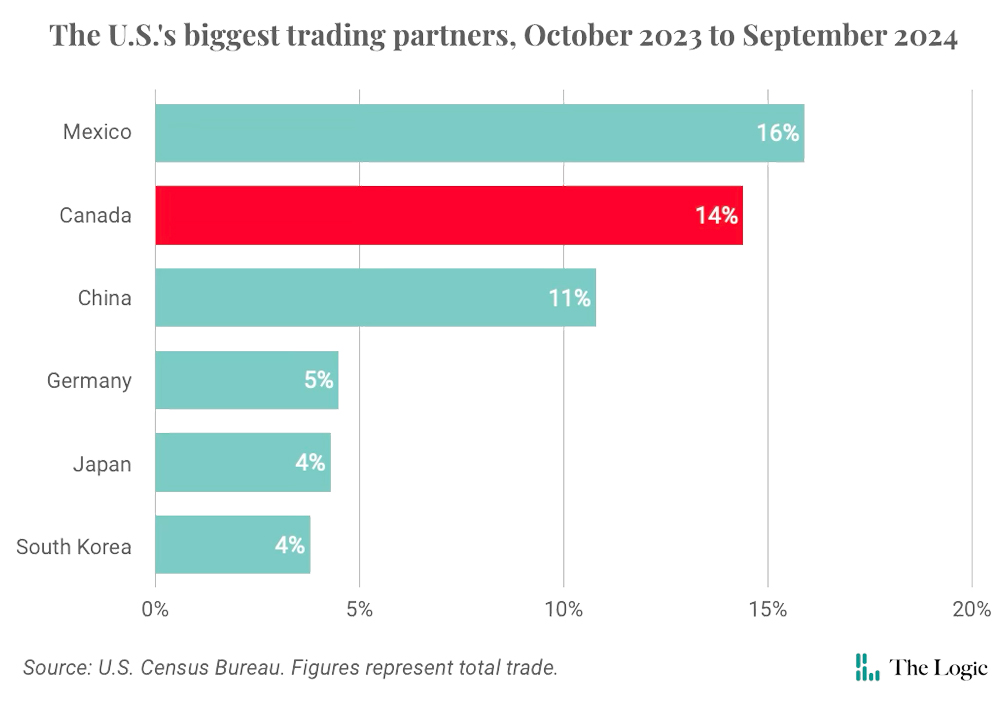
Both sides of the border will be impacted by the tariffs, Ziemba added. The tariff costs would likely be split among U.S. consumers, refineries and Canadian sellers. “There’s no other egress options,” she said.
The fentanyl problem
A tiny percentage of total illegal drugs seized in the U.S. come across the border from Canada, official data shows. There were around 275,000 pounds of illegal drugs seized at the U.S.-Mexico between October 2023 and September 2024, according to data from U.S. Customs and Border Protection. Just 11,600 pounds of illegal drugs were intercepted at the Canadian border in the same period, down from 60,100 in 2022 and 55,100 in 2023.
Trump said the tariffs were particularly aimed at fentanyl. 21,100 pounds of the drug have been seized at the U.S.-Mexico border between October 2023 and September 2024, compared to just 43 pounds at the Canadian border.

Methamphetamine was the primary drug seized at the Mexican border, with 158,000 pounds recorded between October 2023 and September 2024 compared to 185 pounds at the Canadian border in the same period. 56,400 pounds of marijuana, and 30,400 pounds of cocaine were also intercepted at the U.S.-Mexico border during that time. At the Canadian border, 6,800 pounds of marijuana was intercepted and 2,400 pounds of cocaine during the same period.
Many drugs aren’t even intercepted at land borders. Coastal or interior drug seizures in the U.S. represent the most seizures, with 287,000 pounds recorded between October 2023 and September 2024.
Canadian politicians fear Trump’s tariffs lump Canada in with Mexico, Ziemba said. “Trump is trying to set up almost a negotiation to see what people are gonna offer him,” she said. “It is economic coercion.”
The U.S.-Canada border
Canada pales in comparison to Mexico when it comes to illegal border crossings. In 2022, for example, the U.S. Border Patrol apprehended 109,535 people at the border with Canada. On the U.S. border with Mexico, 2,378,944 people were apprehended. Or, to put it another way, the total for the Canadian border was just five per cent the total for the Mexican border.

Numbers at the Canadian border have ticked up over the last two years, with 198,929 apprehensions at the northern border between October 2023 and September 2024, compared to 2,135,005 at the Mexican border in the same period.
A cautionary tale from the steel industry
Canada’s steel industry, which exports nearly 90 per cent of its goods to the U.S., suffered mightily when Trump imposed a 25 per cent tariff on imports in May 2018.
Steel exports from Canada to the U.S. the following year tumbled 26 per cent, to $1.7 billion—and another 14 per cent in 2020. Exports fully recovered in 2021, the year after the new United States-Mexico-Canada Agreement took effect.



Loading...
Thanks for sharing!
You have shared 5 articles this month and reached the maximum amount of shares available.
CloseThis account has reached its share limit.
If you would like to purchase a sharing license please contact The Logic support at [email protected].
CloseGift the full article!
You have gifted 0 article(s) this month and have 5 remaining.
Recipients will be able to read the full text of the article after submitting their email address. They will not have access to other articles or subscriber benefits.