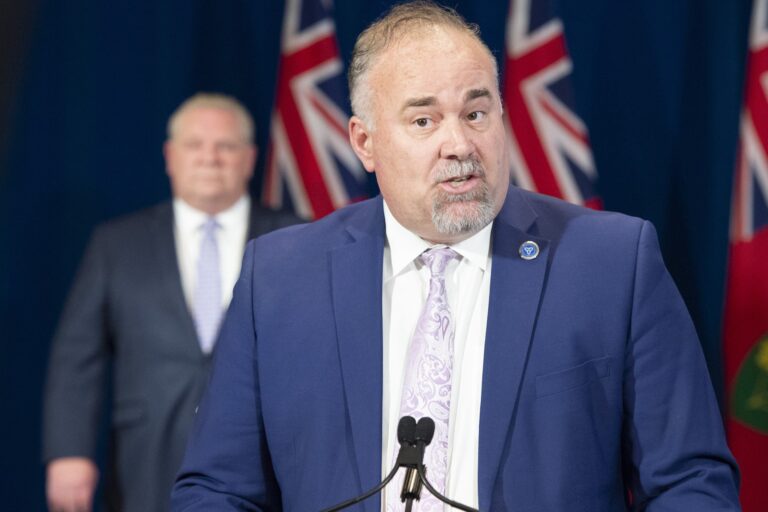
If Donald Trump starts a trade war with Canada by putting 25 per cent tariffs on Canadian goods, Ontario Premier Doug Ford said he might cut off his province’s electricity sales to neighbouring states.
Here’s what you need to know:
If Donald Trump starts a trade war with Canada by putting 25 per cent tariffs on Canadian goods, Ontario Premier Doug Ford said he might cut off his province’s electricity sales to neighbouring states.
Here’s what you need to know:
Cross-border trade in electricity mainly about cost efficiency, not keeping the lights on

If Donald Trump starts a trade war with Canada by putting 25 per cent tariffs on Canadian goods, Ontario Premier Doug Ford said he might cut off his province’s electricity sales to neighbouring states.
Here’s what you need to know:
Back and forth
Ontario exports thousands of gigawatt hours of electricity to the U.S. every year—a noticeable percentage of the amount some states use. Michigan is its biggest importer, with New York not that far behind and Minnesota a very distant third.
Michigan imported about 7,700 gigawatt hours of Ontario electricity in 2023, according to the province’s power grid agency, while generating about 121,000 gigawatt-hours itself. New York imported about 4,100 gigawatt hours from Ontario while generating about 124,000 gigawatt hours.
Quebec, traditionally a major electricity exporter, has had its vast hydro production limited lately by droughts. It has still sold power this year to Vermont and New York, but not as much as Ontario has sent to its southern customers.
British Columbia, also drought-stricken, has recently been a major importer of electricity, including from the United States, relying on the U.S. and Alberta for about a quarter of its consumption. If the U.S. counterattacks with limits on its own energy exports, that could hurt.
Why we do it
This trade is mainly about using the cheapest sources, not keeping the lights on. Ontario’s nuclear plants can’t readily be turned up and down and (with some currently marginal exceptions) electricity can’t be stored. At times, Ontario has even sold electricity for less than it cost to produce, because the alternative was dumping it for nothing.
Within Canada, Ontario and Quebec send a lot of electricity back and forth because they use it differently. In Quebec, widespread electric heating means its demand peaks in winter; air conditioners make Ontario’s demand peak in summer. In each province’s off-season, it sells the other the surplus that would otherwise go to waste and they both save money.
The rules
If a President Trump just sticks 25 per cent tariffs on Canadian goods, the letters of Canada-U.S. trade agreements won’t mean very much, but the United States-Mexico-Canada Agreement gives Canada more control over its “energy goods” than its predecessor treaty.
Under the North American Free Trade Agreement, Canada essentially couldn’t reduce energy exports to the U.S. except by reducing its own consumption at the same time. The new trade deal removed that “energy proportionality clause.”
A hollowing threat
Canadian electricity exports have been trending down. Ontario is rushing to build expensive new power plants just to meet its own needs. In August, it launched its biggest electricity procurement ever, and just a few hours before Ford said he might cut U.S. buyers off, his government upsized the target of that process from 5,000 megawatts to 7,500 megawatts. That’s to meet longer-term demand, not because a shortage is imminent. But the trend is conspicuous.
Western perspective
While Ontario wants to play hardball with energy exports, Alberta appears to want none of it. Premier Danielle Smith categorically rejected a similar shutdown of oil and gas exports to the U.S., saying the province’s fossil-fuel sector could be “part of the solution” to Trump’s tariff threats against Canada.
“Under no circumstances will Alberta agree to cut off oil and gas exports,” she told reporters on Thursday.
Smith met with U.S. governors and other public officials in Las Vegas earlier this week to discuss border issues and trade, and the premier has sought to frame Alberta as a crucial supplier of affordable energy—a key concern for Trump.
The U.S. imported a record-high 4.3 million barrels per day of Canadian crude in July of this year, according to the Paris-based International Energy Agency, and Canada exported $147 billion of oil and gas to the United States last year. Energy accounted for 80 per cent of Alberta’s exports to the U.S. over that period.
Loading...
You have shared 5 articles this month and reached the maximum amount of shares available.
CloseIf you would like to purchase a sharing license please contact The Logic support at [email protected].
CloseYou have gifted 0 article(s) this month and have 5 remaining.
Recipients will be able to read the full text of the article after submitting their email address. They will not have access to other articles or subscriber benefits.
Photo: The Canadian Press/Adrian Wyld
Great journalism delivered straight to your inbox.

Get up to speed in minutes with insights and analysis on the most important stories of the day, every weekday.
See the bigger picture with reporters and industry experts in subscriber-exclusive events.
Membership provides access to our popular Slack channel, participation in subscriber surveys and invitations to exclusive events with our journalists and special guests.