OTTAWA — A key economic adviser to President Donald Trump shared a vision for transforming the international trading system last year that suggests the new administration views tariffs as far more than a short-term negotiating tactic to address grievances with allies such as Canada.
Skip to content

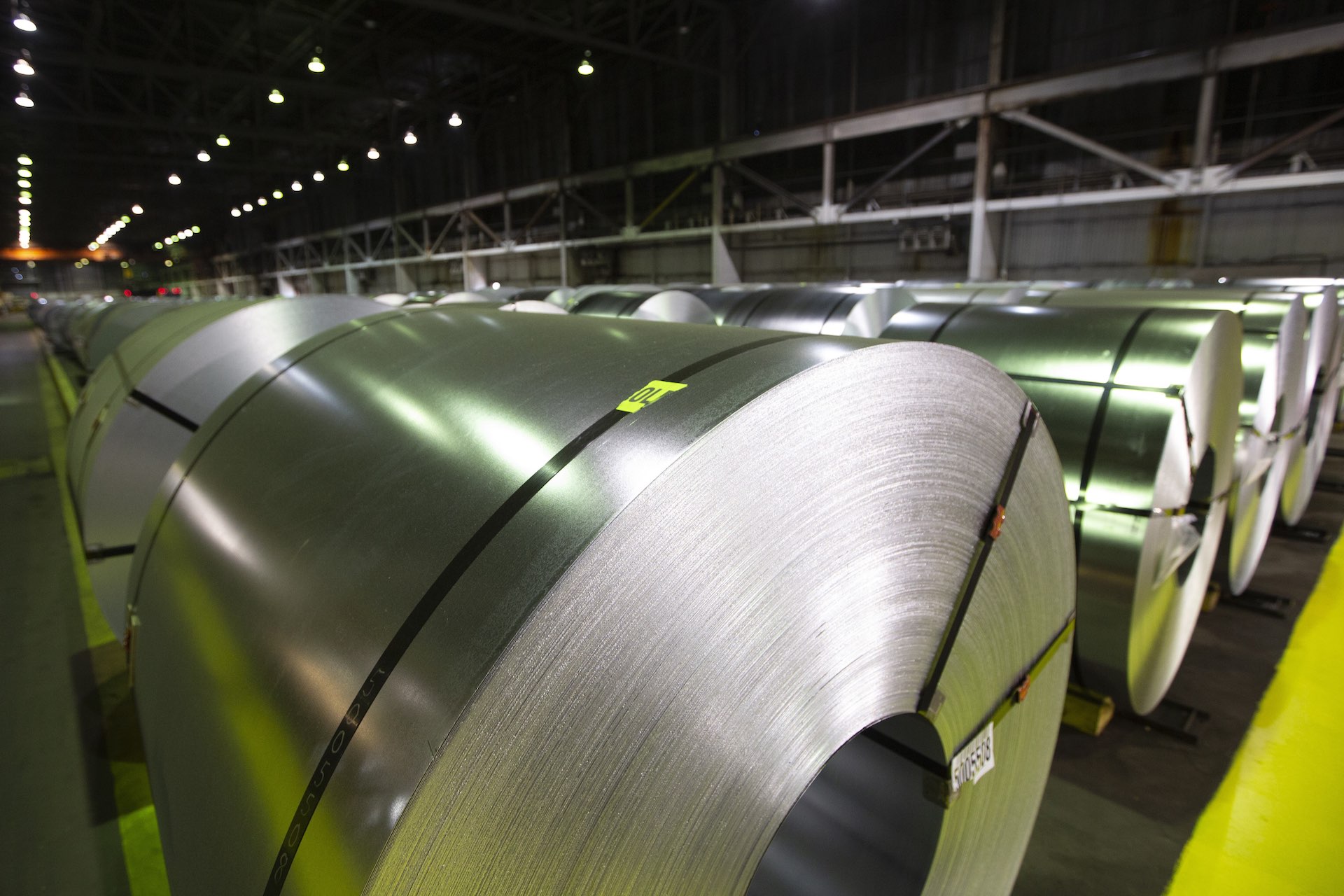 Coated steel waiting for shipment at Stelco in Hamilton, Ont.; Donald Trump's first U.S. administration slapped tariffs on Canadian steel and aluminum, citing national security. Photo: The Canadian Press/Peter Power

News
A key Trump adviser predicts ‘generational change’ is about to hit global trade
Economist Stephen Miran says the U.S. has kept tariffs too low for too long. Trump is ready to test his theory.
Stephen Miran published a paper in November arguing tariffs could reduce U.S. trade deficits. Photo: AP Photo/Mark Schiefelbein
OTTAWA — A key economic adviser to President Donald Trump shared a vision for transforming the international trading system last year that suggests the new administration views tariffs as far more than a short-term negotiating tactic to address grievances with allies such as Canada.
“The desire to reform the global trading system and put American industry on fairer ground vis-à-vis the rest of the world has been a consistent theme for President Trump for decades,” wrote Stephen Miran, Trump’s pick to chair the Council of Economic Advisers, a White House agency the president turns to for advice on economic policy and the research to back it up. “We may be on the cusp of generational change in the international trade and financial systems.”
Talking Points
- Trump’s nominee to chair the Council of Economic Advisers says the U.S. dollar’s status as a reserve currency has kept it high, exacerbating trade deficits
- The Trump administration views tariffs as a way to tackle trade imbalances, which could complicate Canada’s response
Miran wrote the report in November for hedge fund Hudson Bay Capital, where he is a senior strategist, before Trump announced his nomination to the council. Miran, who served as an economic adviser to the U.S. Department of Treasury during the first Trump administration, said the paper “is not policy advocacy.”
In the report, Miran argued that the U.S. dollar’s status as a reserve currency comes with built-in demand for the greenback that has led to persistent overvaluation. This worsens what he describes as “asymmetric trade conditions,” or trade deficits, including with China, that Miran says have harmed domestic manufacturing because foreign imports remain cheap.
He notes that Trump wants the U.S. dollar to keep its reserve status, so he expects the administration to address this perceived imbalance in other ways.
Enter tariffs, which the Harvard-educated Miran argues the U.S. have kept too low for too long.
Related Articles


“These tariffs are, in large part, legacies of an era in which the United States wanted to generously open its markets to the rest of the world at advantageous terms to assist with rebuilding after World War II, or in creating alliances during the Cold War,” he wrote.
Dan Ciuriak, an international trade consultant and a fellow at the Asia Pacific Foundation of Canada, said this broader goal for tariffs complicates how countries like Canada can respond.
“What America is really saying here is that it wants to take its ball and go home,” said Ciuriak, who recently published a discussion paper on populist trade economics, including the ideas shared by Miran. “It doesn’t like the globalization [and] international framework that it sort of midwifed into life in its period as a hegemon. It wants something different.”
The Manhattan Institute, a New York-based think tank where Miran is a senior fellow, said he is not doing interviews.
In his paper, Miran predicted the White House would continue linking trade policy to national security. Canada is not immune from this view of the world. In 2018, Trump cited national security in leveling steep tariffs on Canadian aluminum and steel. Among the factors Miran suggests the U.S. consider in deciding the rates of tariff: “Does the nation pay its NATO obligations in full?” and, “Do the nation’s leaders grandstand against the United States in the international theater?”
Trump originally justified his threat to impose 25 per cent import tariffs on all goods from Canada and Mexico by tying it to his desire to stop the flow of illegal migrants and fentanyl across the border. Canada’s federal government responded with $1.3 billion in border security measures. Howard Lutnick, Trump’s nominee to lead the U.S. Department of Commerce, told his Senate confirmation hearing Wednesday this would be a “separate tariff” to spur action from Canada and Mexico. “And as far as I know, they are acting swiftly, and if they execute it, there will be no tariff,” he said.
Trump has also criticized Canada for not meeting a NATO commitment to spend two per cent of its GDP on defence. Defence Minister Bill Blair recently said Canada would accelerate its plan to get there. Last week, Trump told the World Economic Forum that he would ask NATO members to contribute five per cent.
There is another threat of tariffs that Canada could face. The White House trade policy memo launched an investigation into the causes of U.S. trade deficits in goods, “as well as the economic and national security implications and risks resulting from such deficits.” A “global supplemental tariff” is one of the proposed remedies. That report is due April 1.
It does not mention Canada specifically, but during his confirmation hearing Lutnick mentioned the auto and dairy sectors as areas where the U.S. is looking for change.
In a podcast last week, the Nobel Prize-winning American economist Paul Krugman said prioritizing balanced trade is based on “a misunderstanding of the way the world works, of the way the world should work.” In November, he wrote that while tariffs might reduce trade deficits, they would do so by shutting down the global flow of capital, not by helping U.S. companies compete with foreigners.
“The U.S. can withstand tit-for-tat escalation more easily than other nations and is likelier to win a game of chicken.”
Dan Ujczo, an international trade lawyer based in Columbus, Ohio, who specializes in Canada-U.S. issues, said it is clear the Trump administration—influenced by Miran and others such as former trade czar Robert Lighthizer, who wrote in his 2023 book that “the once nearly unanimous Washington consensus on free trade is dead”—have decided to go there anyway.
“This administration just says, ‘No, trade deficits matter and we’ve seen the hollowing out of American manufacturing because of that, and we are not afraid to use tariffs,’” said Ujczo.
The White House trade policy memo is silent on Canada and trade deficits. Trump has not been.
“I think Canada has been treating us very unfairly on trade, and they’ve taken advantage of us for years, and we’re not going to allow that to happen,” he told reporters aboard Air Force One over the weekend. He referred to the trade deficit with Canada as a “subsidy” worth US$250 billion a year, again saying tariffs would come on Feb. 1.
The U.S. Census Bureau said the trade deficit with Canada was about US$64.3 billion in 2023. A recent analysis by TD Economics showed that if energy exports were removed from the equation, the U.S. would actually have a trade surplus of about US$45 billion.
It remains to be seen whether Trump will be swayed by those numbers. Ujczo said the investigation into trade deficits by the U.S. Department of Commerce could be a chance “for Canadian businesses, but more importantly, U.S. businesses that rely on Canada, to hopefully create that set of facts.”
Regardless, Toronto-based trade lawyer Matthew Kronby said the threat undermines the predictability that was supposed to be a benefit of the continental free trade pact. The U.S.-Mexico-Canada Agreement (USMCA) that replaced NAFTA during the first Trump administration is set to be reviewed next year. “Even if this is a negotiating tactic, it’s an extremely destructive one,” he said.
Miran does caution in his paper that countries facing steep tariffs could retaliate, which would reduce the benefits the U.S. is seeking from imposing them in the first place.
Still, he argues the U.S. would come out ahead. “Because the United States is a large source of consumer demand for the world with robust capital markets, it can withstand tit-for-tat escalation more easily than other nations and is likelier to win a game of chicken.”
If the U.S. is indeed playing the long game with tariffs, the trade consultant Ciuriak warns that Canada may do itself more harm than good by launching retaliatory tariffs.
“That’s us taking our ball and going home,” he said. “It’s not a sensible dynamic to think that you can force someone to trade with you that doesn’t want to trade with you.”



Loading...
Thanks for sharing!
You have shared 5 articles this month and reached the maximum amount of shares available.
CloseThis account has reached its share limit.
If you would like to purchase a sharing license please contact The Logic support at [email protected].
CloseGift the full article!
You have gifted 0 article(s) this month and have 5 remaining.
Recipients will be able to read the full text of the article after submitting their email address. They will not have access to other articles or subscriber benefits.
Photo: AP Photo/Mark Schiefelbein
Coated steel waiting for shipment at Stelco in Hamilton, Ont.; Donald Trump's first U.S. administration slapped tariffs on Canadian steel and aluminum, citing national security.
Most Popular This Week



In-depth, agenda-setting reporting
Great journalism delivered straight to your inbox.
News
Anthropic revealed as client for EverWind’s $10B Nova Scotia data centre
Briefing
EverWind plans $10B data centre and wind development in Nova Scotia
Canada ready to force Stelco to sell its Canadian operations, Joly says
Feds plan a 60 MW defence-oriented data centre for Ottawa
Best business newsletter in Canada
Get up to speed in minutes with insights and analysis on the most important stories of the day, every weekday.
Exclusive events
See the bigger picture with reporters and industry experts in subscriber-exclusive events.
Membership in The Logic Council
Membership provides access to our popular Slack channel, participation in subscriber surveys and invitations to exclusive events with our journalists and special guests.






