Listen Now
0:00
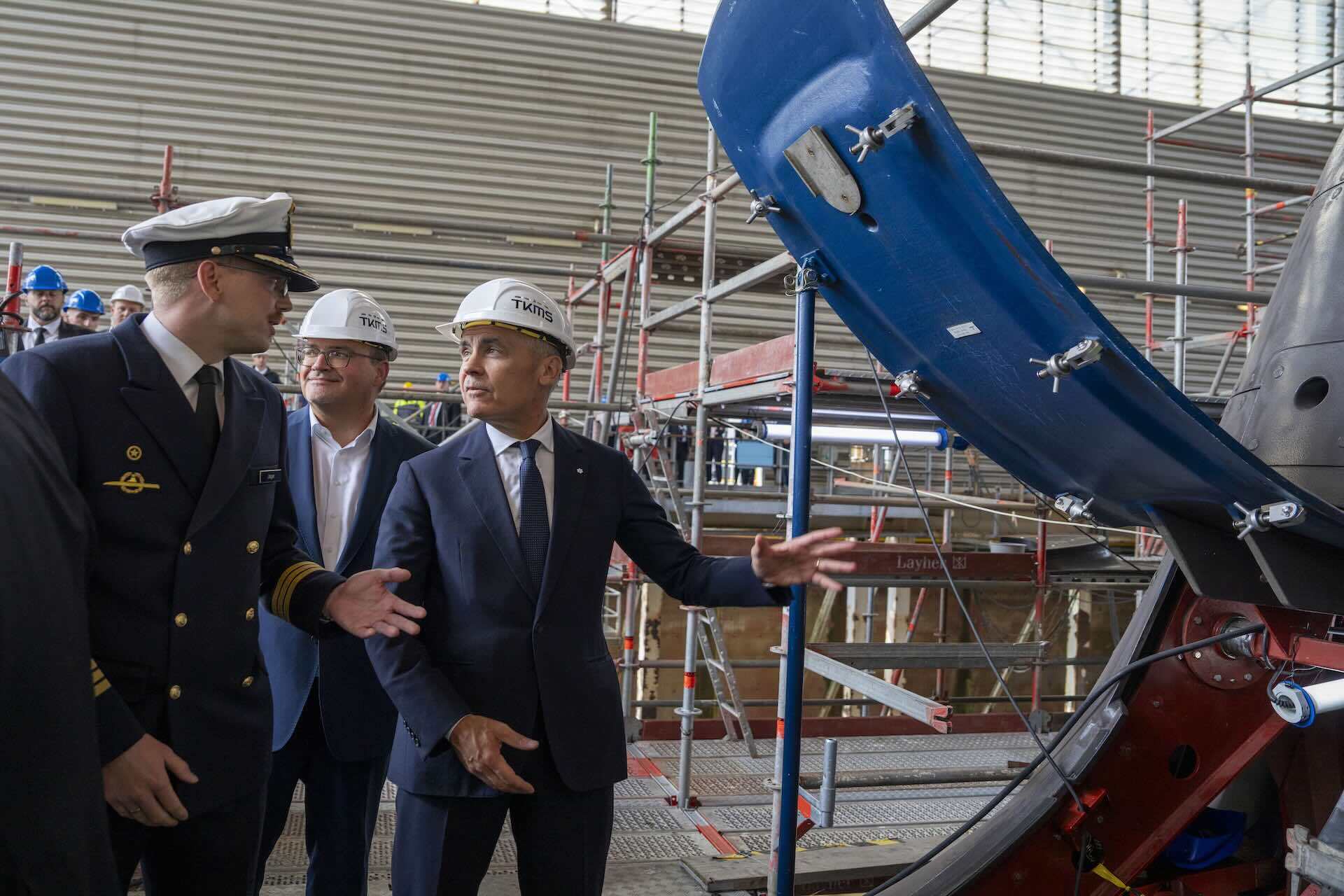
Canada has chosen Europe’s TKMS as the preferred bidder to supply the Royal Canadian Navy with a dozen new 212CD submarines, Prime Minister Mark Carney said in an announcement in Halifax.
The decision is generationally important to the military, to industry and to Canada’s international relationships, lining Canada up with European allies and disappointing TKMS’s rival, South Korea’s Hanwha Ocean.
“It’s the largest procurement that we have made, as a country,” Carney said.
Related Articles


Besides the cost of the subs themselves, decades of sustainment work are expected to put the cost well into the tens of billions of dollars—possibly as much as $100 billion—which is in the same range as buying and operating a full fleet of F-35 fighter jets.
What it means right now
Canada asked interested companies to present themselves in 2024 and, in August 2025, settled on TKMS and Hanwha Ocean as the finalists. By normal defence procurement standards, this has been incredibly fast, but there’s still a lot of work to do.
Selecting TKMS as the preferred bidder means the company and Canada will get into the nuts and bolts of contract negotiations. Carney estimated those talks will take between six and 18 months.
In theory, that bargaining could fail and leave Canada to turn back what Carney said was a very competitive bid from Hanwha.
“We don’t expect that,” he said.
Defence sales come with obligations for vendors to spend in Canada in amounts commensurate with the size of the contract. Whatever the final cost, this deal is enormous, but the eventual dollar figures and delivery schedule will determine just how much business TKMS does with Canadian firms.
Industry cashes in
TKMS promises to work with an array of Canadian-based suppliers of raw materials (like Valbruna, whose Canadian branch is meant to supply non-magnetic steel), parts (like Patriot Forge), training tools (like CAE) and AI services (like Cohere). Seaspan is in line to lead long-term support and servicing on Canadian soil.
The basic pitch: TKMS makes submarines for many countries and if Canada buys some, Canadian industry will be added to TKMS’s supply network. It would join a submarine-making partnership, not be a mere customer.
Norway, Germany-based TKMS’s first foreign customer for the 212CD, shows how the arrangement might work, with plans for a shared maintenance facility in Bergen (on Norway’s Atlantic coast) and the involvement of a Canadian subsidiary of Norwegian defence contractor Kongsberg in the bid.
Carney said Canadians will contribute materials, components and software to the new submarines, and will build and staff facilities to take care of them—and other countries’ 212CD subs—in Canada. He did not say that any of the vessels will be assembled in Canada, which would be even higher-level work.
The path not taken
Hanwha doesn’t have TKMS’s customer base; selling to Canada would have been epochal for the company and South Korean military exports, so it drew on the bigger Hanwha Group conglomerate and its partner Hyundai Heavy Industries to make a broader case for its KSS-III model.
In addition to an array of TKMS-like supply agreements (including with some of the same vendors, like Cohere and CAE), Hanwha pledged to work with the Canadian Automotive Parts Manufacturers’ Association on a joint venture to make heavy military vehicles and Hyundai said it would build up the Canadian ecosystem for hydrogen transport trucks (answering, roughly, Industry Minister Mélanie Joly’s explicit request for a car plant).
Hanwha also proposed to supply rockets for Maritime Launch Services’ fledgling space-launch venture, and to work with Kanata LNG on a multibillion-dollar floating liquefied natural gas platform off Prince Rupert, B.C.
With Hanwha Ocean out of the running, its industrial promises are likely toast unless any of them makes sense on its own for one of the Hanwha conglomerate’s companies.
NATO over the Indo-Pacific
Stung by the U.S.’s disregard for decades of military and economic integration, Carney has been trying to ingratiate Canada with friendly countries in both Europe and the Indo-Pacific region.
The submarine purchase forced him to choose between traditional partners (NATO allies, at that) in Germany and Norway, and shifting Canada’s friendship with South Korea up about five gears. Seoul pushed hard for the contract, including in a meeting between Carney and President Lee Jae Myung at a recent NATO summit in France.
Germany’s and Norway’s defence ministers visited Ottawa to advocate for TKMS’s subs, including a late push from Germany’s Boris Pistorius at the Cansec military trade show in late May, where he promised faster delivery of the first vessels.
Although “Canada’s combined strategic, security and economic interests” were key factors in favour of TKMS, Carney denied that the decision means Canada is turning away from its Indo-Pacific strategy.
“There are a series of other initiatives Canada and Korea are pursuing that build our economic resilience and our security footprint,” he said, and pointed to his cordial meeting with the Philippines President Ferdinand Marcos Jr. last week as further evidence.
For the navy
The 12 new submarines are to replace four that Canada bought secondhand from Britain in 1998, which have never met expectations (one, HMCS Chicoutimi, caught fire on its first Atlantic crossing under Canadian command and didn’t sail again for a decade). Even with a major overhaul, they’ll reach the ends of their lives in the 2030s.
With the existing subs’ days numbered, Canada is taking one significant risk with TKMS’s 212CD model: the company has not completed one. It has boats under construction but none in service. Hanwha sailed a South Korean navy KSS-III to Victoria to show off that difference.
Editor’s note: This story was updated to add quotes and details.