Canada struck an agreement with Germany to develop critical minerals tech, hopes to export natural gas through Churchill, Man., and will buy new submarines from either Germany or South Korea, Prime Minister Mark Carney said Tuesday in a news-packed visit to Berlin.
Skip to content

News
Churchill port expansion among big plans touted by Carney on Europe trip
Mark Carney says major redevelopment of the Hudson Bay port will open the door to LNG shipments to Germany
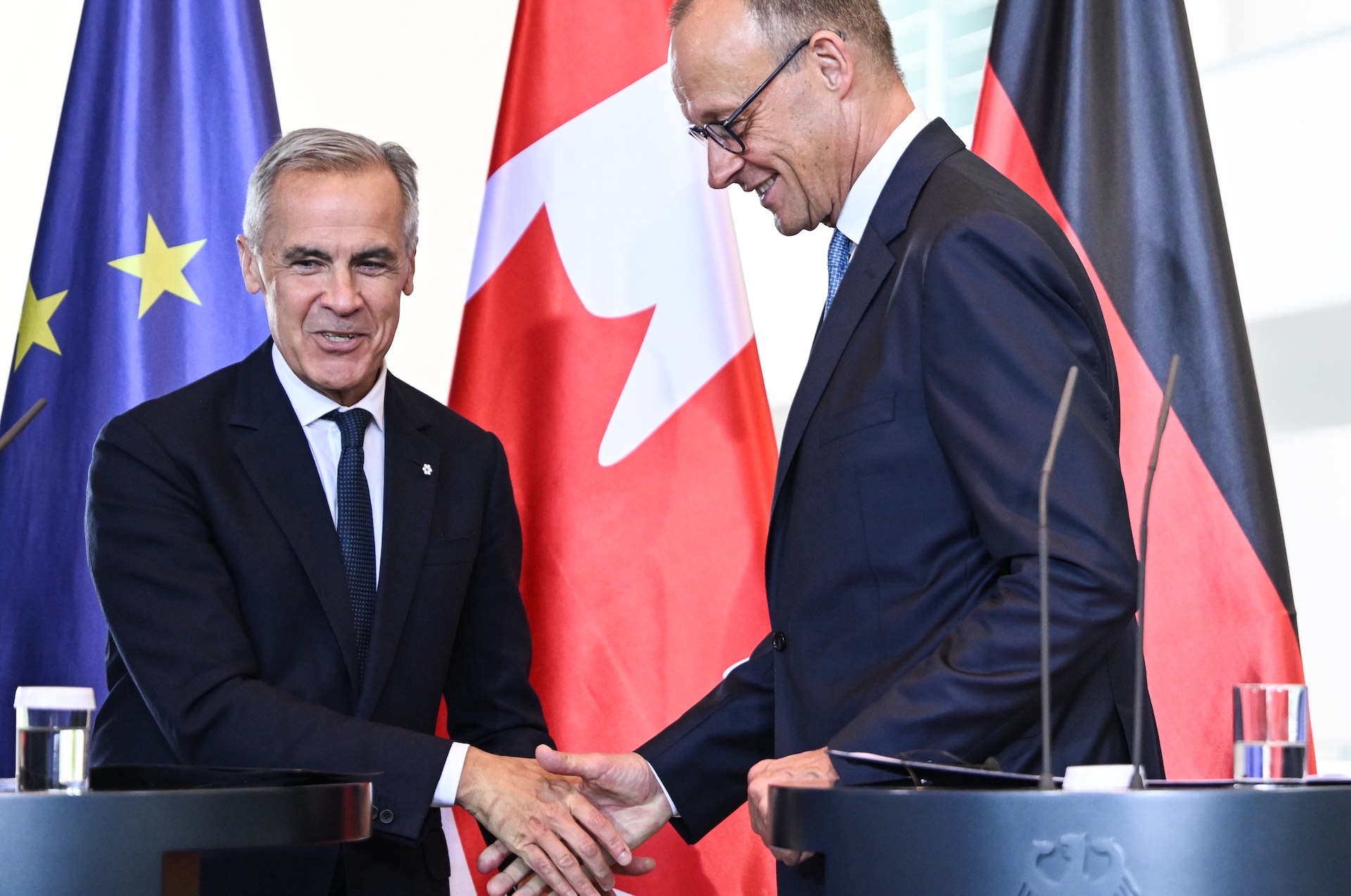
Prime Minister Mark Carney and German Chancellor Friedrich Merz during Carney's visit to Berlin on Tuesday. Photo: Picture Alliance via Getty Images/Britta Pedersen
Canada struck an agreement with Germany to develop critical minerals tech, hopes to export natural gas through Churchill, Man., and will buy new submarines from either Germany or South Korea, Prime Minister Mark Carney said Tuesday in a news-packed visit to Berlin.
Critical minerals deal
The declaration on critical minerals says Canada and Germany will work together on “midstream technologies.” Not mining them, that is, but processing, refining and recycling. They will focus on lithium, copper, tungsten, gallium, germanium, nickel and rare earth elements.
Carney touted three new agreements in this vein between German and Canadian companies. Germany’s Aurubis, a smelter and recycler, is to buy copper concentrate from Canada’s Troilus; Vacuumschmelze, which makes magnets, is to buy rare earth oxides from Canada’s Torngat; and Rock Tech Lithium, which operates in both countries, is to buy renewable energy for a German plant from Germany’s Enertrag.
Related Articles
Gas through Hudson Bay
The Liberals plan to invest in an expansion of the Port of Churchill so substantial it will practically be a new port on the shore of Hudson Bay, Carney said in a news conference with German Chancellor Friedrich Merz. The intent is to create opportunities to export liquefied natural gas (LNG), he said. In a written statement, Carney said “Canada will begin discussions regarding the supply of LNG to German buyers.”
That’s a change from his predecessor Justin Trudeau’s view (despite advice to the contrary) that there was no real business case for eastbound exports of Canadian gas. Germany wanted LNG in 2022, as it weaned itself off Russian supplies, but there was almost no infrastructure to ship LNG east from Canada.
(Work continues on the hydrogen agreement Trudeau struck with Merz’s predecessor Olaf Scholz, the written statement said.)
Carney did not say directly that the Churchill project will be designated a national priority under the Building Canada Act that Parliament passed in June. Nor did he say that the Western Energy Corridor, a scheme that includes an LNG pipeline from Alberta and Saskatchewan to Churchill, would qualify as one.
Other ports on the to-do list
The prime minister also listed Montreal’s Contrecoeur port expansion and “other East Coast ports for those critical metals and minerals” as targets for federal investments that will start to be announced within two weeks.
German ‘U-booten’ or Korean ‘jamsuham’
Backed by a formal announcement from Public Services and Procurement Canada, Carney said in Berlin that Germany’s Thyssenkrupp and South Korea’s Hanwha Ocean are the two finalist bidders to supply Canada with up to a dozen new patrol submarines. He was to visit Thyssenkrupp’s shipyard and will see Hanwha’s in October, he said.
Canada has been soliciting preliminary proposals since July 2024. The navy wants to take delivery of the first sub by 2035; its four Victoria-class boats, bought second-hand from Britain in 1998, are to go out of service a few years after that.
Hanwha, formerly called Daewoo Shipbuilding, has lined up a roster of Canadian partners for the project. Thyssenkrupp, the venerable German arms manufacturer that boasts of working on subs (still referred to as “U-booten”) since the earliest days of the technology is working on assembling a Canadian consortium.
On to Latvia, then home
Carney left Germany for Riga, Latvia, where he met Prime Minister Evika Siliņa and said Canadian troops will extend their Operation Reassurance presence in the fellow NATO member country by three years.



Loading...
Thanks for sharing!
You have shared 5 articles this month and reached the maximum amount of shares available.
CloseThis account has reached its share limit.
If you would like to purchase a sharing license please contact The Logic support at [email protected].
CloseGift the full article!
You have gifted 0 article(s) this month and have 5 remaining.
Recipients will be able to read the full text of the article after submitting their email address. They will not have access to other articles or subscriber benefits.
Photo: Picture Alliance via Getty Images/Britta Pedersen
Most Popular This Week




In-depth, agenda-setting reporting
Great journalism delivered straight to your inbox.
News
Panel decries Canada’s chaotic way of funding world-class science
Briefing
AI is pushing insurers to become asset managers, Canadian CEOs say
Trump administration faces lawsuit over 50% tariffs on Canadian goods
Canada-U.S. trade war to reduce real GDP by 1.4% over 2024 levels after five years: PBO
Best business newsletter in Canada
Get up to speed in minutes with insights and analysis on the most important stories of the day, every weekday.
Exclusive events
See the bigger picture with reporters and industry experts in subscriber-exclusive events.
Membership in The Logic Council
Membership provides access to our popular Slack channel, participation in subscriber surveys and invitations to exclusive events with our journalists and special guests.





