Skip to content


Commentary
Carmichael: Davos Man reminds the ‘powerless’ of their power
In the face of Trump’s aggression, Mark Carney turned to a global audience in search of new allies
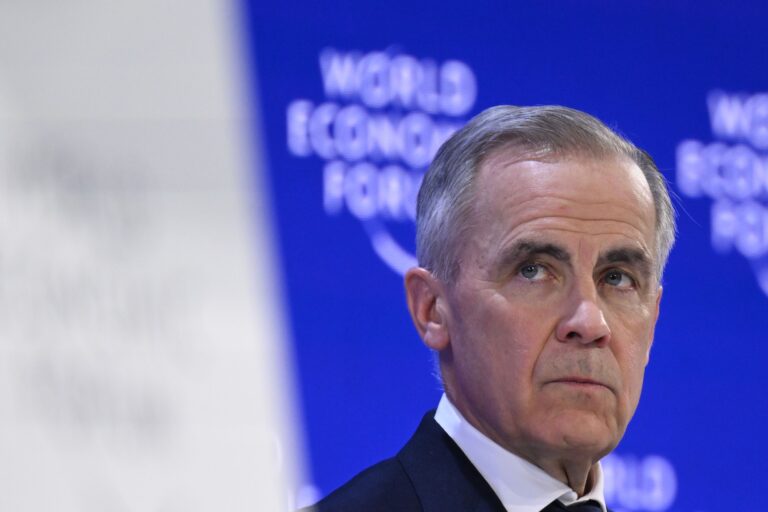
Prime Minister Mark Carney speaks during the World Economic Forum annual meeting in Davos, Switzerland, on January 20, 2026. Photo: Getty Images/AFP/Fabrice Coffrini
I missed the first part of Prime Minister Mark Carney’s speech at the World Economic Forum in Davos on Tuesday, the part where he marked the end of the “nice story” we have been telling ourselves about how the world works.
Like Gerald Butts, the former Carney campaign adviser, I think the “major problem with Davos is 95% of the people there firmly believe they’ll be OK no matter what happens” in this mad, mad world.
Related Articles
What Butts means is too few of them have real skin in the game, which makes it hard to take anything anyone says there seriously. I had a meeting scheduled here in snowy Montreal, and I didn’t want to cancel. I had left myself some time to get back to my computer to watch Carney’s speech, but I walked too close to a bookstore and remembered I wanted a new copy of Nineteen Eighty-four. I didn’t think I’d miss much.
As they say in economics, it’s important to update your priors. Carney’s speech was a landmark event that we will be talking about for a long time.
While I was walking from the metro to my house, Carney was invoking Czech intellectual Václav Havel’s 1978 essay “The Power of the Powerless.” Havel is one of the revolutionaries who helped bring about what many of us thought was the end of history by breaking up the Soviet Union. His writing inspired his country to resist Soviet occupation, and he became the last president of Czechoslovakia and the first president of the Czech Republic.
In “The Power and the Powerless,” Havel argued the communist system sustained itself in part because ordinary people participated in rituals in which they didn’t believe. Carney said Canadians and many others around the world have been living in a convenient fantasy of our own: the rules-based international order. “We participated in the rituals. And largely avoided calling out the gaps between rhetoric and reality,” said Carney, a regular participant in those rituals by virtue of his long career as a G7 central banker.
“This bargain no longer works,” he said. “Let me be direct: we are in the midst of a rupture, not a transition.”
One way to think about Carney’s speech is as an answer to the critics who keep saying that, counterintuitively, he’s been doing too much showing and not enough telling. All that globetrotting; all those new federal offices led by serious people with mandates to get big things done; the pledge to erase internal trade barriers; an industrial policy that targets $1 trillion in new investment—there’s a strain of thought that Canadians are unsure what it’s all for.
That critique is based on polls that suggest the majority of Canadians think the country’s biggest problem is affordability, not reorienting the economy to give us a fighting chance in the Great Power conflict that began in earnest this month when the U.S. government snatched the leader of Venezuela and said that it would be deciding what to do with the country’s oil wealth.
Most of the work Carney is doing will take time to pay off. Inevitably, not all of it will. But part of me thinks the critique of Carney’s messaging is something created by the political class, a group of people who have spent the past two decades using message discipline to mine increasingly narrow veins of the polity for enough votes to govern. A survey last fall for The Logic by Abacus Data showed that a large majority of Canadians would accept slower growth if it meant greater economic independence. That said, if you’re asking people to make sacrifices, an occasional rallying cry is probably helpful.
“Mark Carney’s speech in Davos did not seem designed to comfort anyone,” Abacus Data chief executive David Coletto wrote in his Substack newsletter. “If anything, it was meant to shake people out of complacency.”
As I listened to Carney speak, I scratched the phrases that stood out on a piece of paper, anticipating questions about his remarks at The Logic’s virtual event on the economic outlook for Canada this year. Reviewing them now, I see “variable geometry,” “bridge between the Trans-Pacific Partnership and the European Union,” “third path with impact” and “live in truth,” a sloppy rendering of Carney’s allusion to Havel’s hallmark phrase, “living in truth.”
Let’s start with Carney’s “third path,” an echo of former prime minister Pierre Trudeau’s “third option” policy, a failed attempt to diminish the gravitational pull of the U.S. in the 1970s. I dislike the “middle power” taxonomy. The essay The Logic’s founder and editor-in-chief David Skok wrote from El Salvador this month shows that usefulness is a better measure of relevancy than GDP or population. Nevertheless, there is only upside in teaching smaller nations a little game theory by reminding them that they all will be better off if they resist succumbing to any of Trump, China’s Xi Jinping or Russia’s Vladimir Putin.
The “variable geometry” Carney put forward as Canada’s new approach to international policy is manifest in the “coalition of the willing” countries that are backing Ukraine, Canada’s participation in the EU’s rearmament plan and last week’s trade truce with China.
It signals a break from the days when Canada would play the boy scout at the World Trade Organization, or serve as the stalking horse for some scheme dreamed up at the White House. Carney told the Davos crowd that he hoped Canada could be a bridge between the European Union, suddenly in a standoff with the Trump administration over Greenland, and the Trans-Pacific Partnership, the trade bloc of mostly Asian nations that Trump rejected early in his first term.
“This is not naive multilateralism. Nor is it relying on diminished institutions,” he said. “It is building the coalitions that work, issue by issue, with partners who share enough common ground to act together.”
We’ll be talking about Carney’s speech for a long time. There will be criticism that much of what he said has been said before. But anyone who has read Carney’s book will know that his strength as a thinker is stitching together multiple good ideas, not coming up with new ones. The reason this speech is different is that unlike the previous government, and even that of former prime minister Stephen Harper, Carney has already shown that much of what he talked about is possible. The political class is all about the message. Carney appears to be putting the work first, which is why his words have more power.
There’s one other line that got my attention. It might be the most important thing he said on Tuesday. “Building a strong domestic economy should always be every government’s priority. Diversification internationally is not just economic prudence; it is the material foundation for honest foreign policy. Countries earn the right to principled stands by reducing their vulnerability to retaliation.”
Canada has been living multiple lies for decades. Maybe the biggest was that we were the owners of a world-beating economy when all we really were was a node in someone’s empire. It would be better for everyone if Carney successfully rallies other smaller countries to his cause. But he seems to understand that the real work will be at home.
There is a lot to do. Productivity has been stagnant for decades, business investment is chronically weak, household debt is high, home construction badly trails what is needed to match demand and we’re in danger of missing our climate change targets. These challenges have been around for so long that they all seem impossible. By invoking Havel, Carney reminded us that we’re never powerless.
Kevin Carmichael is The Logic’s economics columnist and editor-at-large. He has spent more than two decades covering economics, business and finance for outlets including Bloomberg News, The Globe and Mail and the Financial Post, where he also served as editor-in-chief.



Loading...
Thanks for sharing!
You have shared 5 articles this month and reached the maximum amount of shares available.
CloseThis account has reached its share limit.
If you would like to purchase a sharing license please contact The Logic support at [email protected].
CloseGift the full article!
You have gifted 0 article(s) this month and have 5 remaining.
Recipients will be able to read the full text of the article after submitting their email address. They will not have access to other articles or subscriber benefits.
Photo: Getty Images/AFP/Fabrice Coffrini
Most Popular This Week



In-depth, agenda-setting reporting
Great journalism delivered straight to your inbox.
The Big Read
Beacon is building an AI empire by fixing Main Street’s software
Briefing
Inovia raises US$200M for new VC fund as it eyes AI’s impact
43% of eligible Albertans voted ahead of Monday’s referendum
AI chip company Tenstorrent raises US$1.5B, valuing it at US$6.2B
Best business newsletter in Canada
Get up to speed in minutes with insights and analysis on the most important stories of the day, every weekday.
Exclusive events
See the bigger picture with reporters and industry experts in subscriber-exclusive events.
Membership in The Logic Council
Membership provides access to our popular Slack channel, participation in subscriber surveys and invitations to exclusive events with our journalists and special guests.







