Canadians expect the national economy to get worse over the next year, but most are prepared to pay a price to disentangle it from the United States, according to a new The Logic poll by Abacus Data.
Skip to content


News
Canadians willing to take economic hit to reduce dependence on U.S., new poll finds
More than a third think their finances will get worse in the next year, according to a survey by Abacus Data. But a huge majority say they’d accept slower growth to loosen ties with Uncle Sam.
Prime Minister Mark Carney and U.S. President Donald Trump, at a meeting of global leaders in Egypt. Photo: Pool via Getty Images/Suzanne Plunkett
Canadians expect the national economy to get worse over the next year, but most are prepared to pay a price to disentangle it from the United States, according to a new The Logic poll by Abacus Data.
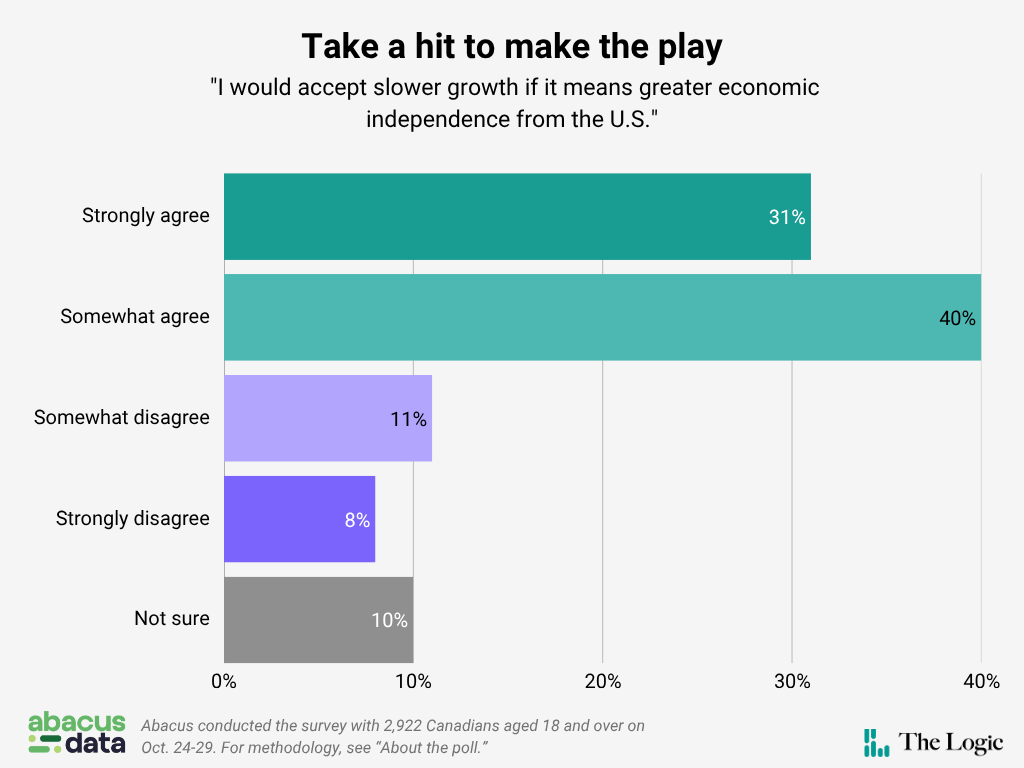
Seventy per cent of respondents will accept slower growth in exchange for more freedom from American economic dominance, including 31 per cent who told Abacus they strongly agreed with that sentiment. Just 19 per cent disagreed.
The finding surprised pollster David Coletto, Abacus’s chief executive: “Even half of Conservatives would accept slower growth if it meant greater control—a sign of a nation redefining prosperity through self-reliance,” he said.
We are not, collectively, expecting the next 12 months to be easy, however. Forty-six per cent of respondents think the Canadian economy will deteriorate, while 30 per cent think it’ll stay about the same.
A smaller percentage expect they will personally take hits (34 per cent think their own finances will get worse, versus 41 per cent expecting to hold their ground), so there’s something of a mismatch in expectations—some people think the economy will deteriorate but mainly for others, while they themselves escape the worst.
The Bank of Canada predicts a mediocre year, for the record, with gross domestic product rising 1.2 per cent in 2025 and 1.1 per cent in 2026. That’s better than a recession, but far from a boom.
Related Articles


The poll found that 63 per cent of respondents prefer Carney to focus on finding new trade partners for Canada, versus 27 per cent who want him to concentrate on mending the relationship with the United States. Similar numbers expect the prime minister to succeed in diversifying Canadian trade: 64 per cent think he can do it, while 23 per cent think he can’t.
Since becoming prime minister last March, Carney has publicly tried to do both. He’s pursued a comprehensive new trade and security deal with the U.S.—yet he’s declared that the era of ever-tighter integration is over. Meanwhile, he’s worked on relations with other countries, including American rivals such as China and India, which Trump has specifically targeted with tariffs (and with which Canada has its own fraught histories).
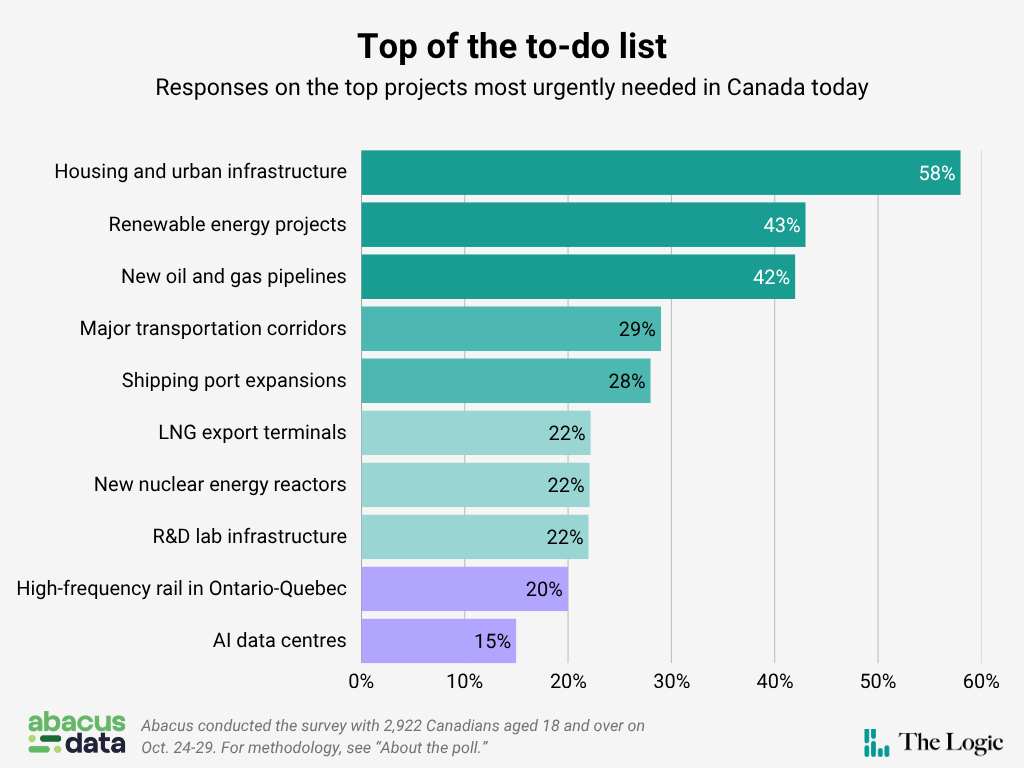
Abacus asked survey participants which types of projects should be national priorities. AI data centres were at the bottom of the list.
Meanwhile, at home, the government has opened a Major Projects Office to streamline federal permissions and announced a first batch of plans to get its special treatment—all of them proposals that were well along the path to approval, if not yet over the finish line. Another set is due to be announced by Nov. 16.
Abacus asked survey participants which types of projects should be national priorities—inviting them to pick three from a list. Fifty-eight per cent of respondents ranked housing and urban infrastructure in their top three, the highest score by 15 points.
At the bottom of the list: AI data centres, which only 15 per cent of respondents named to their top three.
Renewable energy projects and new oil and gas pipelines drew nearly identical support (43 per cent for renewable energy; 42 per cent for pipelines), but with differences among generations. Backing for renewables varied just a few percentage points across age groups, while pipelines drew just 26 per cent support from Abacus’s youngest respondents but 50 per cent from the oldest—suggesting that championing a pipeline could be trouble for the Liberals’ youth vote in a future election.
Regionally, 63 per cent of Albertans put pipelines on their Top 3 lists; only 28 per cent of Quebecers did. Without a private proponent aiming to build one, Alberta Premier Danielle Smith has said her government will take the lead on a new westbound pipeline to the Pacific.
British Columbia’s Premier David Eby isn’t interested, though his voters aren’t fiercely opposed—41 per cent of B.C. respondents put pipelines on their priority lists, second only to housing and urban infrastructure. Separately, Ontario’s Doug Ford (where 42 per cent of respondents put oil and gas pipelines on their Top 3 lists, the same as the national average) is backing a feasibility study for an eastbound oil pipeline.
Canadians remain optimistic that Carney and the Liberals will get national-scale construction and resource developments going, Abacus found. Forty-nine per cent think it’s likely they’ll succeed, against 39 per cent who think it’s unlikely.
That’s fragile, says Coletto. “Belief in his ability to deliver is tentative. Many Canadians are hopeful, few are convinced.”
About the poll: Abacus surveyed 2,922 Canadians aged 18 and over from Oct. 24 to 29 through online panels and weighted the results using census data to match the Canadian population according to age, gender and region. The margin of error for a comparable probability-based random sample of the same size would be 1.8 percentage points, 19 times out of 20.



Loading...
Thanks for sharing!
You have shared 5 articles this month and reached the maximum amount of shares available.
CloseThis account has reached its share limit.
If you would like to purchase a sharing license please contact The Logic support at [email protected].
CloseGift the full article!
You have gifted 0 article(s) this month and have 5 remaining.
Recipients will be able to read the full text of the article after submitting their email address. They will not have access to other articles or subscriber benefits.
Photo: Pool via Getty Images/Suzanne Plunkett
Most Popular This Week




In-depth, agenda-setting reporting
Great journalism delivered straight to your inbox.
News
A tech firm born from post-Brexit trade chaos sets its sights on Canada
Briefing
Czech defence conglomerate CSG buys 9.5% stake in MDA Space
Dominion Dynamics strikes preliminary deal to produce ground drones with Ukraine’s Tencore
Aritzia shares pop after earnings rise 204%
Best business newsletter in Canada
Get up to speed in minutes with insights and analysis on the most important stories of the day, every weekday.
Exclusive events
See the bigger picture with reporters and industry experts in subscriber-exclusive events.
Membership in The Logic Council
Membership provides access to our popular Slack channel, participation in subscriber surveys and invitations to exclusive events with our journalists and special guests.