Listen Now
0:00
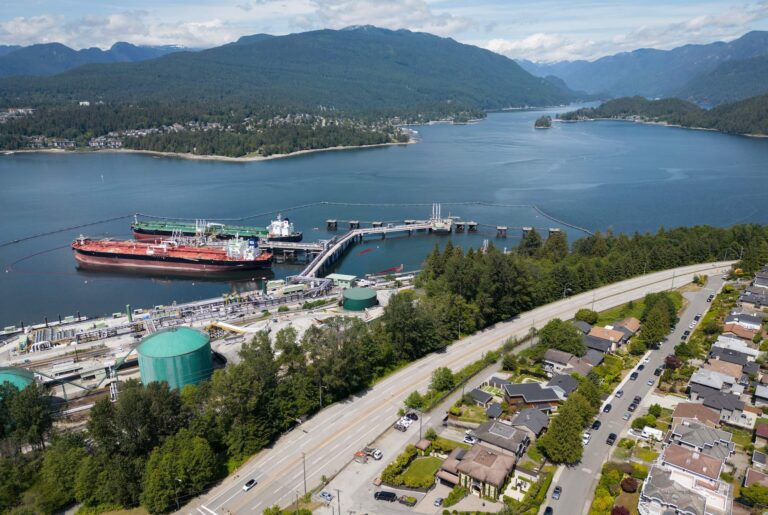
CALGARY — Twenty-nine tankers carrying Canadian crude left Vancouver in July, according to a new analysis of marine exports, pushing exports to record levels and bolstering the case for a new West Coast pipeline to meet the newly whetted appetites of Asian buyers.
Crude exports from the Westridge Marine Terminal climbed for a third consecutive month to an estimated 15.3 million barrels, up three per cent from June—the highest level since RBC Capital Markets began monitoring shipments in 2024 from the terminal supplied by the expanded Trans Mountain pipeline.
Talking Points
- Crude exports from the West Coast terminal supplied by the Trans Mountain Pipeline reached 15.3 million barrels in July, the highest level in RBC Capital Markets’ tracking data
- Asia is driving demand, amid turmoil in the Middle East: Nearly three-quarters of July’s exports went to Asia-Pacific markets, led by China, while a Japan-bound load was celebrated recently by the country’s prime minister
The count suggests the pipeline was running last month close to its full contracted capacity of 712,000 barrels per day, RBC said. About 30 tanker loadings per month would correspond to full utilization of the pipeline’s total 890,000-barrel-a-day capacity (which includes space for short-term or spot-market shipments), the bank estimates.
Nearly three-quarters of the crude went directly to Asia-Pacific markets, with China taking the lion’s share—or 16 of the 31 separate port destinations. The growth in exports comes as turmoil in the Middle East has sharpened fears in Asia about the reliability of energy supplies moving through the Strait of Hormuz.
One of the tankers RBC counted in July was bound for Japan. It arrived last week and was hailed by Japanese Prime Minister Sanae Takaichi in a post on X as a significant step for the country’s push to secure alternative sources of crude.
“We’re finally of interest globally,” said Heather Exner-Pirot, a policy expert in energy and resources at the Macdonald-Laurier Institute. “We are the third-largest exporter in the world, but we were a regional player because we were only selling regionally. And now we’re a global player.”
Related Articles
Exner-Pirot added, “When’s the last time the Japanese prime minister talked about the ‘great joy’ of trading with Canada? It’s crude oil in the middle of a crisis. It’s meaningful to them, and they’re celebrating it.”
Takaichi’s enthusiasm was welcomed in Ottawa where Energy Minister Tim Hodgson’s office pointed to both Alberta’s proposed one-million-barrel-per-day West Coast pipeline and a planned 360,000-barrel-per-day expansion of the current Trans Mountain system as ways Canada could provide more crude to Japan.
The new line proposed by Alberta would largely follow the existing Trans Mountain corridor, diverging only in B.C.’s Lower Mainland to terminate at a new deepwater port at Roberts Bank capable of loading very large crude carriers.
“Canada has been exploring opportunities to meet Japan’s energy needs,” said Charlotte Power, a spokesperson for Hodgson. “With Canadian production continuing to reach record highs, we will continue to supply domestic and global markets, like Japan, with reliable energy exports.”
Japan currently has limited capacity to refine Canada’s heavy oil, with most facilities configured to process lighter, sweeter grades from the Middle East. However, Alberta Energy Minister Brian Jean told Reuters in June his government was in talks with Japan to discuss potential funding for upgrades to the country’s refineries to enable increased imports of heavy crude from Alberta’s oilsands.
Previously, Canada couldn’t offer Asian refiners enough crude to make significant investments in refinery capacity worthwhile, Exner-Pirot said. But a dependable stream of hundreds of thousands of barrels via expansions to Trans Mountain and Alberta’s new West Coast pipeline could dramatically change the math for Asian buyers.
“They’re not going to change their refinery for 50,000 barrels once a while,” she said. “Now there’s enough volume that they can talk about: ‘Okay, is it worth investing in a coker to accept Canadian heavy oil to meaningfully diversify their supply?’”
The growth in exports comes amid increased interest in Western Canada among energy investors, commodity traders and global refiners.
China’s Rongsheng Petrochemical, a major buyer and refiner of Canada’s heavy crude oil exports, is weighing a potential agreement to secure oil supplies from Alberta’s proposed new West Coast pipeline, according to Bloomberg.
China has already accounted for nearly half of Trans Mountain’s marine exports volumes since RBC began tracking shipments.
Rongsheng officials confirmed they met with Prime Minister Mark Carney when he traveled to Beijing in January for an official visit with President Xi Jinping. The trip was one of three missions to Asia and the Indo-Pacific that Carney has made since taking office in a bid to drum up trade and diversify Canada’s non-U.S. exports.
“This isn’t just about making Alberta happy or increasing fossil fuel emissions in Canada—which is how I think the previous government thought of oil production,” Exner-Pirot said. “This is about foreign policy and trade and diversifying our alliances. And being an important partner and actor on the world stage.”