Skip to content


Commentary
Carmichael: Macklem says Trump’s attack on Powell marks ‘a new level’
In an interview with The Logic, the Bank of Canada governor made the case for the independence of the Federal Reserve and other central banks
Bank of Canada governor Tiff Macklem at the central bank’s headquarters in Ottawa on Tuesday, Jan. 13, 2026. Photo: Justin Tang/The Logic
President Donald Trump’s wrecking of economic conventions has become so routine that most practitioners now try to ignore him. But the revelation that the U.S. Justice Department had served the Federal Reserve with subpoenas landed differently. The speciousness of the accusations created the impression that it was a naked attempt by politicians to influence interest rates, something that history and countless research papers show will end badly.
That makes this week’s events a watershed moment for the global economy. Fed chair Jerome Powell, who has tended to ignore Trump’s constant verbal abuse, fought back. And so did Bank of Canada governor Tiff Macklem, who in a statement on Monday offered unusually loud support for his friend and counterpart.
Related Articles
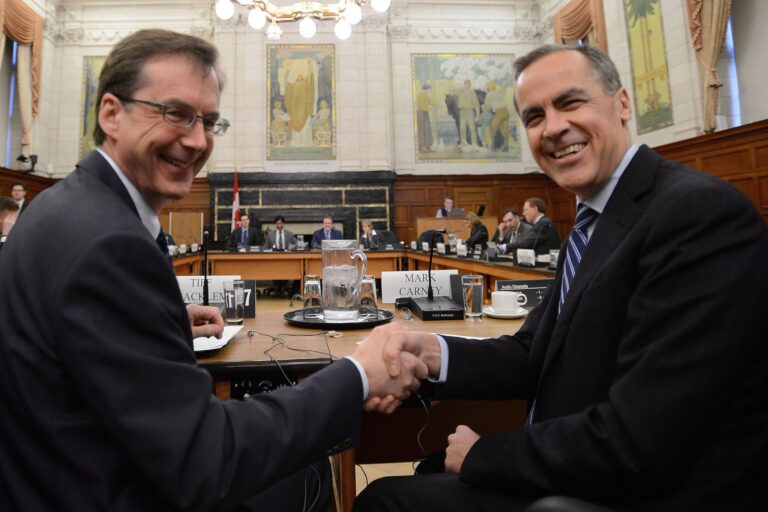

The norm in Ottawa is to discuss Trump’s actions neutrally, as a misplaced word could result in repercussions. Macklem chose to drop his guard and took a side. “Sunday night’s announcements raise it to a new level, and I felt it was important [to say something],” he told The Logic in an interview. “Central bank independence is core to the successful delivery of price stability. That’s why you have a central bank.”
Leave well enough alone: You could organize the history of central banking into three phases. The original central banks attempted to control the money supply by managing a link between government-issued currencies and the price of gold. The Great Depression revealed that this method was too restrictive, as it courted deflation and constrained growth.
But loosening the shackles on central banks introduced the opposite problem, perhaps best exemplified by the runaway inflation of the 1970s. The absence of a physical anchor made monetary policy susceptible to human error and political pressure. As economists studied ways to avoid a repeat of the 1970s, a consensus emerged that the best way to protect the value of money was to give a team of technocrats some marching orders and then stay out of their way. Canada decided on an inflation target of about two per cent that the government would review every five years.
“You have to distinguish between criticism and independence,” Macklem said. “We’re going to get criticism, and it’s important we listen to that criticism. We may agree with it, we may not agree with it, but that doesn’t challenge our independence. At the end of the day, you listen, you make your judgments and you take your decisions.”
Avengers assemble: Central bankers are a tightly knit group. Some might say too tight, as all the big ones misjudged how much help economies needed during the COVID-19 crisis. The global surge in inflation that followed animates the political attacks they are now trying to withstand.
But their cohesion is the reason the recent financial crises haven’t morphed into replays of the Great Depression. They have become adept at flushing fear out of global markets by flooding the system with cash. The Fed is central to this voluntary brigade because the dollar is the de facto reserve currency and U.S. treasuries are de facto risk-free assets. That means that if the Fed is in trouble, everyone is in trouble. After issuing his own statement, Macklem added his signature to a group letter issued by European Central Bank president Christine Lagarde that was also signed by the central bankers from the U.K., Sweden, Denmark, Switzerland, Norway, Iceland, Australia, South Korea, Brazil, South Africa and New Zealand.
“The Federal Reserve is a very important central bank,” Macklem said. “Jay Powell is doing a very good job under very trying circumstances, keeping monetary policy focused on data, on evidence, on facts and free of political influence. I certainly hope it stays that way. I thought it was important to express that.”
It could happen here: Macklem said he’s “highly confident” in the Bank of Canada’s independence from political influence, and that he hasn’t seen any “serious challenges” to the principle during his tenure.
Others are less sure. In 2022, Conservative Leader Pierre Poilievre said he would fire Macklem if he became prime minister. That was a threat, not constructive criticism of the Bank of Canada’s failure to contain inflation after the pandemic. The latest five-year review of the Bank of Canada’s mandate is due by the end of 2026 and some would like to see Prime Minister Mark Carney do some things to protect the central bank from future attacks.
Macklem acknowledged those concerns. He said he’s focused on using the mandate review to make sure the central bank’s dashboard of inflation indicators is up to date and to do some deep research on the relationship between housing and monetary policy.
Still, if others want to discuss independence, Macklem would “welcome the discussion.” Why? Because politics is a copycat sport and what happens in the U.S. tends to be applied elsewhere. “In the United States, the administration of President Trump is challenging the independence of the Fed,” he said. “There’s a risk that when you’re arguably the most important central bank in the world, its independence is under attack, that could affect us all.”



Loading...
Thanks for sharing!
You have shared 5 articles this month and reached the maximum amount of shares available.
CloseThis account has reached its share limit.
If you would like to purchase a sharing license please contact The Logic support at [email protected].
CloseGift the full article!
You have gifted 0 article(s) this month and have 5 remaining.
Recipients will be able to read the full text of the article after submitting their email address. They will not have access to other articles or subscriber benefits.
Photo: Justin Tang/The Logic
Most Popular This Week




In-depth, agenda-setting reporting
Great journalism delivered straight to your inbox.
News
Canada faces a satellite-launch crunch as SpaceX retires its workhorse rocket
Briefing
Cohere says it caught an Alibaba model trying to send data to a server in China
Feds and First Nations to work on sharing resource revenue, with a sovereign wealth fund one option
Zafin buys U.S. fintech Naehas in nine-figure deal
Best business newsletter in Canada
Get up to speed in minutes with insights and analysis on the most important stories of the day, every weekday.
Exclusive events
See the bigger picture with reporters and industry experts in subscriber-exclusive events.
Membership in The Logic Council
Membership provides access to our popular Slack channel, participation in subscriber surveys and invitations to exclusive events with our journalists and special guests.