Inside a dreary meeting room in Halifax late at night on March 19, provincial lawmakers got a reality check. They had assembled hoping to move forward a seemingly straightforward bill aimed at boosting interprovincial trade. It was, they thought, a silver bullet that could help bolster Canada’s economy in the face of U.S. President Donald Trump’s trade war. Then, over the course of three hours, representatives from eight organizations tasked with regulating their professions raised a litany of concerns.
Skip to content

 Nova Scotia Premier Tim Houston was an early mover in introducing legislation to tear down internal trade barriers in response to the trade war. Photo: The Canadian Press/Sean Kilpatrick
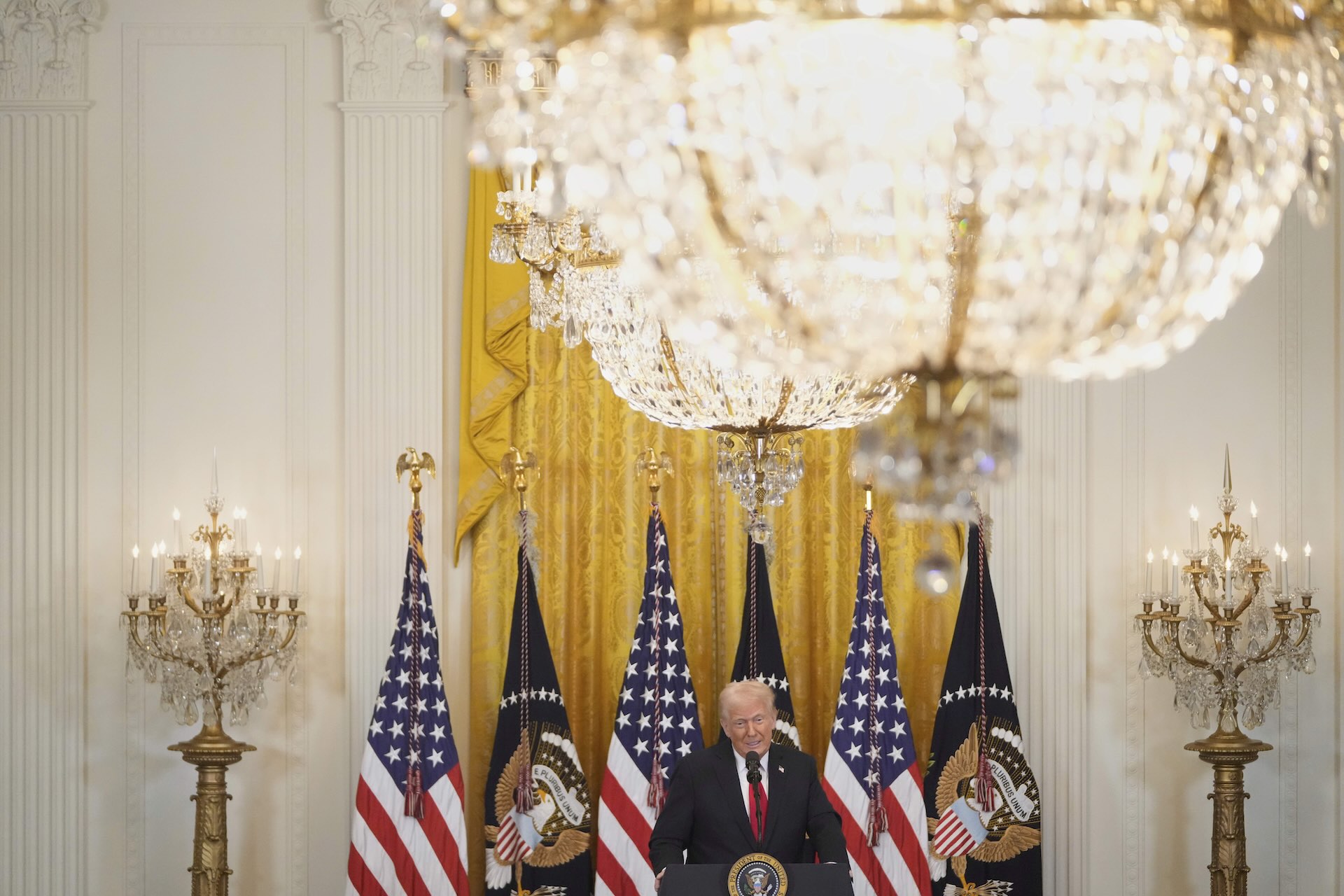 U.S. President Donald Trump delivers a speech in the East Room of the White House. Trump’s trade war could cost the Canadian economy as much as $40 billion this year alone. Photo: AP Photo/Mark Schiefelbein

The Big Read
Inside the great untangling of Canada’s internal trade mess
Fixing internal trade has been presented as a silver bullet to fix Canada’s productivity crisis and protect the country against the ongoing trade war. If only it were that simple.
A freight train near Medicine Hat, Alta. Removing restrictions to interprovincial trade is the oft-cited potential solution to both the trade war and Canada’s productivity crisis. Photo: The Canadian Press/Larry MacDougal
A freight train near Medicine Hat, Alta. Removing restrictions to interprovincial trade is the oft-cited potential solution to both the trade war and Canada’s productivity crisis. Photo: The Canadian Press/Larry MacDougal
Inside a dreary meeting room in Halifax late at night on March 19, provincial lawmakers got a reality check. They had assembled hoping to move forward a seemingly straightforward bill aimed at boosting interprovincial trade. It was, they thought, a silver bullet that could help bolster Canada’s economy in the face of U.S. President Donald Trump’s trade war. Then, over the course of three hours, representatives from eight organizations tasked with regulating their professions raised a litany of concerns.
Jane Corkum of the Nova Scotia Veterinary Medical Association worried delinquent out-of-province vets could practise unchecked in Nova Scotia. Valerie Heard from the Nova Scotia College of Social Workers was concerned about less qualified workers from Alberta—where professionals can be licensed with a diploma rather than a university degree—diluting the quality of care in the province. Patricia Towler, president of CPA Nova Scotia, said under the bill, member accountants could flock to whatever regulator charged the lowest dues, threatening the association’s very existence.
Talking Points
- Removing restrictions to interprovincial trade is often cited as a solution to Canada’s productivity crisis and a way to soften the blow of a trade war with the U.S.
- In the last few months, governments across Canada have moved fast to remove long-standing barriers, with Nova Scotia being the first to table legislation
- Pushback from professional organizations in the province, however, shows that breaking down internal trade barriers will not be a painless fix to Canada’s economic woes
Not everyone in the room was in the mood to hear such excuses. “In 150-plus years of Confederation, this would represent the most important drive towards interprovincial prosperity we might have ever seen,” Ryan Manucha, a research fellow at the C.D. Howe Institute, told those at the meeting.
Since Trump launched a trade war against Canada, including with threats of sweeping tariffs that could devastate the economy of his closest neighbour and ally to the tune of $40 billion this year, Canadian political and business leaders have been searching for ways to make up the losses. With the White House outside of their control, that has also meant looking to resolve Canada’s longstanding productivity problem.
Removing restrictions to interprovincial trade is the oft-cited potential solution to both. In a 2022 report for the Macdonald-Laurier Institute, Manucha and University of Calgary economist Trevor Tombe estimated internal trade barriers increase the average cost of goods and services by eight to 22 per cent.
They and other advocates for liberalizing internal trade argue that adopting mutual recognition agreements would go a long way. That would mean if a good, service or professional credential met the regulatory requirements in one province or territory, it would be accepted by the others—cutting virtually all costs beyond time and transportation. Manucha and Tombe estimated that reducing internal trade barriers in this way could increase Canada’s real GDP by 4.4 to 7.9 per cent over the long term—or by up to $200 billion per year.
Related Articles


Politicians have been talking about untangling interprovincial trade for decades, but, in the last few months, things have moved at relative warp speed. A push to liberalize the sale of booze got a lot of attention, but labour mobility could make a bigger impact. There has been limited research into the potential economic gains from this aspect of internal trade. A 2020 report from the C.D. Howe Institute, also co-authored by Tombe, estimated that in Alberta, the economy would grow by one per cent for each 10 per cent reduction in the cost of bringing in services from other provinces.
Earlier this month, first ministers gave the Committee on Internal Trade, which oversees the implementation of the Canadian Free Trade Agreement (CFTA), until June 1 to sort out how to let anyone with professional credentials get them recognized elsewhere in Canada and be able to start working within 30 days. Quebec is not currently part of that plan but intends to find ways to recognize credentials down the road.
Speeding things up could make a big difference. On March 3, Statistics Canada released data on labour mobility from its first countrywide survey on interprovincial trade. Businesses reported the biggest obstacle to hiring someone from another province was time waiting for that worker to get their licence of certification.
Nova Scotia has moved the fastest. On Feb. 25, Premier Tim Houston introduced a bill that would follow the mutual recognition approach and essentially treat goods and services from other provinces and territories, from wine to welders, as if they were produced in Nova Scotia—as long as those jurisdictions do the same for the Atlantic province. If, say, an engineer who had trained in Alberta wanted to move to Nova Scotia, they could do so and start working right away.
As the Nova Scotia bill moved through the legislative process, complex differences in how the provinces manage and regulate workers showed how labour mobility might be the toughest knot in the midst of the great untangling.
In the face of that pushback from provincial regulators last week, Nova Scotia passed amendments to the bill that would go some way to preserving the authority regulators have over all workers in their jurisdiction, including those from out of province. In return, the regulators will have a tight deadline to grant their approval, so that no one is left waiting for months before they can get to work. Satisfied with the changes, the legislature passed the bill Wednesday. The process gives other provinces a blueprint for how they, too, can tackle trade barriers. It also suggested it won’t be easy.
Nova Scotia NDP Leader Claudia Chender supported the bill, but warned that breaking down interprovincial trade barriers will not be a painless fix to Canada’s economic woes.
“This is a bill that will have literally thousands of unintended consequences,” Chender said in the legislature after the government tabled its amendments. “It will be effective. It will be helpful. But it will be disruptive,” she said. “There will be winners and losers in interprovincial trade. That is why it has been so difficult to move this needle for so long.”
Canada’s current muddle of interprovincial trade rules is based on a series of carve-outs that were, in turn, the result of previous attempts to free up the movement of people, goods and services across Canada. As far back as 1995, Ottawa and the provinces signed the Agreement on Internal Trade to do just that. In 2017, it was replaced by the CFTA, which aimed to cover more sectors than its predecessor. Under the CFTA, regulated professionals should be able to work anywhere in Canada without significantly more training, experience or testing. But regional quirks in laws and standards make that hard to do without risking public security, health and safety—creating yet more exemptions.
The most persistent remaining barriers yet to be toppled are still standing because of a “lack of political will”, said Ryan Mallough, vice-president of legislative affairs in Ontario for the Canadian Federation of Independent Business (CFIB). Protectionism is another motivation. “The belief is that if we open our market, then it will get flooded with other products that hurt our local producers,” he said. “And if they’re not opening theirs, then there’s no advantage.” That same attitude can also get in the way of labour mobility. “The advantage to not letting a nurse in Newfoundland work in New Brunswick is that nurse, who is needed in Newfoundland, is now locked to Newfoundland.”
Many industry associations say they’ve been recognizing professional credentials from other provinces for decades. It’s not about preventing movement, they say, but about not wanting the government to dictate—especially through a blanket approach—how those associations manage those affairs.
Take architects, for example. Margo Dauphinee, executive director of the Nova Scotia Association of Architects (NSAA), said the profession has had mutual recognition agreements across Canada since 1992. An architect that wants to practise in Nova Scotia will need to fill out some paperwork and pay some fees, but the numbers show they are doing so. Nearly 60 per cent of the 538 architects currently licensed to practice in Nova Scotia do not reside in the province. Nearly all of them got their Nova Scotia licence through the reciprocity agreement already in place.“There is no barrier for somebody to become licensed in Nova Scotia and practice architecture if they’re coming from another Canadian jurisdiction,” Dauphinee said.
Pal Mann, CEO of Engineers Nova Scotia, said it takes an average of nine days for an out-of-province engineer to become licensed in Nova Scotia. Similar to the NSAA, that profession has had a national mutual recognition agreement in place since 1999. Nova Scotia’s legal industry also has professional mobility regimes with all other provinces and territories, except Quebec.
Representatives from those and other professions argued that the initial draft of the province’s free-trade bill would effectively deregulate their industries. It could create a labourforce operating unbeknownst to any regulatory authority, they said, with no way to know who is working in the province, and whether they’re licensed and in good standing.
Dauphinee said in an interview that the NSAA was concerned that treating someone licensed outside the province as if they were licensed within the province—without any requirement to register with the local regulatory body—could leave clients in Nova Scotia stranded if something goes wrong. Mann made a similar point, telling the committee the new rules would create a two-tiered system. There would be “registered engineers subject to our oversight” alongside “licensed engineers practicing in Nova Scotia without our knowledge or regulatory oversight.”
The amendments to the bill would address some of those concerns. They require someone seeking professional certification in Nova Scotia to first prove they are in good standing—with no unresolved complaints—in the other jurisdictions where they are licensed. That person would also need to hold liability insurance that satisfies the Nova Scotia regulatory body. At first glance, the amendments would keep the current process for some industries, including architects and engineers, largely intact. It does, however, require regulatory bodies to issue the licence or certification within 10 days.
The legislation also fails to mention professional membership fees—a factor several industry representatives said could be a big problem. “Proper regulation in the public interest requires sustainable funding,” Mann said in his remarks at committee last week. Non-resident registrants contribute about 26 per cent annually to Engineers Nova Scotia’s $3.2 million operating budget, said Mann. That revenue could disappear if non-resident engineers aren’t required to pay dues in Nova Scotia.
Despite their concerns, both Mann and Dauphinee said their organizations support the intent of the bill. Dauphinee said how hard it is to figure out the precise impact of the bill when the government did little to consult with regulatory bodies before introducing the legislation. Her organization is keen to see details of eventual regulations to implement the new regime. “Our main focus is being able to regulate the profession in the public interest, and part of that is the ability to have the financial resources, the human resources, and the processes in place in order to do that,” she said.
While some industries have made big strides to harmonize labour standards and mobility across Canada, barriers still remain. For example, Nova Scotia, New Brunswick and Alberta are the only provinces that regulate interior design as a profession. Designers in those provinces require more training and have more responsibilities. Mutual recognition in that field would create a “backdoor entry” for less qualified designers to take on work they’re not trained for, said Lori Arnold, president of Interior Designers of Nova Scotia.
Even in industries with mutual recognition agreements, standards aren’t always perfectly harmonized. Some provincial engineering regulators, for example, only track names of engineers licensed in their jurisdiction; not whether they’re in good or bad standing.
Rambod Behboodi, an Ottawa-based trade lawyer at Borden Ladner Gervais LLP, said the provincial differences that remain will be stubbornly hard to change. “We’re not going to see the removal of all barriers and nor, frankly, should we in some sectors.”
Even if all trade hurdles fall, Behboodi said he doubts it will do enough to counteract the economic pain from the U.S.-Canada trade war. “It is not going to be a silver bullet,” he said. “Simply put, we have a trillion dollars of trade with the U.S. annually, and no amount of removal of trade barriers across the country is going to replace that.”
For Manucha, higher productivity linked to better internal trade is worth the effort—even if it takes a while. He said adopting the mutual recognition approach is not like flipping a switch but would likely create ripple effects that wash away more barriers over time. He pointed to Australia, where most occupations have allowed workers registered in one state to transfer their credentials to another since the 1990s, as an example of success. He said 20 occupations in Australia moved to adopt national standards within five years.
Guio Jacinto, an economist and researcher at United Steelworkers Canada, said the union supports the idea of labour mobility but wants to ensure that it leads to higher standards, not lower ones. A 2015 report by the Australian government did flag the risk of “shopping and hopping”—applying in a state with fewer training requirements and then moving to another one where a licence would have been harder to get. Manucha said the answer is to find a way to force that one state to raise its standards, such as by refusing to recognize its credentials, not restricting mobility for all.
Manucha said it is hard to approach the labour mobility issue one sector and profession at a time. That’s why he admired the broad-based approach that Nova Scotia used in drafting its bill. He also fully expected there to be carveouts and amendments. That’s the case in Australia, where state and territory governments have excluded some occupations from mutual recognition for safety reasons. In some instances, people looking to work in another state or territory have to inform the local government of that intention. Manucha said this level of friction is not what is getting in the way of interprovincial trade in Canada—and economic productivity. He said the real barriers are when people have to pay thousands of dollars in registration fees and are then kept waiting for months.
Mutual recognition agreements, though, require more than one province to make a move—but that’s already happening. Ontario Premier Doug Ford has said that his first piece of legislation once the provincial legislature resumes sitting on April 14 would be to eliminate the remaining exemptions to the CFTA. On March 21, two days before triggering the federal election, Liberal Leader Mark Carney committed to removing any labour mobility restrictions on federally regulated professions and remaining federal exceptions to the CFTA with legislation introduced by July 1.
Conservative Leader Pierre Poilievre plans to focus on health and safety regulations for tradespeople if his party wins the vote on April 28. “Right now, believe it or not, a tradesworker who goes across the country has to redo the four day health and safety program,” he said recently.
New Brunswick is also moving to allow professionals licensed in other provinces to begin working as soon as they arrive, while they wait for their credentials to be recognized. Having consulted with regulatory bodies ahead of time, New Brunswick Premier Susan Holt suggested she expects a smoother reception than Nova Scotia got. “They understand how it’s designed to let people get to work right away, and bring the skills that they have that have been recognized across Canada into New Brunswick,” she said.
Dismantling internal trade barriers, and realizing the economic benefits of doing so, requires a tremendous amount of co-operation by the provinces, said Mallough from the CFIB. Even though Nova Scotia passed its own bill, It’s effectively worthless if other provinces don’t follow its lead. Until recently, that kind of alignment seemed impossible, said Mallough. “What we’re seeing now is that the [political] will is there,” he said, “and if we can all jump at the same time, fantastic. Let’s do it.” Mallough said he has been encouraged by the recent progress, but also frustrated. “The tariffs are here, and we should have been working on this for 158 years.”
With files from Laura Osman



Loading...
Thanks for sharing!
You have shared 5 articles this month and reached the maximum amount of shares available.
CloseThis account has reached its share limit.
If you would like to purchase a sharing license please contact The Logic support at [email protected].
CloseGift the full article!
You have gifted 0 article(s) this month and have 5 remaining.
Recipients will be able to read the full text of the article after submitting their email address. They will not have access to other articles or subscriber benefits.
Photo: The Canadian Press/Larry MacDougal
Nova Scotia Premier Tim Houston was an early mover in introducing legislation to tear down internal trade barriers in response to the trade war.
U.S. President Donald Trump delivers a speech in the East Room of the White House. Trump’s trade war could cost the Canadian economy as much as $40 billion this year alone.
Most Popular This Week




In-depth, agenda-setting reporting
Great journalism delivered straight to your inbox.
Commentary
Carmichael: Canadian ignorance about India is a strategic weakness
Briefing
Aritzia shares pop after earnings rise 204%
First Nation in Alberta goes to court over fast-tracked oil pipeline
Chinese EV maker Geely Auto Group to launch in Canadian market in 2027
Best business newsletter in Canada
Get up to speed in minutes with insights and analysis on the most important stories of the day, every weekday.
Exclusive events
See the bigger picture with reporters and industry experts in subscriber-exclusive events.
Membership in The Logic Council
Membership provides access to our popular Slack channel, participation in subscriber surveys and invitations to exclusive events with our journalists and special guests.





