I was in Toronto this week and had lunch with someone who knows a lot about innovation policy. At one point, he asked whether Canada had built anything as impressive as the CN Tower since a Sikorsky helicopter called Olga placed the last of the 39 pieces of the antenna in 1975. It was a rhetorical question. We both knew the answer.
Skip to content

Commentary
Carmichael: Carney gives Canada a reality check
This week, the prime minister addressed a nation that may not be ready for the long, hard work ahead of it
Prime Minister Mark Carney makes a speech on Canada’s plan to build a stronger economy in advance of the 2025 budget, at the University of Ottawa on Wednesday, Oct. 22. Photo: The Canadian Press/Sean Kilpatrick
I was in Toronto this week and had lunch with someone who knows a lot about innovation policy. At one point, he asked whether Canada had built anything as impressive as the CN Tower since a Sikorsky helicopter called Olga placed the last of the 39 pieces of the antenna in 1975. It was a rhetorical question. We both knew the answer.
Prime Minister Mark Carney knows the answer, too. “When the Second World War ended, Canada was ambitious, determined and united in a mission to build big things,” he said Wednesday night in a speech at the University of Ottawa that was also broadcast live in prime time.
Carney cited the CN Tower as an example of what we can do when we’re so inclined. He also listed the St. Lawrence Seaway (opened in 1959); the Trans-Canada Highway (opened in 1962), the world’s fair that a Crown corporation hosted in Montreal in 1967; and all the homes and universities that governments built to house and educate veterans of the Second World War.
Related Articles


“We used to build in this country,” Carney said. “We can build again.”
I’m hopeful that Carney can lead an industrial renaissance. The writer and journalist André Pratte once observed that Canada was not a result of popular will, but of the “dreams and aspirations of a few politicians and businessmen and the contract they had signed.” That’s less true today than in 1867, but our various regional identities and jealousies make it hard to generate change from the bottom up. Canada is a country that needs strong leadership to meet its potential, and Carney is the first prime minister since Paul Martin who has preferred the language of pragmatism over ideology.
Listen to how Carney talks about climate change, an existential threat that has nonetheless divided the country for a generation. He said next month’s budget will contain a climate plan, but one that focuses on “results over objectives” and “on investment over prohibition.” The details will matter, obviously. But Carney’s rhetoric implies a willingness to compromise that hasn’t existed in decades.
Still, I can’t say that I’m optimistic. Not yet.
There was little new in Carney’s speech. The objective appeared to be to remind voters of what they hired him to do. “I will always be straight about the challenges we face and the choices we must make,” Carney said. “To be clear, we won’t transform our economy easily or in a few months—it will take some sacrifices and some time.”
Building big things requires a lot of work, a lot of money and a lot of patience. There won’t be dopamine rushes like those that followed former prime minister Stephen Harper’s GST cut, or Justin Trudeau’s err-on-the-side-of-generous COVID-19 rescues. The polls imply we want more Harper- and Trudeau-style dopamine.
Carney is confronting what he calls a “hinge” moment, but Abacus Data’s polling shows that more than 60 per cent of us rank the cost of living as one of their three greatest concerns, while the economy and Trump come in at 38 per cent and 35 per cent, respectively. The political tailwind that swept Carney to power is fading. That needn’t be fatal; President John F. Kennedy’s 1961 pledge to put a man on the moon polled poorly until the U.S. became the first to do it eight years later. But it adds an element of political risk that could make it that much more difficult to overcome uncertainty and secure private investment.
And maybe that’s the risk factor in all of this that we don’t talk about enough—our unreadiness as a society to cope with what’s happening.
Crises tend to surface the ideas of dead thinkers whose ideas would have kept us out of trouble, if only we’d listened. These days there is renewed interest in economist Albert Hirschman, who showed in 1945 that Germany’s industrial policy between the world wars was motivated by a desire to project influence and withstand pressure from rivals such as the U.K.
The revival of what practitioners call geoeconomics is an attempt to explain why theories of international trade that relied on comparative advantage and welfare maximization failed to capture what motivates great powers such as the U.S. and China. It was never only about lower prices, innovation through competition and ending poverty. It was also about power and security.
When geoeconomics dictates international trade, smaller countries must sharpen their survival instincts. Canada has rarely had to work that hard to survive. The big things on Carney’s list were built during a period of great power competition when the triumphant power was friendly and happened to be a neighbour. Geoeconomics was working in our favour.
The contrast is Finland, a country that was forced to choose between the Soviet Union and Nazi Germany. It chose Germany because more than 20,000 Finns died while trying to repel a Soviet invasion in 1939, and most believed Stalin would try again. That’s what happened.
Finland built big things after the war too, but in the shadow of menace. Under the conditions of the armistice, Finland had to imprison some of its own leaders, pay the Soviet Union reparations and agree to trade with a communist regime that was bent on absorbing the tiny democracies on its borders. The three years that followed the end of the Second World War were known in Finland as “the years of danger.”
It would have been reasonable to concede to the hegemon next door. But as Jared Diamond describes it in his book Upheaval: Turning Points for Nations in Crisis, Finns and their leaders were prepared to do whatever it took to protect their independence. They created an industrial economy from scratch in order to generate the wealth they needed to pay reparations. They embraced democratic capitalism, but their foreign policy was based on keeping the Soviet Union happy. Public criticism of the totalitarian state next door was strongly discouraged.
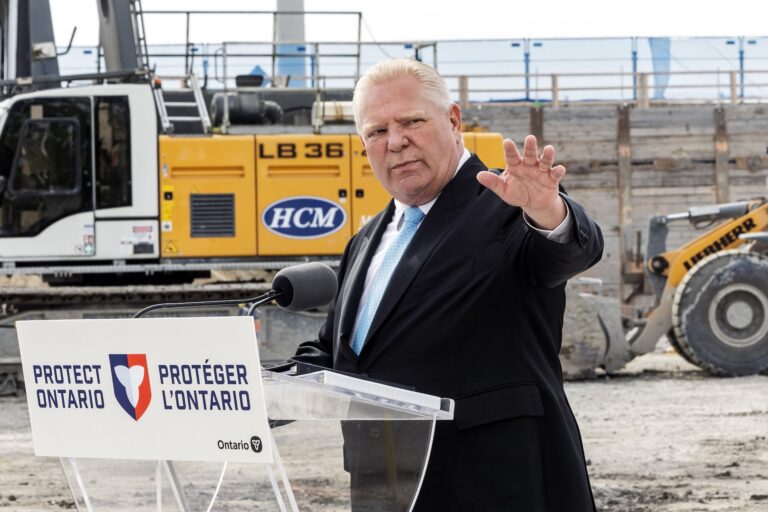
That last point echoed loudly Friday after Trump ended trade negotiations with Canada over Ontario’s anti-tariff television ads that feature former Republican president Ronald Reagan. As Manitoba Premier Wab Kinew said, the ads are good. But when analyzed through the lens of geoeconomics, are they helpful?
That’s also a rhetorical question.
Kevin Carmichael is The Logic’s economics columnist and editor-at-large. He has spent more than two decades covering economics, business and finance for outlets including Bloomberg News, The Globe and Mail and the Financial Post, where he also served as editor-in-chief.



Loading...
Thanks for sharing!
You have shared 5 articles this month and reached the maximum amount of shares available.
CloseThis account has reached its share limit.
If you would like to purchase a sharing license please contact The Logic support at [email protected].
CloseGift the full article!
You have gifted 0 article(s) this month and have 5 remaining.
Recipients will be able to read the full text of the article after submitting their email address. They will not have access to other articles or subscriber benefits.
Photo: The Canadian Press/Sean Kilpatrick
Most Popular This Week




In-depth, agenda-setting reporting
Great journalism delivered straight to your inbox.
News
Canada faces a satellite-launch crunch as SpaceX retires its workhorse rocket
Briefing
Rio Tinto gets nearly $165M in additional federal funds for Quebec aluminum
U.S. to lift tariffs on some Canadian products crucial to Maine: Collins
Carney warns of tech dependence after Starlink disruptions in Ukraine
Best business newsletter in Canada
Get up to speed in minutes with insights and analysis on the most important stories of the day, every weekday.
Exclusive events
See the bigger picture with reporters and industry experts in subscriber-exclusive events.
Membership in The Logic Council
Membership provides access to our popular Slack channel, participation in subscriber surveys and invitations to exclusive events with our journalists and special guests.