
Listen Now
0:00
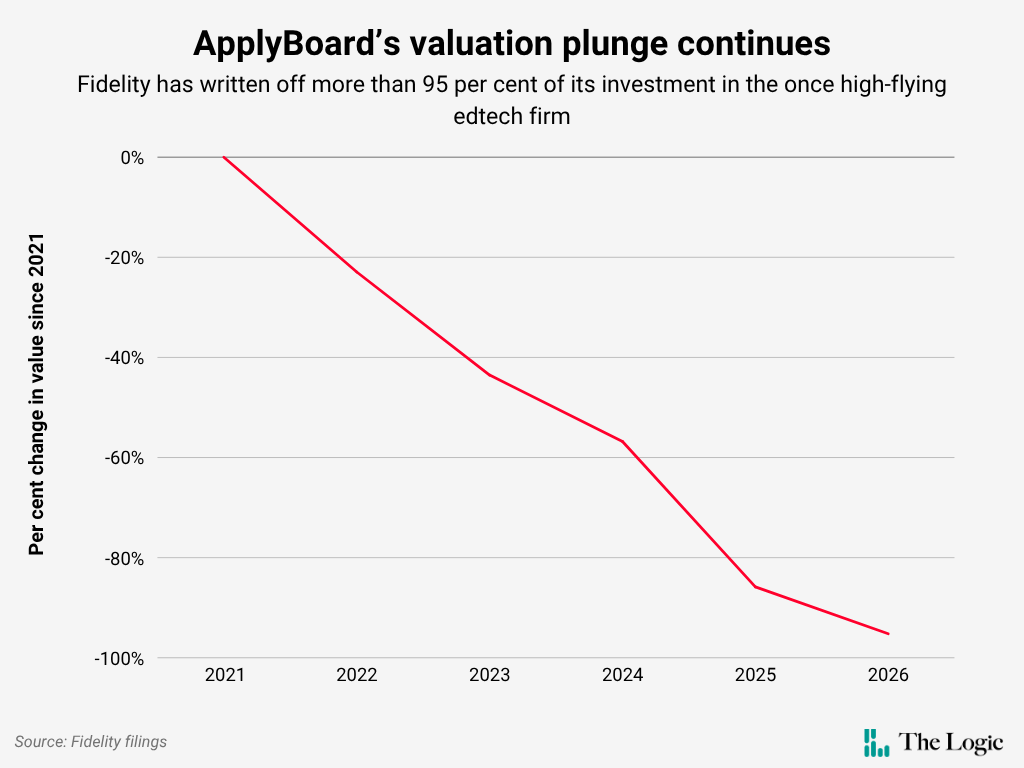
ApplyBoard, a Waterloo-region startup that operates a platform connecting prospective international students with universities and colleges, was the worst-performing Canadian startup in Fidelity’s portfolio in 2026, losing about two-thirds of its value over the past year.
The asset management giant’s stake in ApplyBoard is now worth about $5.4 million, down from about $113 million at its peak in 2021, according to Fidelity’s annual filing for its Canadian funds. Richard Rémillard, an Ottawa-based financial services consultant and former executive director of the Canadian Venture Capital & Private Equity Association, said the decline is likely significant enough to drag down Fidelity’s overall returns from its Canadian startup investments, which could make other foreign investors think twice before deploying their own capital.
Talking Points
- Asset management giant Fidelity wrote down the value of its stake in ApplyBoard, a Waterloo-region company that connects prospective international students with universities and colleges, by about two-thirds in 2026 from the previous year, more than any other Canadian startup in its portfolio
- Fidelity’s holdings in ApplyBoard are large enough that the writedown is likely dragging down its overall returns in the Canadian venture market, which could make other foreign investors think twice before deploying their own capital, former Canadian Venture Capital & Private Equity Association executive director Richard Rémillard said
“Fidelity has instant name recognition and a long track record,” Rémillard said. “Its actions could have considerable influence on the actions of other funds, both U.S. and international, considering exposure to the Canadian market.”
ApplyBoard’s valuation soared to $4 billion in 2021 amid looser immigration policies during the pandemic, which made it easier and more attractive for international students to come to Canada. In addition to Fidelity, it counts heavy-hitting institutional investors including the Ontario Teachers’ Pension Plan, La Caisse and the Business Development Bank of Canada.
Since then, the Canadian government has rolled back many of those policies, sending ApplyBoard’s valuation plunging. Its revenue has flatlined despite efforts to diversify into other international markets and supplementary business lines such as test vouchers, a May investigation by The Logic found.
Related Articles


In an email, ApplyBoard spokesperson Tony Vlismas said Fidelity’s accountants likely compared the startup to IDP Education, a publicly traded competitor that has lost more than 90 per cent of its value since 2021. “ApplyBoard is a technology platform built on a different model, but when a sector’s public benchmark falls that far, private valuations across the sector follow,” he said.
Vlismas said immigration policy changes in Canada, the U.S., the U.K. and Australia “have made the past few years the most disruptive in modern international education.” Canadian international student visa approval rates rose in early 2026, which he said reflects “a market rewarding quality and transparency.”
Vancouver’s Hootsuite, which makes social media management software, posted the second-largest one-year decline in Fidelity’s portfolio, losing almost half its value. In April, co-founder Ryan Holmes returned as interim CEO, saying he planned to take advantage of the opportunities artificial intelligence presents. Spokesperson Catherine Kee declined to comment on Fidelity’s markdown.
Fidelity’s filings provide a rare public window into how major investors value their private holdings. Mutual funds, including some of Fidelity’s Canadian offerings, sometimes take stakes in private companies, and regulators require them to disclose how the holdings are performing. ApplyBoard and Hootsuite’s markdowns come amid a broad selloff among software companies seen as vulnerable to AI, although some firms have recovered in recent months.
Chris Pepper, a spokesperson for Fidelity Canada, said in an email that the investment manager takes stakes in startups to learn about cutting-edge tech that might affect other companies in its portfolio, not just to generate returns. “As with public markets, valuations of individual private companies will move over time. We take a long-term approach and evaluate each investment based on its individual fundamentals and prospects rather than short-term changes in valuation,” he said.
Rémillard said Fidelity’s Canadian startup portfolio follows a typical pattern. Successful venture capital investing, he said, relies on one or two standout companies to make up for “all the rest of the non-performers and the absolute dogs that are killing your returns.” However, the Canadian tech industry has far fewer rocketship successes than the U.S., making it difficult for the venture funding model to work, he said. “There is a crying need for the industry to attract more capital. The challenge remains performance.”