OTTAWA — Canada has launched the Canadian AI Safety Institute (CAISI) a new organization that will test artificial intelligence models and study the technology’s risks.
Skip to content

News
Canada just launched its own AI safety institute
The Canadian AI Safety Institute will join similar organizations around the world in overseeing the testing of models and in assessing AI’s risks
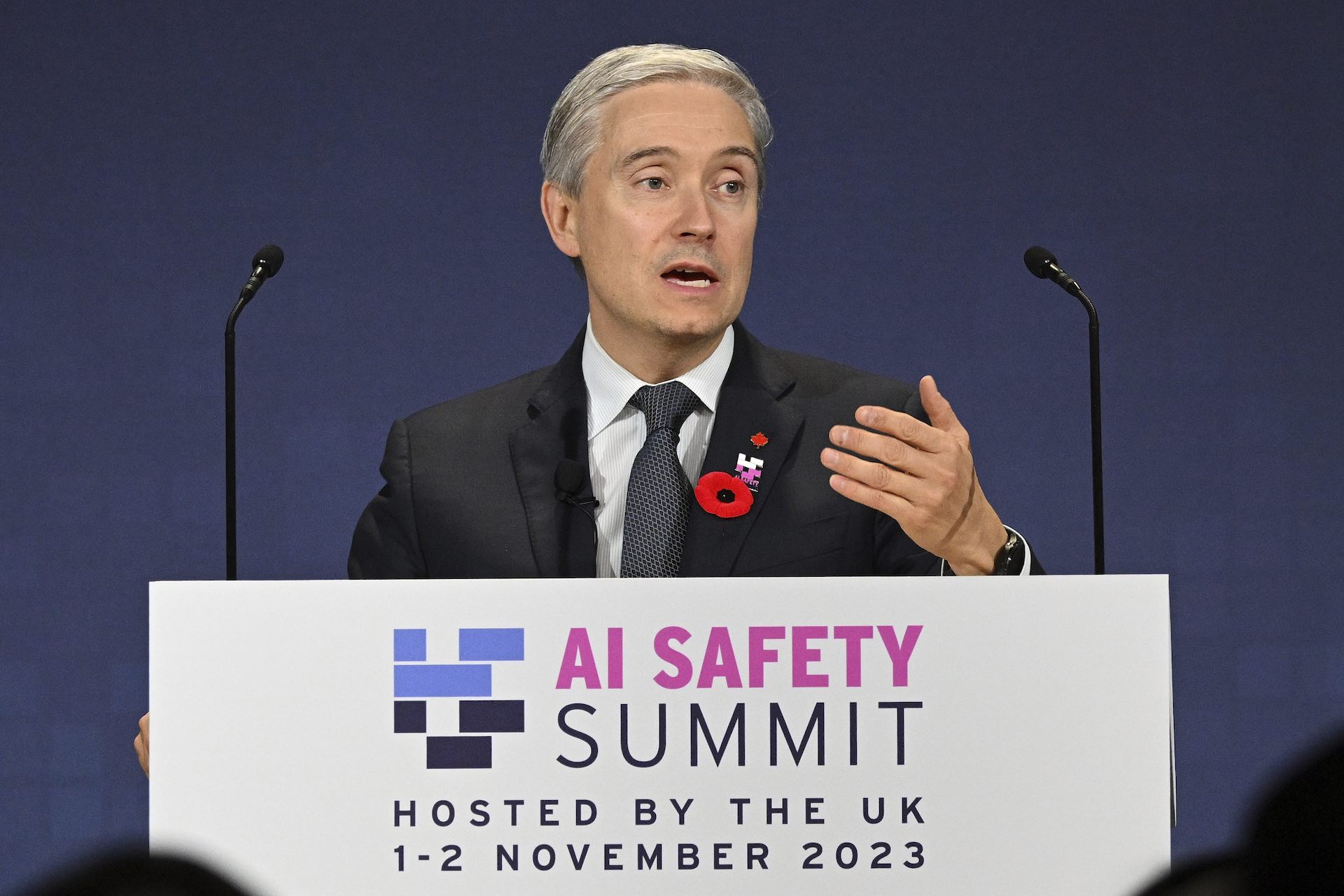
Innovation Minister François-Philippe Champagne at the AI Safety Summit at Bletchley Park, in Bletchley, England, in Nov. 2023. Photo: Leon Neal/Pool Photo via AP
OTTAWA — Canada has launched the Canadian AI Safety Institute (CAISI) a new organization that will test artificial intelligence models and study the technology’s risks.
The centre will work with a growing collection of similar agencies in other countries, which are scheduled to meet in San Francisco next week. “Users of AI need to feel that this new technology is safe and secure,” Innovation Minister François-Philippe Champagne said, adding that the new program is designed to help build trust to encourage adoption, which in turn will boost productivity.
Talking Points
- The federal government has launched the Canadian AI Safety Institute to test artificial intelligence models and fund research into the technology’s applications and risks
- The new organization joins a growing network of similar centres around the world, with officials scheduled to meet in San Francisco next week to discuss how they can work together
The CAISI’s mandate includes testing models. Ottawa is still determining what kinds of risks it will check for and whether it will seek to assess systems before they are released, said a senior government official, speaking on condition of anonymity.
Champagne first signalled his interest in such a centre last November, in an interview with The Logic at the AI Safety Summit at Bletchley Park in the U.K. Both the U.K. and U.S. announced plans for institutes at the conference. The Liberal government’s April budget allocated $50 million to establish a Canadian version.
The CAISI will be housed within the federal innovation department. Ottawa will fund researchers studying the technology’s applications via the Canadian Institute for Advanced Research (CIFAR), which already runs the national AI strategy. The National Research Council of Canada, meanwhile, will tackle public policy issues related to AI like cybersecurity.
Both the U.K. and U.S. institutes were set up in part to test models submitted voluntarily by their makers. At Bletchley, eight major AI developers agreed to let the U.K. AI Safety Institute check their products pre-launch, but it has subsequently faced challenges accessing those systems. This August, the U.S. AI Safety Institute announced an understanding with OpenAI and Anthropic to assess their models. London and Washington have signed a deal to share information and jointly develop evaluations.
Related Articles


Leading AI firms have pushed for such institutes to collaborate on safety testing and research, so that they don’t have to submit to all of them. In May, Ottawa and 10 other governments agreed to have their centres work together. The Canadian government official said the institutes will use the San Francisco meeting and France’s AI summit next February to discuss what that will look like.
The country’s AI talent pool can contribute to global efforts to understand the technology, according to Yoshua Bengio, the decorated computer scientist who’s advising Ottawa and other governments. “To bring out the benefits of AI, we need to steer it wisely,” he said. “This institute will certainly help our research ecosystem on this front.”
The CAISI should focus on “real-world risk and applications” of the technology, and work with startups as well as researchers as it designs its programming, said Melika Carroll, head of global government affairs at Toronto-based AI firm Cohere, in an interview last month.
It will cost startups time and resources to get products tested, so they’re more likely to participate if the evaluation focuses on issues that customers care about—like privacy, security and bias, according to Carroll.
Clients may still want a seal of approval from their home-country regulator for any AI product they buy, but governments could decrease duplication by recognizing each others’ assessments. Carroll also called for the AI safety institutes to share data with startups on the threats their technology might face.
In a statement Tuesday, Caroll said the CAISI will bolster “Canada’s continued AI innovation leadership position.”
Ottawa is giving CIFAR $27 million for its part of the program. The money will pay for projects that bring together researchers around the country, working in both computer and social sciences. It will also subsidize Canada’s three AI institutes in Edmonton, Toronto and Montreal to hire staff scientists to examine safety issues.
The program will study immediate concerns about the technology such as bias and AI-generated disinformation, according to Elissa Strome, CIFAR’s executive director for the national AI strategy. Such issues have both technical and social implications, and “we need to be working on them urgently,” Strome said. But the CAISI “can’t ignore” the existential risks AI may pose, she added.
CAISI joins other federal initiatives designed to foster trust in AI in a bid to encourage businesses to adopt it. In September 2023, Cohere was among the first batch of firms to sign on to Ottawa’s voluntary code of conduct for generative AI. Signatories commit to assess the potential negative impacts of their products and to work with researchers focused on responsible AI.
The Liberal government’s proposed Artificial Intelligence and Data Act, meanwhile, remains stalled at a Parliamentary committee.



Loading...
Thanks for sharing!
You have shared 5 articles this month and reached the maximum amount of shares available.
CloseThis account has reached its share limit.
If you would like to purchase a sharing license please contact The Logic support at [email protected].
CloseGift the full article!
You have gifted 0 article(s) this month and have 5 remaining.
Recipients will be able to read the full text of the article after submitting their email address. They will not have access to other articles or subscriber benefits.
Photo: Leon Neal/Pool Photo via AP
Most Popular This Week




In-depth, agenda-setting reporting
Great journalism delivered straight to your inbox.
The Big Read
Alberta’s referendum is just the start of the turmoil
Briefing
EverWind plans $10B data centre and wind development in Nova Scotia
Canada ready to force Stelco to sell its Canadian operations, Joly says
Feds plan a 60 MW defence-oriented data centre for Ottawa
Best business newsletter in Canada
Get up to speed in minutes with insights and analysis on the most important stories of the day, every weekday.
Exclusive events
See the bigger picture with reporters and industry experts in subscriber-exclusive events.
Membership in The Logic Council
Membership provides access to our popular Slack channel, participation in subscriber surveys and invitations to exclusive events with our journalists and special guests.






