U.S. President Donald Trump spared Canada from another layer of punishing tariffs Wednesday as he escalated his trade war against the rest of the world, while extending indefinitely the carve-out for Canadian goods moving through the North American trade pact.
Skip to content

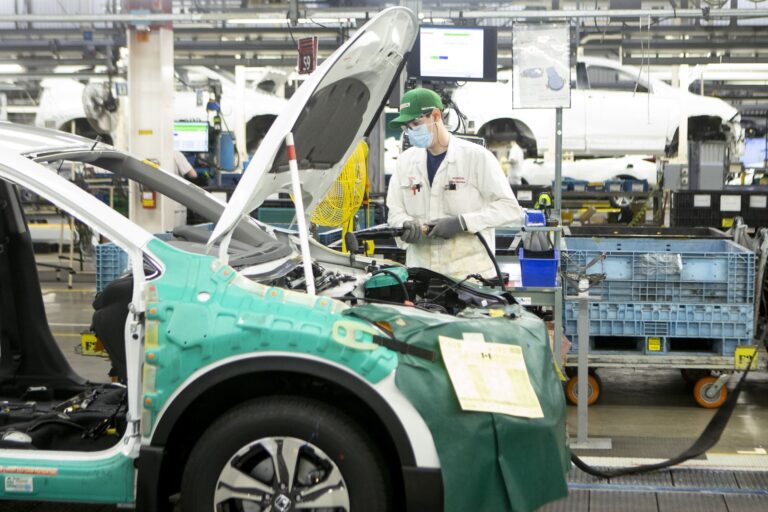
 An assembly line at Honda Canada's plant in Alliston, Ont. Photo: The Canadian Press/Chris Young
Special Report
Canada avoids the worst of Trump’s tariffs—for now
Goods that comply with USMCA won’t face tariffs, but Trump confirms 25% levy on autos will go ahead
President Donald Trump announces new tariffs in the Rose Garden at the White House. Photo: AP Photo/Mark Schiefelbein
U.S. President Donald Trump spared Canada from another layer of punishing tariffs Wednesday as he escalated his trade war against the rest of the world, while extending indefinitely the carve-out for Canadian goods moving through the North American trade pact.
Talking Points
- U.S. President Donald Trump brought in minimum 10 per cent tariffs on goods from all countries on Wednesday, and higher rates on imports from countries he accuses of unfair trade practices
- The White House confirmed that goods from Canada and Mexico that comply with the United States-Mexico-Canada Agreement will not be subject to those tariffs; those that don’t will face 25 per cent levies, with a lower 10 per cent rate for energy and potash
- Trump also confirmed the U.S. will go ahead with planned 25 per cent tariffs on light-duty vehicles, a move that could devastate Canada’s auto industry
A lasting, but partial, reprieve
Neither Canada nor Mexico made the list of countries to be hit with individualized reciprocal tariffs that Trump unveiled with the fanfare of a game-show host on his promised “Liberation Day.” The White House said the fentanyl-related tariffs on both those countries remain in place, but so does the partial reprieve Trump granted last month.
That includes a carve-out for goods that go through the United States-Mexico-Canada Agreement (USMCA). U.S. trade data shows about 38 per cent of total Canadian exports to the U.S. went through the trade deal last year. Since World Trade Organization rules allowed most Canadian exports to enter the U.S. with low or non-existent duties, many businesses did not bother to complete the paperwork needed to prove compliance. Many have since been scrambling to go through that process. Those efforts are likely to increase now that the U.S. is allowing the exemption to stay—while still keeping the 25 per cent duty on anything outside it. The lower 10 per cent levy on non-USMCA Canadian energy products and potash, a key ingredient in fertilizers, also remains in place.
Related Articles

If Trump decides to end the fentanyl-related tariffs, then non-compliant USMCA goods will face a 12 per cent duty. Anything moving through USMCA, which is set to be reviewed by July 2026, will not face an additional tariff. Trump did not share these details in his speech in the Rose Garden, although he did repeat previous grievances against Canada.
Auto tariffs still on
While his announcement left Canadians in many sectors breathing easier, Trump confirmed that 25 per cent tariffs on light-duty vehicles imported to the U.S. will take effect on Thursday. As a result, noted Cory Renner, associate director of economic forecasting at Conference Board of Canada, celebrations will be limited for automaking hubs like Windsor, Ont., which will be “hit hard.” The executive order for the vehicle tariffs also applies to major parts like engines, transmissions and electrical components by May 3.
Auto levies could add up quickly, given how many Canadian parts end up in American vehicles. TD Economics has estimated that vehicles make up nearly 15 per cent of the country’s southbound shipments, and auto parts alone are four per cent of total Canadian trade with the U.S.
David Adams, president and CEO of Global Automakers of Canada, said in a statement that the auto tariffs will still raise the cost of vehicles, adding that political leaders must “think carefully” about how to respond, with a focus on “stability and maintaining competitiveness while minimizing unintended consequences.”
Trump versus rest of the world
Canada’s day of relative reprieve was one of pain for scores of other nations. Trump invoked emergency powers to bring in a 10 per cent tariff on all countries, which the White House characterized as a response to a “national emergency posed by the large and persistent trade deficit” linked to unfair trade practices. That will take effect at 12:01 a.m. EDT on Saturday.
Some of those countries will face higher duties he calls reciprocal tariffs. Trump said those amounts were determined by calculating what his administration considers to be the total number of trade barriers imposed on the U.S., including non-monetary measures, then cutting it in half. The chart he held at the podium showed amounts that did not strictly adhere to that formula.
The White House said those tariffs will take effect on April 9 at 12:01 a.m. EDT and remain in effect “until such a time as President Trump determines that the threat posed by the trade deficit and underlying nonreciprocal treatment is satisfied, resolved, or mitigated.”
Reciprocal tariffs, explained
Trump announced in February that he would impose tariffs to counter trade measures other countries have set up against the U.S.—a wide-ranging definition that includes subsidies, red tape and “unfair, discriminatory, or extraterritorial taxes.” The White House singled out Canada’s three per cent digital services tax as an irritant. It was not mentioned in the executive order published Wednesday. The scope and the details have shifted over time, which has increased uncertainty for businesses.
Canada’s response
Liberal Leader Mark Carney, in his capacity as the sitting prime minister, said he’d convene a meeting with the premiers Thursday morning and would deliver Canada’s response after that.
Canada already has counter-tariffs on nearly $60 billion worth of U.S. products in place, and Carney warned Trump last week he was ready to step up the country’s response. Under former prime minister Justin Trudeau, Ottawa had planned another wave of counter-tariffs on $125 billion worth of U.S. goods, then delayed implementing them after Trump granted the partial reprieve. Cars and trucks, plus many of their parts, were on that list. That was before Trump announced the 25 per cent tariffs on vehicles.
This week, Carney seemed open to narrowing down the proposed countermeasures. “We will not disadvantage Canadian producers and Canadian workers relative to American workers,” he said Tuesday in Winnipeg.
On the campaign trail
“In a crisis, it’s important to come together, and it’s essential to act with purpose and with force,” Carney said Wednesday evening. The lack of new measures targeting Canada means preserving important parts of the economic relationship, he said. But the existing tariffs remain in place, new ones are about to hit the auto sector and Trump has signalled that more are coming to cover pharmaceuticals, lumber and semiconductors.
Furthermore, the new tariffs on countries Trump hadn’t previously targeted will change the global economy, Carney said. “President Trump has just announced a series of measures that are going to fundamentally change the international trading system,” he said. They’ll affect the United States, increasingly seriously as time goes on, and will affect millions of Canadians, Carney said.
Conservative Leader Pierre Poilievre addressed Trump’s action briefly just after taking the stage at a rally in Kingston, Ont.
“The president is betraying America’s closest friend and attacking our economy, proving once again that Canada must end its era of overdependence and weakness,” he said.
A Conservative government “will push hard to put an end to these tariffs and get a quick but fair deal that protects our sovereignty, knocks down all the tariffs and allows us to rebuild our military so that we can be a true sovereign nation,” he added.



Loading...
Thanks for sharing!
You have shared 5 articles this month and reached the maximum amount of shares available.
CloseThis account has reached its share limit.
If you would like to purchase a sharing license please contact The Logic support at [email protected].
CloseGift the full article!
You have gifted 0 article(s) this month and have 5 remaining.
Recipients will be able to read the full text of the article after submitting their email address. They will not have access to other articles or subscriber benefits.
Photo: AP Photo/Mark Schiefelbein
An assembly line at Honda Canada's plant in Alliston, Ont.
Most Popular This Week




In-depth, agenda-setting reporting
Great journalism delivered straight to your inbox.
News
Canada faces a satellite-launch crunch as SpaceX retires its workhorse rocket
Briefing
Rio Tinto gets nearly $165M in additional federal funds for Quebec aluminum
U.S. to lift tariffs on some Canadian products crucial to Maine: Collins
Carney warns of tech dependence after Starlink disruptions in Ukraine
Best business newsletter in Canada
Get up to speed in minutes with insights and analysis on the most important stories of the day, every weekday.
Exclusive events
See the bigger picture with reporters and industry experts in subscriber-exclusive events.
Membership in The Logic Council
Membership provides access to our popular Slack channel, participation in subscriber surveys and invitations to exclusive events with our journalists and special guests.






