OTTAWA — Whether Canada chooses to keep or abort its plan to buy 88 F-35 fighter jets from U.S. defence contractor Lockheed Martin, President Donald Trump’s tariffs could demolish the deal’s economic benefits for Canada.
Skip to content

 Sweden-based Saab offered to build and maintain Gripen E jets on Canadian soil. Photo: AP Photo/Andre Penner
News
Trump’s tariff mania shoots holes in economic case for buying F-35s
Competing bid from Sweden would bring production, engineering and maintenance of fighter jets to Canada—if it’s still on the table
Canada is obliged to buy 16 F-35 fighter jets similar to these aircraft, which appeared at a 2019 air show in Ottawa, with the option to acquire another 72. Photo: The Canadian Press/Adrian Wyld
OTTAWA — Whether Canada chooses to keep or abort its plan to buy 88 F-35 fighter jets from U.S. defence contractor Lockheed Martin, President Donald Trump’s tariffs could demolish the deal’s economic benefits for Canada.
The F-35 is a plane born from free-trade agreements and the NATO military alliance, both of which the United States is repudiating to varying degrees.
Talking Points
- The F-35 was conceived as an ultra-advanced fighter jet developed and built together by tight allies in both trade and security
- The U.S.’s new affinity for tariffs could rule Canadian vendors out of the planes’ supply chain, even if Canada proceeds with plans to buy $19 billion worth of them
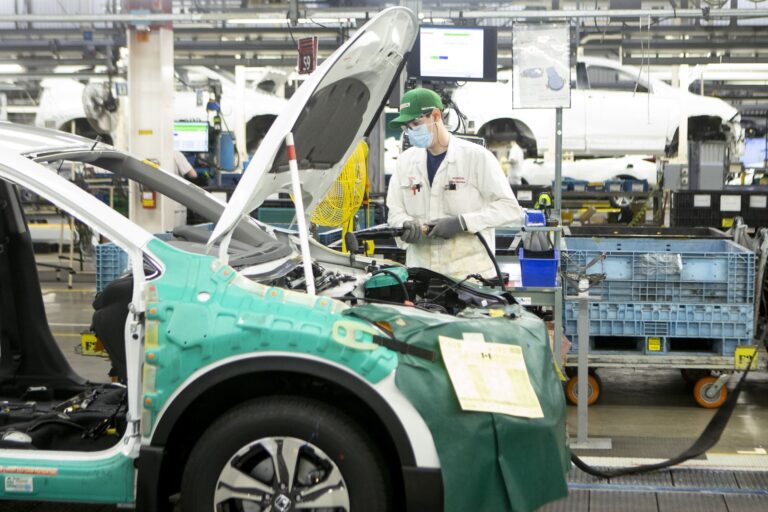
“A lot of this is like the auto sector—it’s integrated, back-and-forth, complex manufacturing,” said David Perry, president of the Canadian Global Affairs Institute and a specialist in military procurement.
Lockheed’s main assembly line for F-35s is in Fort Worth, Texas, where components sourced from all over the world, including Canada, are put together into some of the most advanced planes ever to fly. Those components often take long, circuitous routes before they get there.
And like the cross-border supply chains for a North American-made Toyota or Ford, the chains connecting Canadian suppliers to the Fort Worth jet factory could snap under Trump’s pressure.
During his short stint as prime minister before calling an election, Liberal Leader Mark Carney asked the defence ministry to reconsider the $19-billion purchase, partly on industrial grounds. Canada is contractually obliged to buy 16 F-35s, but the other 72 are not locked in.
Related Articles
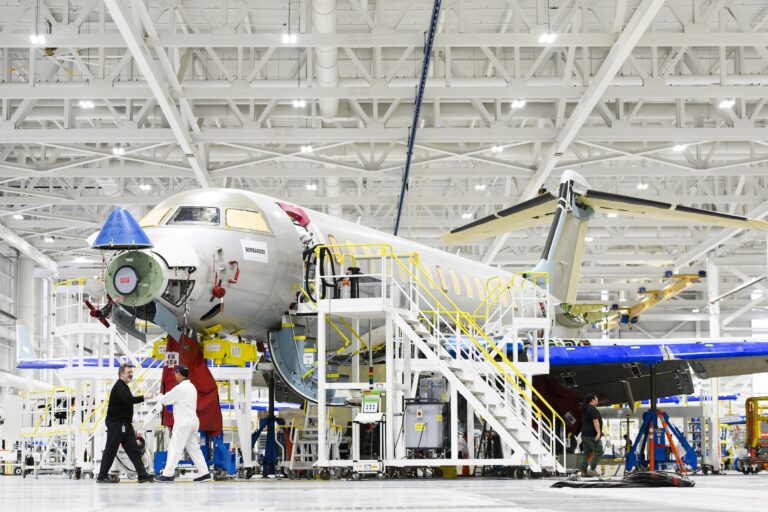
The review “will explore how the F-35 program could be adjusted, including greater investment here in Canada, greater production here in Canada,” Carney said last week in a Halifax news conference.
It’s also, of course, about whether Canada should buy crucial military equipment from the United States amid a trade war and the administration’s threats to this country’s independence.
An air force in need
The Royal Canadian Air Force’s current CF-18s date to the 1980s; they were wearing out nearly a decade ago. They’ve been overhauled, and reinforced with used Australian jets; even so, they’re in poor shape. On the current schedule, F-35s are supposed to arrive just in time, with the first one due in 2028. Bailing out would be a huge problem for Canada’s air force.
But sticking with the F-35—as opposed to, say, the second-place finisher in Canada’s fighter-jet competition, the Gripen E from Sweden’s Saab—could be a big problem for Canadian industry.
Traditionally, large Canadian defence contracts demand that foreign bidders make pledges of “industrial and technological benefits” for Canada. Yet the F-35 deal Canada signed in 2023 wasn’t traditional.
The F-35 program was meant from the beginning to be a long-term project shared among allies and trading partners. Some other countries could buy F-35s, but Canada was in the core international partnership designing and producing the planes along with the U.S., the United Kingdom, Italy, the Netherlands, Australia, Denmark and Norway.
We had economic opportunity that was consequential, but not assured legally.
That gave Canadian suppliers the right to bid to make parts for Lockheed, the prime contractor, to assemble into finished planes. Canadian companies still had to compete for the business, but they’d be up against bidders from a limited number of partner countries, for the chance to sell into a program that might build more than 3,450 jets.
The thing is, none of that business was guaranteed. Canadian suppliers have booked $3.3 billion in F-35 business as of January 2025, according to the federal government, but could in theory have ended up with nothing if they didn’t make better bids than suppliers from other countries. “We had economic opportunity that was consequential, but not assured legally,” said Perry.
A Lockheed Martin spokesperson, Amanda Hauck, emphasized the point: “As an F-35 partner nation, having participated in the program from its inception, Canada has had the benefit of competing for work,” she wrote in an email.
Suppliers in jeopardy
The F-35 supply chain already has numerous Canadian vendors, counting some Canadian subsidiaries of American enterprises, even though not a single plane has been delivered here yet.
Magellan Aerospace touts its factory in Kitchener, Ont., as the first non-U.S. supplier to deliver F-35 parts, all the way back in 2003; it makes machined titanium components, including the planes’ horizontal tailpieces. A steady stream of orders for F-35s factored into Magellan’s 2025 outlook.
Héroux-Devtek of Longueuil, Que., recently bought by a U.S. private equity firm, makes landing gears and related components. Its sales of F-35 parts helped push its defence sales up by tens of millions of dollars, or nearly 22 per cent, in the first half of its fiscal year, according to a release in November.
Lockheed has noted many others, with Canadian producers contributing everything from composite parts for the F-35’s fuselage to circuit boards for its external lights. In a 2023 presentation deck, the company said more than 110 Canadian companies had been involved to that point, and every F-35 off the line had US$2.5 million in Canadian components in it.
(None of the suppliers contacted by The Logic responded to questions about what tariffs could mean for its business.)
If a part that comes from Canada becomes 25 per cent more expensive for Lockheed because of U.S. tariffs—or many times that, if the part crosses the U.S. border several times as it’s being produced—the supplier becomes much less attractive. “What does that potentially do to their competitive position?” Perry asked rhetorically.
Hauck couldn’t say. “We are carefully evaluating the [Trump administration’s] announcements and will work with our suppliers to address any potential impacts,” she wrote.
The Swedish option
Saab’s Gripens, in contrast, would have been sold to Canada in a more traditional type of defence procurement. Saab was promising to assemble the planes in Canada—effectively creating a new industry in a country that makes civilian planes but not military ones. That’s how Saab is supplying Gripens to Brazil’s air force.
“Saab was bringing production and localizing it in Canada, whereas the F-35 was taking Canadian production and internationalizing it,” Perry said.
Talks with Saab never reached the point of signing an agreement with the government, even conditionally, but the company publicly promised Canada an array of goodies in pursuit of the Gripen deal. Those included:
- A pair of aerospace engineering centres in greater Montreal, one of them dedicated to the Gripens and one with a wider scope.
- A sensor-development site in Vancouver that would also develop systems to be sold internationally for tracking orbital space junk.
- A cybersecurity development and testing centre in Toronto.
Saab also signed a preliminary deal with maintenance firm StandardAero to service Gripen engines in Winnipeg.
Whether those exact enticements are still available if Canada comes calling again isn’t certain. “Saab is always ready to discuss offering our Gripen E fighter aircraft to nations seeking a cutting-edge, multi-role air combat system,” Saab Canada president Simon Carroll told The Logic in an emailed statement, but that’s as far as the company would go.
The Gripen, it’s worth noting, includes U.S.-made components. So if things get even uglier between Canada and the United States, it could forbid Saab to sell Canada planes with American parts.
Plane politics
Going further than the review Carney initiated, the NDP has promised to scrap the F-35 plans if it’s elected.
“We’ll cancel the F-35 contract, and build the fighter jets Canada needs in Canada, using Canadian workers,” NDP Leader Jagmeet Singh said in a statement about the party’s defence policies.
The Conservatives don’t quite take a position on the F-35 contract. Spokesperson Sam Lilly repeated a statement issued by Tory defence critic James Bezan earlier in March: “If the U.S. administration continues to demonstrate that it is an unreliable partner and ally, then Canada will need to look for other options when it comes to defence purchases for the Canadian Armed Forces.”
What would Perry do about the 72 additional F-35s? “Lose a lot of sleep and resort to heavy drinking,” he joked bleakly.
Putting off getting new jets would be terrible for Canada’s air force, he said. Getting F-35s that put the air force at the mercy of a hostile U.S. administration would also be bad. But then, so would spending billions of Canadian dollars on American planes made without Canadian components because of U.S. trade policy.
Playing for time—sticking with the F-35s but going slowly—might be the best bet, Perry said. With luck, he added, Canada might avoid committing to the next tranche before it has a clear new sense of a relationship that took an abrupt turn upon Trump’s inauguration. “All the options here suck compared to getting in a time machine and going back to the 19th of January.”



Loading...
Thanks for sharing!
You have shared 5 articles this month and reached the maximum amount of shares available.
CloseThis account has reached its share limit.
If you would like to purchase a sharing license please contact The Logic support at [email protected].
CloseGift the full article!
You have gifted 0 article(s) this month and have 5 remaining.
Recipients will be able to read the full text of the article after submitting their email address. They will not have access to other articles or subscriber benefits.
Photo: The Canadian Press/Adrian Wyld
Sweden-based Saab offered to build and maintain Gripen E jets on Canadian soil.
Most Popular This Week




In-depth, agenda-setting reporting
Great journalism delivered straight to your inbox.
News
Canada faces a satellite-launch crunch as SpaceX retires its workhorse rocket
Briefing
Rio Tinto gets nearly $165M in additional federal funds for Quebec aluminum
U.S. to lift tariffs on some Canadian products crucial to Maine: Collins
Carney warns of tech dependence after Starlink disruptions in Ukraine
Best business newsletter in Canada
Get up to speed in minutes with insights and analysis on the most important stories of the day, every weekday.
Exclusive events
See the bigger picture with reporters and industry experts in subscriber-exclusive events.
Membership in The Logic Council
Membership provides access to our popular Slack channel, participation in subscriber surveys and invitations to exclusive events with our journalists and special guests.






