U.S. President Donald Trump’s decision to place 25 per cent tariffs on imports of light-duty vehicles is rippling across the global economy, from Canadian communities like Ingersoll, Ont., to far-flung auto parts hubs in Slovakia and the Czech Republic.
Skip to content

News
Auto industry warns it could shut down within two weeks as Trump’s tariffs hit
Wall Street is in shock, automakers are already struggling and union leaders are warning the entire industry could grind to a halt by the end of next week
An autoworker stands on the production line for the Honda CRV, at a Honda plant in Alliston, Ont., on Wednesday, March 16, 2022. Photo: The Canadian Press/Chris Young
U.S. President Donald Trump’s decision to place 25 per cent tariffs on imports of light-duty vehicles is rippling across the global economy, from Canadian communities like Ingersoll, Ont., to far-flung auto parts hubs in Slovakia and the Czech Republic.
Analysts say the move is likely to raise the price of vehicles across the board, and will make it difficult for automakers to maintain several key Canadian automotive plants that are already struggling.
Talking Points
- Vehicle prices will rise and Canadian auto plants could shut down if tariffs proceed in April, industry warns
- The move was worse than Wall Street expected, driving markets lower
Wall Street was shocked by the move, while Canadian leaders have called the disruption of free trade in Canada’s second most valuable export an “attack”—one that some say warrants retaliation.
The impact on automakers: Toyota Canada spokesperson Philippe Crowe said that the situation is still “highly fluid” but Toyota has “no plans to change our production within the foreseeable future.”
“Our vehicles are in high demand, and we will continue to build,” Crowe wrote. “We will continue to work with our federal and provincial governments toward a sustainable solution.”
Honda was unable to comment by deadline. Global Automakers of Canada CEO David Adams said a long-term solution is needed to avoid hurting workers on both sides of the U.S.-Canada border. The association represents manufacturers like Toyota and Honda.
Stellantis said its Windsor assembly plant and Etobicoke casting plant are continuing operations in Ontario, while assembly lines in Brampton, Ont. remain in a long-term freeze. Ford Canada did not provide comments by deadline. GM said its plants are currently operating regularly but did not address questions about future downtime.
The Canadian Vehicle Manufacturers’ Association, which represents Stellantis, Ford and General Motors, said it plans to use the period up to the tariff deadlines, which are April 3 for vehicles and May 3 for auto parts, to urge “all parties” to honour the United States-Mexico-Canada free trade agreement.
Related Articles
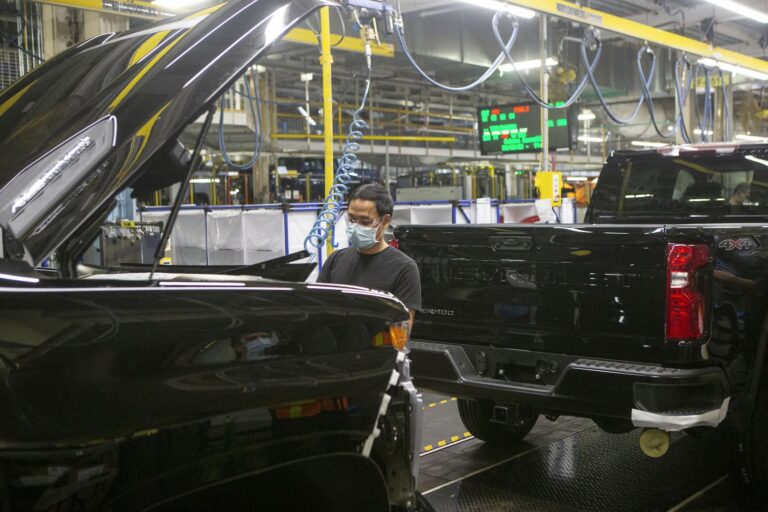

The impact on autoworkers: The news comes at a time when many autoworkers in Canada are already under pressure, with several major plants shuttered by renovations. Even plants that are operating normally are not full-steam ahead.
Union workers in Ingersoll, Ont., said last night that production had been cut down and workers were given the option to go home four hours early each day. Local union leaders advised their members in a memo to avoid making any big purchases and to brace for potentially “life changing” shift revisions that could upend their families’ schedules.
Executives at General Motors told the union that it committed to the plant, which makes BrightDrop electric vans. But GM is frustrated by the Trump administration’s week-to-week decision making.
“Not in any world is this sustainable,” the memo by GM plant chairperson Mike Van Boekel said. “If tariffs come, I expect we would shut down at the end of that week. Again, that is only my opinion; and I think all of auto would shut down in two weeks.”
They found no solidarity with their U.S. counterparts at the United Auto Workers union. UAW President Shawn Fain lauded the tariffs as a way to repatriate business to plants in the U.S. where workers are underemployed or laid off. “We applaud the Trump administration for stepping up to end the free trade disaster that has devastated working class communities for decades. Ending the race to the bottom in the auto industry starts with fixing our broken trade deals, and the Trump administration has made history with today’s actions,” Fain said in a statement. Fain’s statement said little about Canada, but made several references to Mexico, and wages that undercut those paid in the U.S.
“Lordstown Assembly sits empty in Lordstown, Ohio, and employed nearly 10,000 autoworkers when NAFTA was passed,” Fain’s statement said.
“Not in any world is this sustainable”
The impact on the economy: Will Roberts, head of automotive at EV research house Rho Motion, said that facilities like Stellantis’s Brampton plant and Ford’s Oakville, Ont. assembly complex, which he said have already had their production plans “mothballed” once in the past year, may become easy targets for automakers looking to move production out of Canada. General Motors’ Oshawa, Ont. plant, which it already shut down once in 2019, makes trucks that are also made in Michigan and Indiana.
Canada is also home to several engine factories. BDO Canada’s Jesus Ballesteros said engines are typically made very close to final assembly plants and would be tough to ship to new markets. Ballesteros said offering extra support for workers and freezing rates on energy costs are two actions that may help struggling manufacturers justify their Canadian footprint.
On top of that, prices are likely to rise on every vehicle model, since nearly all will have at least some content from outside of the U.S., said Ballesteros, who leads the manufacturing industry and distribution practice at the advisory firm.
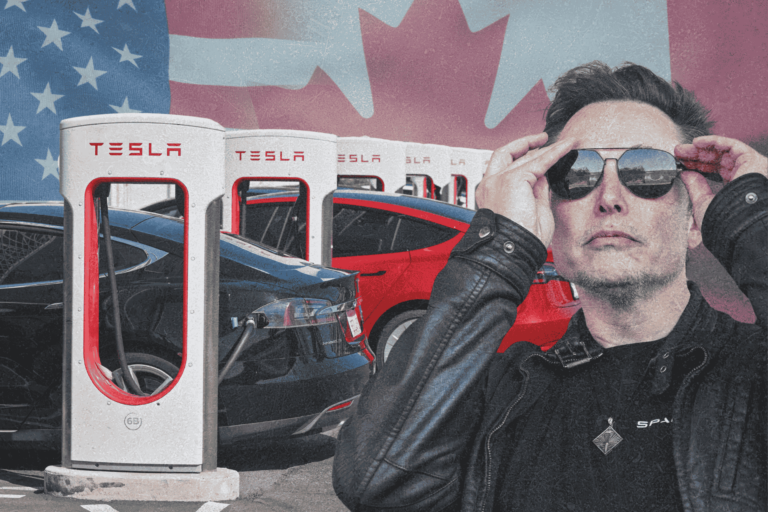
“Even Teslas, which are made in the U.S., there is a percentage of Tesla components that come from Mexico,” he said.
There will be fewer models on the market to choose from, both Ballesteros and Roberts said, as some models will no longer be economical to produce, and companies like Volkswagen may have no incentive to take the time to prepare every possible Audi model for the U.S. market, for instance.
“Either you’re taking the hit on additional tariffs,” Roberts said, “or you’re taking a hit by reorganizing production, slowing down production in one place, moving models to different production lines, paying overtime in one place and paying staff to not work in another place.”
The impact on the stock market: American automakers like Ford, General Motors and Stellantis saw stocks slide, with GM dropping a steep seven per cent by mid-day. Shares of Canadian auto parts makers Magna, Linamar and Martinrea also tumbled.
Others that are less exposed to tariffs, like EV makers Tesla and Rivian and Canadian bus maker NFI, saw stocks rise, in contrast to the downturn in both the S&P/TSX Composite index and the S&P 500.
Trump plans to add tariffs eventually to imported parts in any sedans, sport utility vehicles, crossover utility vehicles, minivans and cargo vans. But during the month of April the tariffs will focus on final assembly. Of auto companies that build in Canada, Toyota and Volkswagen will be punished most in April, according to data from Wards Automotive and Barclays. Even they will fare better than Mazda or Volvo, which do little manufacturing in the U.S. and none in Canada.
The impact on politics: Prime Minister Mark Carney called the tariffs a “direct attack” on workers, and convened a cabinet committee on Canada-U.S. relations Thursday morning. He has promised to provide a $2 billion fund to the industry if his Liberal party wins Canada’s April 28 election, as well as aid that lets companies defer income tax and GST or HST remittances from April 2 to the end of June.
Carney said nothing is off the table for Canada’s response, though he will wait until after April 2, when the U.S. said it will implement wider tariffs across all its trading partners. He expects to speak with Trump in the coming days.
Conservative Leader Pierre Poilievre said Canada “must retaliate” to maximize impact on Americans and minimize Canadian impact. He said the country will rally to top up bank accounts of autoworkers struggling to pay for their mortgages or children’s sports.
“We need to take drastic action to build an economic fortress in Canada able to reach other markets across the world,” he said.
Trump has said he will hike tariffs if Canada and the European Union work together to “do economic harm to the USA.” French Finance Minister Eric Lombard has warned that the E.U. must raise its own tariffs, though others, like U.K. Chancellor Rachel Reeves, don’t plan to escalate the issue. Japan’s Prime Minister Shigeru Ishiba said “every option” is under consideration.
Ontario Premier Doug Ford, whose province is home to more automakers’ assembly plants than any jurisdiction in North America, said he will support the federal government and will wait until April 2 to decide on any reciprocal tariff decisions. Ford said U.S. Commerce Secretary Howard Lutnick told him that Canadian-made vehicles with 50 per cent or more American parts would face 12.5 per cent tariffs.
Meanwhile, Ford said, tariffs “will do nothing more than increase costs for hard-working American families.”



Loading...
Thanks for sharing!
You have shared 5 articles this month and reached the maximum amount of shares available.
CloseThis account has reached its share limit.
If you would like to purchase a sharing license please contact The Logic support at [email protected].
CloseGift the full article!
You have gifted 0 article(s) this month and have 5 remaining.
Recipients will be able to read the full text of the article after submitting their email address. They will not have access to other articles or subscriber benefits.
Photo: The Canadian Press/Chris Young
Most Popular This Week




In-depth, agenda-setting reporting
Great journalism delivered straight to your inbox.
Commentary
Carmichael: Being boxed in will help Canada focus on what matters
Briefing
Rio Tinto gets nearly $165M in additional federal funds for Quebec aluminum
U.S. to lift tariffs on some Canadian products crucial to Maine: Collins
Carney warns of tech dependence after Starlink disruptions in Ukraine
Best business newsletter in Canada
Get up to speed in minutes with insights and analysis on the most important stories of the day, every weekday.
Exclusive events
See the bigger picture with reporters and industry experts in subscriber-exclusive events.
Membership in The Logic Council
Membership provides access to our popular Slack channel, participation in subscriber surveys and invitations to exclusive events with our journalists and special guests.






