Listen Now
0:00
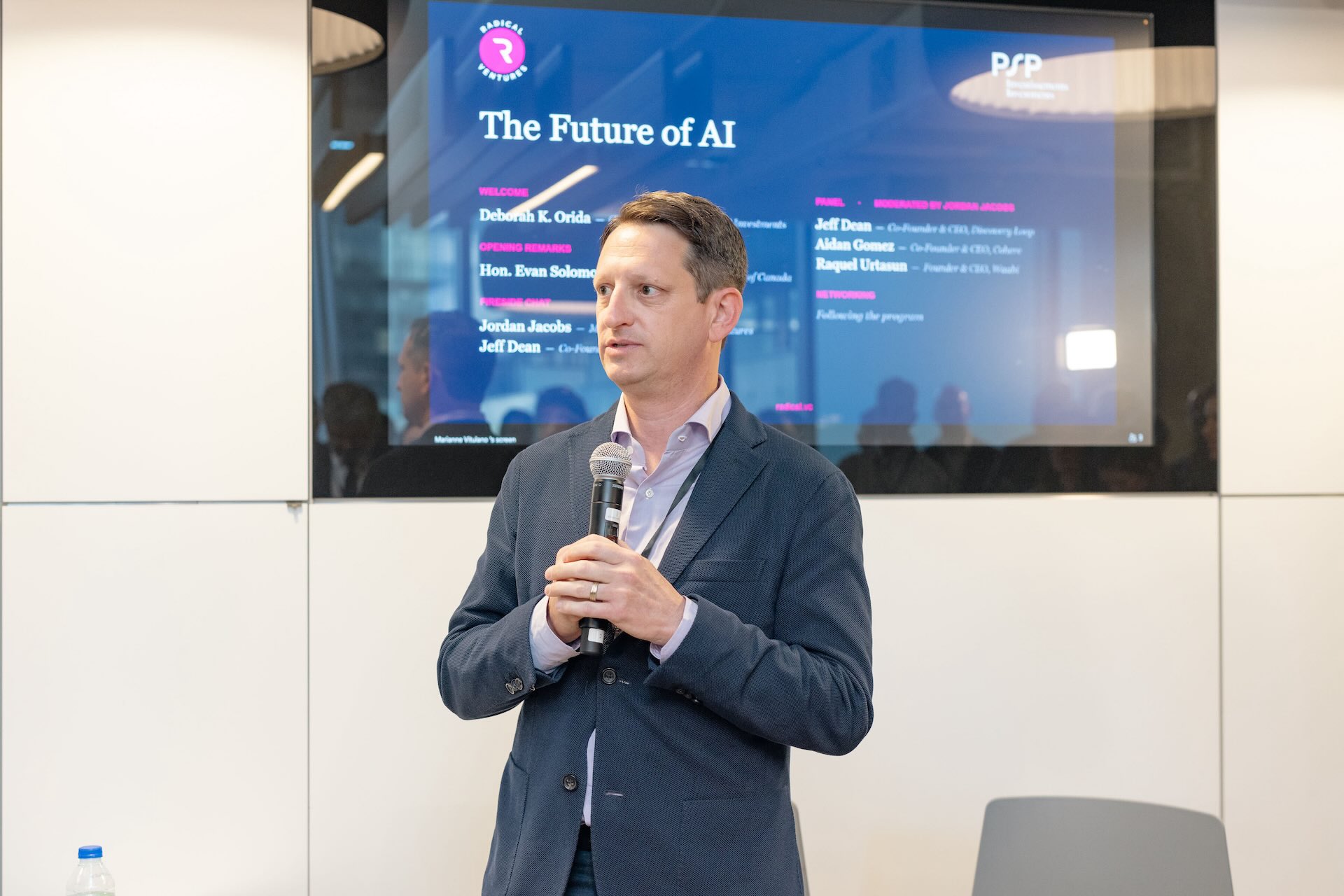
TORONTO — Radical Ventures has raised over US$1 billion so far for a new fund to back AI scaleups with the potential to become the next generation of tech giants.
The Toronto-based firm’s new venture fund is the largest ever raised in Canada, and is backed by some of the country’s biggest asset managers. “We’re seeing the demand from the best founders in the world,” said managing partner Jordan Jacobs.
Investors in the new fund, dubbed Breakouts, include four of Canada’s largest retirement savings managers in the Canada Pension Plan Investment Board (CPP Investments), Public Sector Pension Investment Board (PSP Investments), the Healthcare of Ontario Pension Plan and OPTrust. Other Canadian backers include TD Bank and Bank of Montreal, as well as CI Global Asset Management. Radical said it’s also received commitments from foreign investors, although it did not name them.
Related Articles


The firm’s new mega-fund comes as huge sums of capital continue to flow into AI, backing superstar researchers leaving tech giants to launch their own so-called neolabs as well as application makers growing at unprecedented speed. Meanwhile, startups are raising ever-larger rounds and staying private longer.
“It’s the creation of ubiquitous intelligence, and that will produce the biggest lift economically we’ve ever seen,” Jacobs said of developments in AI, adding that he expects this moment to generate more “giant companies” than in previous industrial eras. The firm is ultimately looking to raise “multi-billions” for the fund, he said. In a press release Tuesday afternoon, Prime Minister Mark Carney’s office put the fund’s target at $4 billion.
Breakouts will initially back 12 firms, including existing Radical portfolio companies. It has allocated three existing deals to the new fund, including its investments in Discovery Loop, co-founded by Alphabet chief scientist Jeff Dean, and Etched, a new Nvidia rival.
Radical put the first cheque into Cohere and co-led its most recent $600-million round. Its portfolio also includes AI-for-science company Periodic Labs, physical AI startup Veeda AI, self-driving technology firm Waabi, world model developer World Labs and quantum computing firm Xanadu. All are led by prominent researchers in their respective fields.
Jacobs argued that the size of the new fund and names in its portfolio are proof that its model is working. “We’re getting picked by the founders to lead or take significant portions of rounds because they know that we’re differentiated,” he said, citing Radical’s program of post-investment support, which includes technical hiring, commercial connections and marketing. While lots of major Silicon Valley firms have service arms working with portfolio firms, he says Radical stands out for its expertise in AI.
Radical currently has two employees embedded with Discovery Loop helping recruit researchers and sift through the thousands of job applications it’s received since launching last month. In a post on X last month, Dean said the co-founders “absolutely could not have gotten this company off the ground as smoothly and quickly” without the help of Radical’s staff.
The venture firm helps portfolio companies negotiate compute contracts and access the latest chips; Jacobs said it has facilitated billions of dollars worth of such deals; Nvidia is a co-investor in several of its deals. Radical can also connect startups to a network of the world’s largest businesses and government leaders via partner Dominic Barton, the former head of McKinsey.
Neolabs have raised a lot of capital this year. Dean and Veeda CEO Sanja Fidler and Periodic Labs co-founder Liam Fedus are recent examples of prominent researchers leaving major Silicon Valley firms to strike out with teams of their own. Many of the neolabs are building foundation AI models to do for domains like robotics and materials science what OpenAI’s large language models did for content.
“A lot of these people are real missionaries about using AI to change the world for the better,” said Jacobs. Many have accumulated significant wealth from their time at a tech or AI giant, giving them the financial security to pursue other goals through new startups, he added.
Many AI deals are significantly larger than the software financings of the past. “The rounds are getting bigger and bigger,” Jacobs said, adding that’s partly because firms are seeing high costs sooner as they hire expensive technical talent and buy a lot of compute.
It also reflects the “unprecedented” speed at which the revenues of many AI firms are growing, he added. A round that would have happened in four years is now happening in six months, he said, or there are multiple rounds in that period. Etched, for example, has announced US$1.8 billion in three financings in as many months.
Companies are also staying private longer—the median age of a company at public listing has doubled since the 1990s, according to Morgan Stanley. Radical has not had many publicly disclosed exits so far. Portfolio firms Covariant and CentML have been acquired, and Xanadu went public in March. Jacobs said Radical’s backers understand that venture is a long-term play.
The firm announced the new fund at the start of the Canada Investment Summit, a two-day effort by the federal government to attract foreign capital, encourage Canadian asset managers to invest more at home and drum up deals for domestic firms and projects.
Some of Radical’s Canadian and British portfolio companies are benefiting from their national origins, as countries and companies seek to buy AI systems that aren’t made in or controlled by the U.S. or China, according to Jacobs. For Radical itself, international investors “like the fact that we compete and win the best deals in Silicon Valley, but also have a broader worldview,” he said. As well as its headquarters in Toronto, the firm has offices in London, New York and San Francisco.
Radical’s new fund tops the US$1 billion that Royal Bank aims to raise for its growth-stage tech fund, and the US$525 million fund that late-stage-focused Intrepid Growth Partners announced Monday. Globally, it trails the mega-funds that AI-focused firms like Thrive Capital (US$10 billion), General Catalyst (US$10 billion) and Spark Capital (US$3 billion) are reportedly raising. Those firms are significantly older than Radical, though.
Jacobs and co-founder Tomi Poutanen launched the firm as a full-time venture in May 2019, with backing from CPP Investments, PSP Investments and TD, to whom the duo had sold their AI startup Layer 6. The team has since raised several early-stage funds and a growth-stage fund, and has grown to 40 people.
All that money chasing AI opportunities has sent valuations soaring. “I’ve always believed that there’s a lot of hype, post-ChatGPT, in the AI space,” Jacobs said, which can inflate the price tags on some firms. Still, he’s confident that the AI moment will also produce true giants, and that Radical can back many of them. “No one’s perfect at it,” he said. “We just want to be more perfect than others.”
Update: This story has been updated with details of Radical Ventures’s target for the Breakouts fund.