Listen Now
0:00
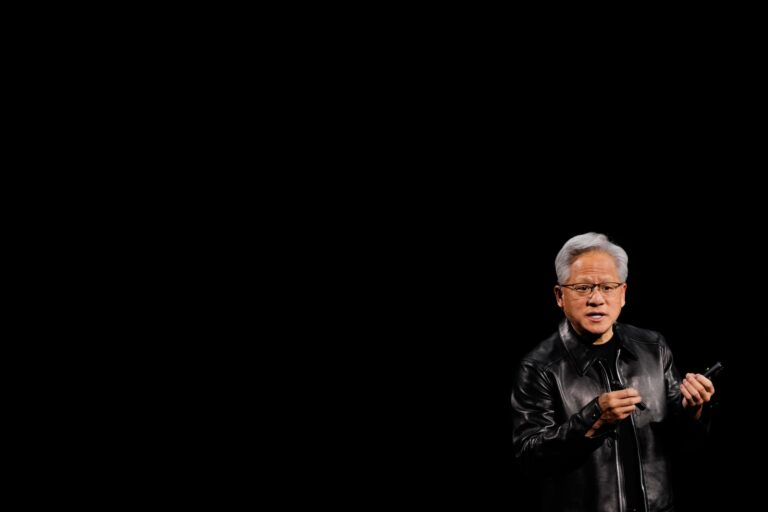
The sudden and dramatic resignation of Nvidia CEO Jensen Huang has torn through the Canadian financial and business communities and shone a light on the extent to which the country’s AI fortunes are entangled with the U.S. firm. Huang resigned Thursday after admitting to having had an extramarital affair with an alleged Chinese spy and following reports of a separate affair with a company executive who reported to him.
Seven of Canada’s biggest pension funds held a combined US$20.7 billion worth of Nvidia holdings as of June 30, according to their U.S. securities disclosures. The roughly 103 million shares represent just one way in which the company’s fortunes are entangled in Canadian business.
As well as developing the technology powering much of the AI industry, Nvidia is also one of the industry’s largest financial backers with Huang a vocal and vociferous cheerleader for the technology’s allegedly world-changing potential. In Canada, as elsewhere, Nvidia is a supplier, investor and partner in financing AI infrastructure and development.
Related Articles
Canada Pension Plan Investment Board held the largest chunk of Nvidia amongst Canadian retirement fund managers as of June 30, worth US$10.3 billion, followed by Healthcare of Ontario Pension Plan with US$4.4 billion in shares and La Caisse with US$2.5 billion, while PSP Investments held US$2.2 billion in shares as of Sept. 30. Ontario Municipal Employees Retirement System, British Columbia Investment Management Corporation and Alberta Investment Management Corporation also disclosed holdings.
Nvidia stock price has nosedived following Huang’s resignation and the scandal that led to it. At its midday low on Thursday, the stock was down about 20 per cent from its close on Friday, the last trading day before the former CEO admitted to having an affair with a suspected Chinese spy.
Nvidia’s board launched an investigation Sunday into reports that Huang’s relationship with Alice Huang, an executive of Singaporean data-centre company Megaspeed, exposed him to a foreign intelligence operation. The board said then that it retained confidence in his leadership and had no reason to believe national security or company secrets had been compromised.
On Wednesday, The New York Times reported a second affair, this time between Huang and Kimberly Powell, one of his direct reports at Nvidia. The company announced Huang’s resignation Thursday morning. Huang has been married to his wife, Lori Huang, for 41 years.
Nvidia’s share price has shot up around 800 per cent since November 2022, when ChatGPT’s public release ignited a market frenzy for AI and the infrastructure needed to power it. Based on their share holdings as of June 30, Canada’s largest pension funds had collectively lost about $5.3 billion at Nvidia’s low point on Thursday.
Nvidia was also a returning equity investor in AI developer Cohere’s planned $7-billion Series E announced last month. The Toronto-based company hasn’t closed the round and did not immediately respond to The Logic’s question about whether Nvidia’s leadership turmoil would impact its investment.
Cohere will run its AI models on Nvidia chips at Bell’s Merritt, B.C. data centre under an agreement with Bell, Canadian server manufacturer Hypertec and cloud computing provider Buzz High Performance Computing.
Telus, meanwhile, plans to equip two new Vancouver data centres and an expanded Kamloops facility with Nvidia chips, networking equipment and software to help Canadian customers train and run AI models. And Bell’s 300-megawatt data centre under construction near Regina will also house Nvidia chips through tenant CoreWeave.
Beyond building Nvidia into the world’s pre-eminent chipmaker—the company controls about 90 per cent of the market—Huang personally championed Nvidia’s expansion into financing its customers, a strategy that has helped bind the industry’s fortunes together. Investors are watching whether the approach survives Nvidia’s leadership change.
Nvidia’s venture arm also invested in Toronto-based autonomous-driving startup Waabi’s US$750-million funding round, and Montreal-based industrial automation company Vention’s US$110-million financing, both announced in January.
Some analysts see Nvidia’s business holding up better than its stock. Bernstein’s Stacy Rasgon downgraded the shares despite saying the company’s fundamentals remain intact, warning that further revelations, investigations and uncertainty over Huang’s long-term successor make it difficult to recommend buying.
Nvidia named chief financial officer Colette Kress interim CEO and longtime director Harvey Jones its first board chair. Alongside resigning as CEO, Huang also resigned as president and a director, ending his 33-year tenure.
The longer-term concern is the deal making that helped fuel Nvidia’s growth. William Blair analyst Sebastien Naji said existing contracts would survive a CEO change, but future deals—and Nvidia’s ability to defend its market share—could suffer without Huang.
Kress will stay in her finance role while the board searches for a permanent replacement. Directors said they expect operations and customer commitments to continue without interruption.