Listen Now
0:00
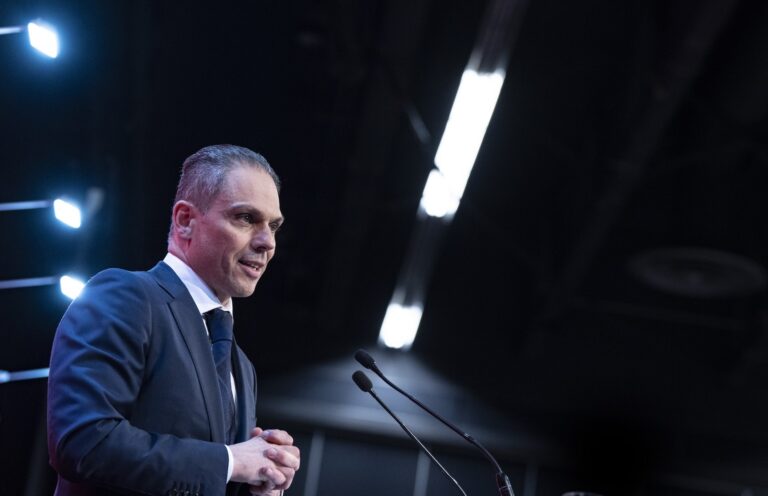
Prime Minister Mark Carney plans to draw 100 of the world’s top CEOs, investors and global business leaders to Toronto to make the case for Canada as the most reliable place to invest in an uncertain world.
He announced plans for a Canada Investment Summit in September to get investors with as much as $50 trillion worth of capital into a room, in the hopes they’ll fund the major projects and industries at the centre of his economic agenda. The gathering is part of Carney’s plan to attract $1 trillion in investment to Canada over the next five years.
Related Articles

The idea: The invites are coming from Carney himself, but the event will be co-hosted by two of Canada’s biggest pension funds, the Canada Pension Plan Investment Board and the Public Sector Pension Investment Board (PSP).
The timing is almost as important as the guest list. The idea is to introduce investors to Toronto at the height of its glitzy season, on the heels of the 2026 FIFA World Cup and in the middle of the Toronto International Film Festival.
Canadian content: The choice of hosts is also a strong signal for Canadian companies hoping for backing from the Maple 8 pension funds. Calls for the funds to invest more domestically have been building for years, cresting with the Buy Canadian movement triggered by U.S. President Donald Trump’s trade war.
“We were having dialogues about how to get more Canadian investors to invest in Canada,” Michel Leduc, CPP Investments’ senior managing director and chief public affairs officer.
Since then, CEOs at several of the funds have said they’re open to growing their Canadian portfolios—under the right conditions. The tone shift followed the federal government’s commitment to support major infrastructure projects, which could become investment targets for Canadian pensions and international investors. “The Summit is a strong signal that policymakers across Canada are focused on creating compelling investable opportunities,” Annesley Wallace, CEO of Healthcare of Ontario Pension Plan, told The Logic.
The guest list: The Prime Minister’s Office wouldn’t give up the names of any specific invitees, but Audrey Champoux, Carney’s deputy director of communications, said the government is targeting international banks, pension plans, hedge funds, sovereign wealth funds, private equity and asset managers.
Leduc said the guest list includes the top 10 to 20 investors in each of those categories, which together would represent roughly $50-trillion worth of capital. If he’s right, the list would include the likes of BlackRock, the world’s largest asset manager; J.P. Morgan, the U.S. investment firm; and the Government Pension Fund of Norway.
The Logic reached out to several of the investors and banks likely to receive the prime minister’s invite. While none of the potential international participants responded immediately, Scotiabank, HOOPP and La Caisse said they are attending.
The pitch: Carney has emphasized Canada as a stable place to invest, as international trade disruptions and global conflicts threaten to upend economies around the world.
“We’re an energy superpower, with the most educated workforce in the world and rock-solid fiscal strength,” Carney said in a statement. “The first-ever Canada Investment Summit will capitalize on those advantages to help drive billions in new investments into Canada.”
The government argues his case is already resonating. Last year, Canada experienced the largest surge in foreign investment in nearly two decades, climbing to $96.8 billion. Nearly half of those investments were driven by mergers and acquisitions, however.
It’s not clear which projects the government plans to put forward, but his office said they will focus on sectors that will boost Canada’s competitiveness, including clean energy, critical minerals and artificial intelligence.
What’s old is new again: Though the prime minister announced the summit as a first for Canada, it might inspire déjà vu. Former prime minister Justin Trudeau and his finance minister Bill Morneau invited the same types of heavyweights to an event organized by BlackRock, to convince them that Canada is a stable and attractive place to spend their money.
It was around that time Morneau announced plans to launch the Canada Infrastructure Bank to spur private investment, though critics said municipal and provincial governments failed to put up the matching funds to execute on the idea.
Foreign direct investment had been trending down for years, and sunk another $13.4 billion the following year.
This time around, Canada is building on momentum, said Finance Minister François-Philippe Champagne. Many countries are looking to diversify their supply of essentials like food and energy, and Canada’s geography, predictability and adherence to the rule of law make it attractive, he said.
Champagne suggested the prime minister’s financial bona fides don’t hurt: “The fact that the prime minister will be chairing that investment summit is leading that momentum that we see around Canada these days.”
Flies in the ointment: Randall Bartlett, deputy chief economist at Desjardins, points to a few possible spoilers to the government’s plan, including political upheaval tied to separation pushes in Alberta and Quebec, as well as uncertainty around USMCA negotiations this summer.
Beyond that, he said, Canada has struggled in the past to attract large-scale infrastructure capital because many projects lacked the scale and returns investors are looking for. Before COVID-19, low global interest rates pushed capital towards emerging markets, while Canada struggled to offer the same yields on infrastructure.
Even CPP, one of the hosts of the event, invests 88 per cent of its assets outside of Canada as of 2025. “We see Canada as a very solid market, a place that we want to continue to invest [in],” Leduc told a parliamentary committee Thursday. “It is more a focus on seeking the highest possible returns.”
Just what kind of projects are investors seeking? “We might be an enthusiastic acquirer of a larger airport in Canada,” Leduc told the committee. “They’re long-term, they’re like a high-paying bond.”
New beginnings: What may be changing are the priorities at both provincial and federal levels of government, including efforts to streamline approvals, Bartlett said. Prime Minister Carney’s background as a central banker and executive at Brookfield will help, he added.
While he’s cautiously optimistic the summit will pay off, Bartlett is waiting to see what other steps the government might take, such as legislation to help expedite foreign investment. “The proof of the pudding,” he said, “is always in the tasting.”
This story was updated to add details and comment.