Skip to content


News
Canada’s biggest investors are starting to reconsider their U.S. exposure
Capital continues to flow into the U.S., but political uncertainty and market volatility are pushing institutional investors to hedge their bets
Canadian investors remain heavy buyers of U.S. stocks, bonds and treasuries, but more are taking steps to hedge their U.S. dollar exposure. Photo: Aslam Iqbal/NurPhoto via Getty Images
Canadian institutional money is still flowing into the United States, but rising political and economic turmoil is forcing a rethink of how that capital is deployed.
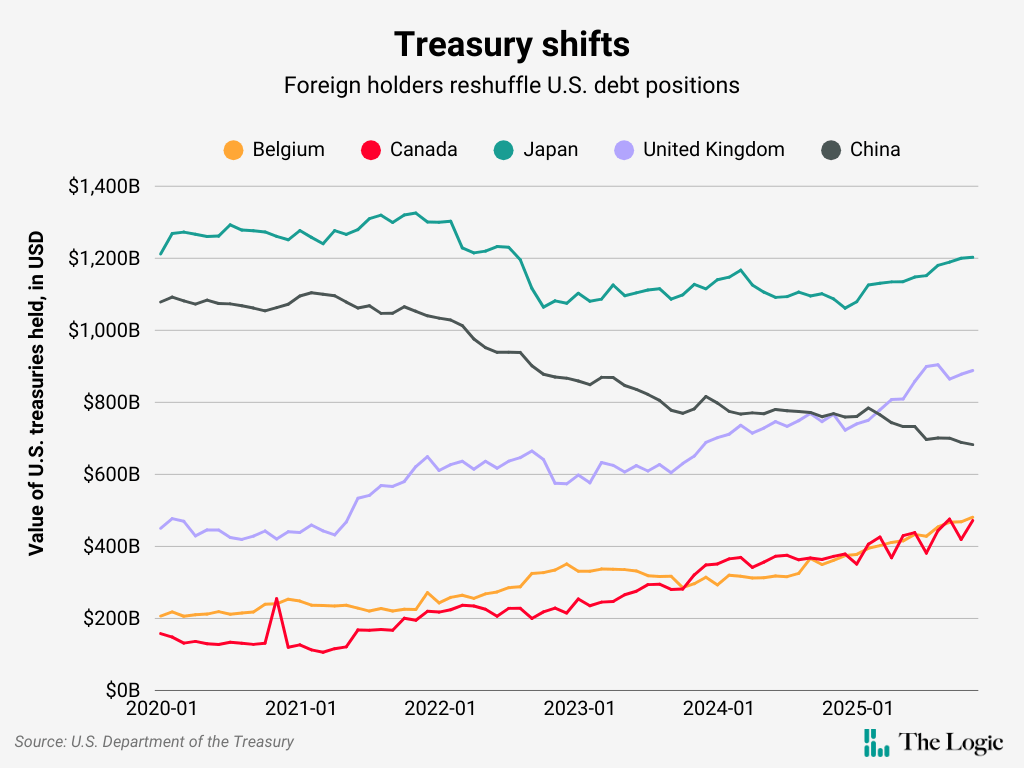
High volumes of capital continued flowing to the U.S. in 2025, with Canadian investors funnelling the equivalent of eight per cent of the country’s GDP into the country, according to a recent report from TD Bank. As of November, Canada held US$472 billion in U.S. treasuries, up about 27 per cent from a year earlier, making it the world’s fifth-largest holder of the securities, U.S. government data shows.
Talking Points
- Canadian investors are still major buyers of U.S. stocks, bonds and treasuries, but a growing number are hedging U.S.-dollar risk, borrowing in other currencies and slowing longer-term commitments amid ongoing U.S. policy uncertainty
- Economists say even small shifts away from the U.S. could have outsized effects on the dollar and the American economy
Meanwhile, Canadian investors allocated nearly three-quarters of their foreign bond holdings to the U.S., even though American debt makes up only about 40 per cent of the global market, according to Desjardins data.
However, some of Canada’s largest institutional investors are signalling that the risks tied to the U.S. market, and the dollar, are becoming harder to ignore.
In January, Investment Management Corporation of Ontario said it was looking beyond the U.S. dollar as a default safe haven, citing growing unease with U.S. policy direction and fiscal risks. In its annual outlook, the $86-billion fund manager pointed to alternative currencies such as the Swiss franc and Japanese yen, as well as gold, as potential hedges.
Related Articles

Similarly, Ontario Teachers’ Pension Plan cut its exposure to the U.S. dollar by 56 per cent in the first half of last year. Stephen McLennan, the pension fund’s chief investment officer for asset allocation called the greenback “a headwind for all Canadian-domiciled investors,” adding that the pension had adjusted its expectations for 2025 and the next several years.
Other fund managers, including the Toronto Transit Commission Pension Fund and UBC Investment Management have started redirecting money into Europe and Asia, citing U.S. policy uncertainty and concerns over dollar depreciation.
The trade turmoil that followed U.S. Donald Trump’s so-called “Liberation Day” last April marked a break from past market dynamics that favoured U.S. assets, Royce Mendes, head of macro strategy at Desjardins said in an interview. Recent market volatility has sent U.S. bond yields higher, equities lower, and weakened the dollar.
“I don’t want to say the U.S. is not a safe haven anymore,” said Mendes. “It’s certainly just moving a little bit away from being the very clear global safe-haven asset.”
TD’s report on Canadian capital flows also found that while capital continued to move into U.S. stocks and bonds, foreign direct investment has cooled. Canadian investment in the U.S. declined 69 per cent to $14.3 billion in the first three quarters of 2025 compared to the same period a year earlier, a sign that Canadian investors are becoming more cautious about locking longer-term money in the U.S. market.
Still, some economists stress that the shift does not signal a wholesale retreat from the U.S. Bank of Montreal chief economist Douglas Porter said the U.S. dollar remains relatively strong and lacks credible medium-term alternatives, arguing that the reality of the broader Sell America narrative “doesn’t quite live up to the hype.”
“The U.S. is just such a big part of the global equity and bond market, and it has had such a strong performance for an extended period of time that [investors] cannot move. Few can move completely out of the U.S.,” said Porter.
Nadja Dreff, who leads global insurance and pension ratings at Morningstar DBRS, said Canadian institutional investors have been diversifying geographically. A recent report from the credit ratings agency found that while Canadian pension funds increased overall borrowing in 2025, their issuance in U.S. dollars declined, with more debt raised in other currencies, including the Australian dollar and the euro.
Dreff said the drop in U.S.-dollar borrowing doesn’t necessarily mean Canadian pensions are investing less in that market. Investors routinely borrow in the currency, she said, given its global stability, and deploy the money worldwide, including—but not exclusively—in the United States. Dreff added, however, that borrowing in alternative currencies signals an intention to invest more heavily in those markets. “There’s natural hedging that happens when you have the same currency that you’re borrowing in and the currency that you’re investing in,” she said.
While there’s no sign yet of a mass investor exodus from the U.S., Porter said even a modest shift by institutional investors away from the dollar could affect the American economy. “The U.S. does depend on the kindness of strangers to fund its budget deficit and its large current account deficit,” he said, “it just takes less buying of U.S. dollars to weigh on the currency.”
Mendes said that the fading appeal of U.S. assets could redirect capital back to Canada. Many of Canada’s top pension funds, which declined to comment ahead of their full-year results expected this spring, have recently said they’re keen to invest more at home if the right assets become available.
Porter said institutional investors are loath to move quickly, and cautioned against reading too much into early signals. “We have certainly not heard the end of the policy changes and uncertainty out of the U.S. administration,” he said.



Loading...
Thanks for sharing!
You have shared 5 articles this month and reached the maximum amount of shares available.
CloseThis account has reached its share limit.
If you would like to purchase a sharing license please contact The Logic support at [email protected].
CloseGift the full article!
You have gifted 0 article(s) this month and have 5 remaining.
Recipients will be able to read the full text of the article after submitting their email address. They will not have access to other articles or subscriber benefits.
Photo: Aslam Iqbal/NurPhoto via Getty Images
Most Popular This Week




In-depth, agenda-setting reporting
Great journalism delivered straight to your inbox.
News
Adam Waterous proposes massive crude exports to Asia by rail through northern B.C.
Briefing
Rivals may be ‘horrified’ to realize how exposed their investments are to AI, Aviva CIO warns
Shopify, Sequoia co-lead US$200M investment in online-selling platform Whop
Amid revenue gains, 1Password bets on tools to protect data from AI agents
Best business newsletter in Canada
Get up to speed in minutes with insights and analysis on the most important stories of the day, every weekday.
Exclusive events
See the bigger picture with reporters and industry experts in subscriber-exclusive events.
Membership in The Logic Council
Membership provides access to our popular Slack channel, participation in subscriber surveys and invitations to exclusive events with our journalists and special guests.







