OTTAWA — Business groups say the Liberal government’s fall economic statement goes some way to addressing the workforce and financial challenges they’re facing amid full labour markets and rising economic uncertainty—but not far enough.
Skip to content

News
Freeland’s restrained mini-budget draws criticism from innovation-economy players
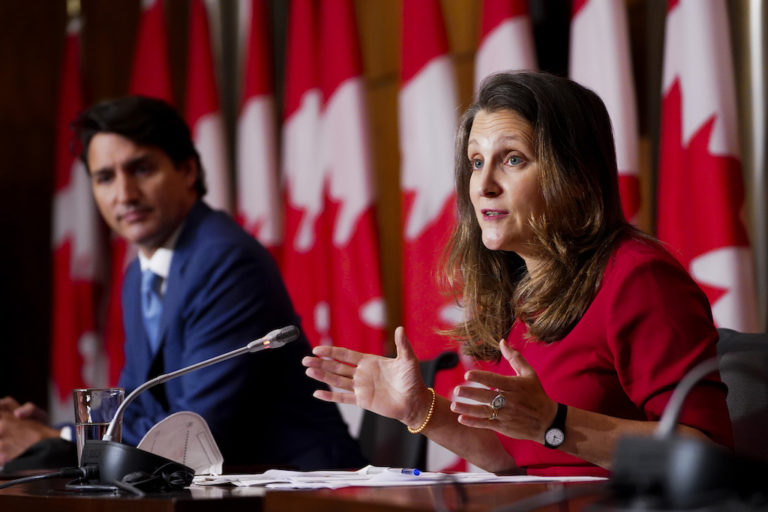
Finance Minister Chrystia Freeland delivers the fiscal update in the House of Commons, in Ottawa on Nov. 3, 2022. Photo: The Canadian Press/Adrian Wyld
OTTAWA — Business groups say the Liberal government’s fall economic statement goes some way to addressing the workforce and financial challenges they’re facing amid full labour markets and rising economic uncertainty—but not far enough.
Thursday’s mini-budget included a new refundable tax credit for clean technology and details of a forthcoming $15-billion growth fund set up to bring private-sector capital into emissions-reducing megaprojects. Some sectors had been seeking more measures to respond to the $369-billion U.S. Inflation Reduction Act, or movement on promised reforms to key existing programs. But Ottawa chose to “maintain the fiscal firepower we need” in case of a recession, and deferred some policy files.
Talking Points
- Finance Minister Chrystia Freeland’s fall economic statement tried to balance the competing goals of fighting inflation, helping the vulnerable and keeping up with the United States’s massive new industrial spending
- Big banks gave her mostly positive reviews, but innovation-economy players said the Liberals are putting off too much work that’s essential to growth
Despite the concerns about an oncoming recession, newly released jobs numbers for October suggest a slowdown isn’t hitting the job market. Statistics Canada reported that Canada added 108,000 jobs last month, all of them full time, 74,000 of them in the private sector. The employment increase was “widespread across industries, including manufacturing, construction, and accommodation and food services,” the agency reported, and made up for several months of slippage in total employment.
But inflation is still biting workers, as wage increases have persistently stayed below price increases. “Despite average wages growing by more than five per cent on a year-over-year basis in each of the past five months, they have not kept pace with inflation, which was 6.9 per cent in September, contributing to concerns about affordability and the cost of living for many Canadians,” StatCan said.
Nearly two-thirds of the highest-waged employees have had raises in the past year versus about half of the lowest-waged workers, StatCan added.
All of which adds some weight to Finance Minister Chrystia Freeland’s stated objective of helping the poorest people in Canada while holding back on measures that could boost inflation—along with the effects that cause the most pain to people with the least wealth.
More from the Fall Economic Statement
However, it meant leaving some key advocates for the productivity-boosting measures Freeland promised in April’s budget waiting for longer.
The Council of Canadian Innovators (CCI), a lobby group representing over 150 scale-up firms, pointed to the $1-billion Canadian Innovation and Investment Agency, and a review of the scientific research and experimental development (SR&ED) tax incentive. The statement promised details on the former “in the coming weeks,” and the results of the latter in next year’s budget. “It is a shame that the government has not pushed to set this agency up more quickly,” said CCI president Benjamin Bergen in a statement, calling for “a clear mandate which treats data and IP as valuable strategic assets.”
Ottawa promised a review of the $3.5-billion-a-year SR&ED in April’s budget. The CCI has recommended changes to the program—popular among startups—which it says will adapt it to the way tech is developed today. “Innovators cannot wait an entire year for substantive action on commitments” from this year’s budget, Bergen said. But his group praised new programs announced in the statement to train workers or upgrade their skill sets.
Related Articles

Last month, the Canadian Venture Capital & Private Equity Association (CVCA) warned that the IRA’s incentives would attract cleantech startups in this country to the U.S., and called for Ottawa to respond. Thursday’s statement makes clear that “the government understands this even if the proposed growth fund and tax credit minimally address the magnitude of the U.S. bill,” CVCA CEO Kim Furlong wrote in a note to members.
Other industry groups expressed concern about Ottawa’s response to economic headwinds. Goldy Hyder, CEO of the Business Council of Canada (BCC), called the mini-budget “encouraging,” but pointed to rising interest payments on the national debt and a deteriorating economic outlook. “Time is not our friend,” he said in a statement. On industrial policy, Ottawa has taken “a scattered approach with new funds, structures, and agencies that spread out billions here and there,” wrote Robert Asselin, senior vice-president of policy at the BCC, in a post for The Hub. He called for a clearer and more coordinated strategy.
The balance Freeland is seeking is difficult. RBC Economics, for instance, pointed out that the things the government does say it wants to do, such as launching the growth fund and beginning to issue tax credits for cleantech projects, must get done quickly to make much difference.
While none of the big banks really panned the update or applauded it, RBC and Scotiabank were most critical of the government’s spending plans as it tries to execute a soft economic landing—a few quarters of stunted growth but no actual recession.
“Program spending in the current fiscal year is the highest in nearly three decades outside the pandemic,” RBC noted. It was one of the first to predict a recession in Canada, in July, and its economists said the spending in the fiscal update means that, if one comes, the government “might not have quite as much dry powder as hoped.”
Scotiabank’s Rebekah Young echoed that sense: “The finance minister is signalling constraint in the update, but the taps are hardly closed,” she wrote in Scotiabank’s assessment. “The Bank of Canada’s job is hard enough with very high uncertainty on the inflation and interest rate path (at home and abroad). A modest-but-persistent expansive fiscal stance adds to this uncertainty.”
Canada’s other big banks gave the update reserved approval:
- BMO: The “fiscal news can be characterized as moderately positive, as Ottawa largely steered clear of aggravating an already tough inflation backdrop.”
- TD: Banking the extra revenue is “a prudent stance” given the effect that spending it could have on inflation and the Bank of Canada’s efforts to fight it by hiking interest rates.
- CIBC: Most of the new spending doesn’t start until next year, and “next year may be one where the economy needs a greater boost from fiscal policy.”



Loading...
Thanks for sharing!
You have shared 5 articles this month and reached the maximum amount of shares available.
CloseThis account has reached its share limit.
If you would like to purchase a sharing license please contact The Logic support at [email protected].
CloseGift the full article!
You have gifted 0 article(s) this month and have 5 remaining.
Recipients will be able to read the full text of the article after submitting their email address. They will not have access to other articles or subscriber benefits.
Photo: The Canadian Press/Adrian Wyld
Most Popular This Week




In-depth, agenda-setting reporting
Great journalism delivered straight to your inbox.
News
National Bank CEO warns AI alone won’t give banks a lasting edge
Briefing
Canada and Ontario commit over $5B to support tariff-hit steel sector
Hackers will see cars as major targets in next 3 years, 83% of car-tech workers say
EA shutting down Edmonton studio BioWare
Best business newsletter in Canada
Get up to speed in minutes with insights and analysis on the most important stories of the day, every weekday.
Exclusive events
See the bigger picture with reporters and industry experts in subscriber-exclusive events.
Membership in The Logic Council
Membership provides access to our popular Slack channel, participation in subscriber surveys and invitations to exclusive events with our journalists and special guests.





