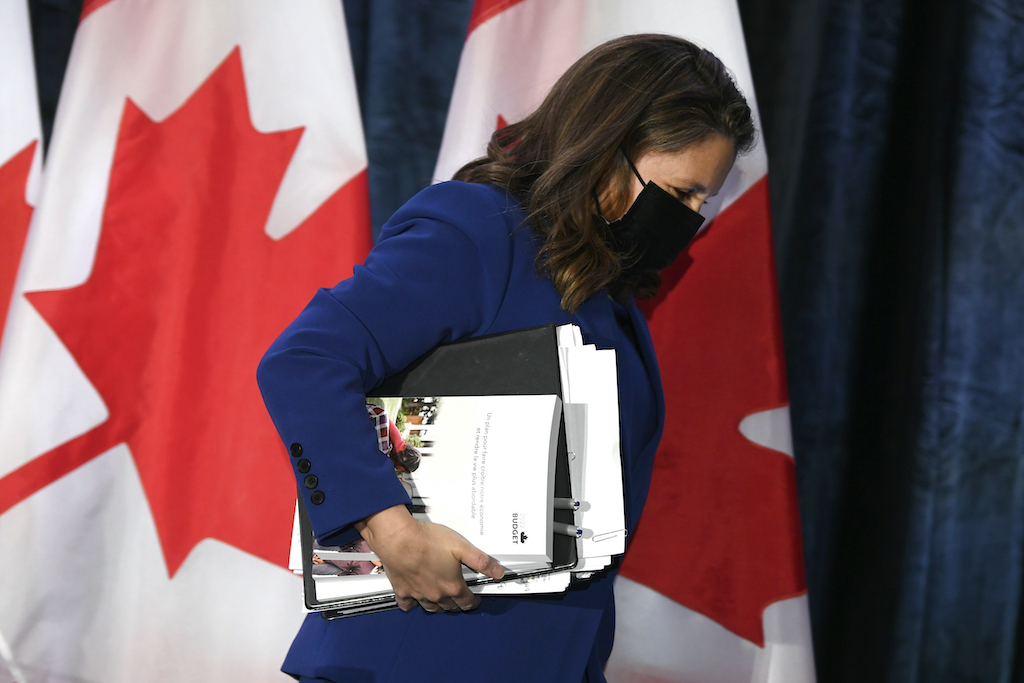
OTTAWA — The federal government is creating a new federal innovation agency to support both startups and legacy companies, but it’s chosen not to try to create a Canadian version of the U.S.’s DARPA.
It’s also creating a new $15-billion Canada Growth Fund (CGF) to try to encourage private sector investment to meet net-zero climate goals and strengthen supply chains.
Talking Point
The Liberal government’s 2022 budget proposes a $15-billion fund to attract private investment to net-zero and supply-chain projects, and a $1-billion innovation agency. The new, arm’s-length programs are designed to tackle longstanding shortfalls in business investment and R&D spending.
Taken together, they mark a concession from the governing Liberals that even after allocating billions of dollars through a swathe of programs designed to spur business spending and help them turn more homegrown ideas into money-making products, Canada still has an innovation and investment deficit.
Productivity and innovation is “the Achilles heel of the Canadian economy,” a “well-known” and “insidious” problem for the country, Finance Minister Chrystia Feeland’s prepared speech acknowledged. Businesses here spend significantly less on R&D than their contemporaries elsewhere in the OECD, and inventors file for far fewer patents per capita. Innovation-economy executives and policy experts have long expressed concern that ideas and discoveries made in Canada—often with public funding—are being commercialized by foreign firms, and worry that a similar fate will befall promising domestic sectors like AI and quantum.
Ottawa hopes these massive new measures will address the commercialization problem, and attract the private-sector investment necessary for a green economic transformation.
Notably, it’s setting up them independently, outside the purview of Innovation, Science and Economic Development Canada, which runs or oversees existing programs like the Strategic Innovation Fund, the superclusters and research funding agencies.
The budget proposes a new, “operationally independent federal innovation and investment agency,” to be seeded with $1 billion over five years. The document is sparse on details, with the government planning consultations later this year to flesh out the new organization’s mandate and spending plans.
While the agency will be federally funded, it’ll be “staffed by innovation experts, technologists and business people” who advise firms and help firms access financing, a senior government official told reporters Thursday. (The government conducts such briefings on the condition that officials not be publicly identified.) The organization will support startups and firms in emerging sectors, but it’s also supposed to help traditional industries who must innovate to remain competitive.
During the 2021 federal election campaign, the Liberals promised to set up a Canadian version of the U.S. Defense Advanced Research Projects Agency (DARPA), with an initial $2 billion in funding. In addition to funding basic research, the original organization sets challenges in fields like cybersecurity and autonomous vehicles, with teams of researchers and companies creating and competing with their own solutions.
In December, Innovation Minister François-Philippe Champagne told The Logic that a DARPA-style “moonshot” and “mission-driven” approach was what was “missing currently in the ecosystem of research and science in Canada.” But Thursday’s budget doesn’t cite the Pentagon division as an inspiration for Ottawa’s new agency, instead naming Finnish and Israeli examples.
“DARPA is not a model for Canada,” the senior government official told reporters Thursday. While the U.S. agency’s challenges generate new, breakthrough ideas, Ottawa is focusing later on in the process of turning an idea into products and services. “We have really cutting-edge thinking being done here,” Freeland told reporters. “Where the gap is in Canada is translating invention into innovation.” She described the Liberals’ campaign proposal for a Canadian DARPA as a “shorthand,” and a “high-level commitment” rather than proposal for the agency’s ultimate structure.
But one of the chief proponents of a Canadian DARPA said there’s a risk that the new agency will try to focus on too many things. “We have to play to our strengths,” said Robert Asselin, senior vice-president of policy at the Business Council of Canada (BCC). The government needs to “have a clear sense of where you want to boost R&D from the private sector.” He said it’s unclear from the budget whether the new agency will take anything from the ARPA model, but ensuring the agency is independent of political decision-making is important.
Asselin has previously proposed that a Canadian DARPA focus on climate change, producing technology that the energy sector could use to reduce emissions.
Achieving Canada’s net-zero goals is the focus of the budget’s other blockbuster new program. The document estimates that getting to that carbon break-even point will require up to $140 billion of spending economy-wide, every year; current annual expenditures top out at $25 billion. So the Liberals are proposing to set up a new Canada Growth Fund (CFG), seeded with $15 billion in public capital over five years and designed to incentivize private-sector investment in emissions reduction, economic diversification and supply-chain projects.
The new program will be run at arm’s length from the government. It will make investments in businesses in firms for equity stakes, loan them money or issue financing guarantees. “Its mandate is to share risk in these types of development projects,” the senior government official said; project proponents, institutional investors and other financiers could be offered better returns than the government seeks for itself.
The fund will “help crowd in billions of dollars in private capital we need to transform our economy at speed and at scale,” Freeland’s speech promised. It will target three dollars of such investment for every dollar it puts into a project.
In June 2017, Ottawa established the $35-billion Canada Infrastructure Bank (CIB) with a similar goal of bringing private capital into transit and other mega-projects. But the arm’s-length agency has struggled to interest institutional investors in its undertakings. The CIB “has this brand of not working,” said Asselin.
In April 2020, Ottawa ousted the CIB’s CEO and chair, appointing Michael Sabia, former CEO of the Caisse de dépôt et placement du Québec, as chair; he launched a $10-billion plan focused on green and broadband projects. Sabia is now the deputy minister of the finance department, which wrote the budget.
Asselin said the budget doesn’t provide enough details on either the new fund or the agency to assess whether they’ll tackle the problems of low business investment and R&D spending and Canada’s weak commercialization performance. By creating these two new programs and making them independent, he said the government is admitting “that the current system is not working” and that existing incentives like the scientific research and experimental development (SR&ED) tax credit and the SIF “are not really yielding results on innovation.” But Asselin expressed concern about adding two new schemes to the existing pile.
Elsewhere in the budget, the government has promised to review the SR&ED incentive, a longstanding concern for innovation-economy firms. And it hasn’t allocated any new money for the CGF, promising instead to draw the capital from existing programs. That could include the SIF, which already has an $8-billion stream dedicated to industrial decarbonization. However, it’s also renewed ISED programs like the superclusters, which have generated matching or better private-sector investment for the public funds they’ve spent.