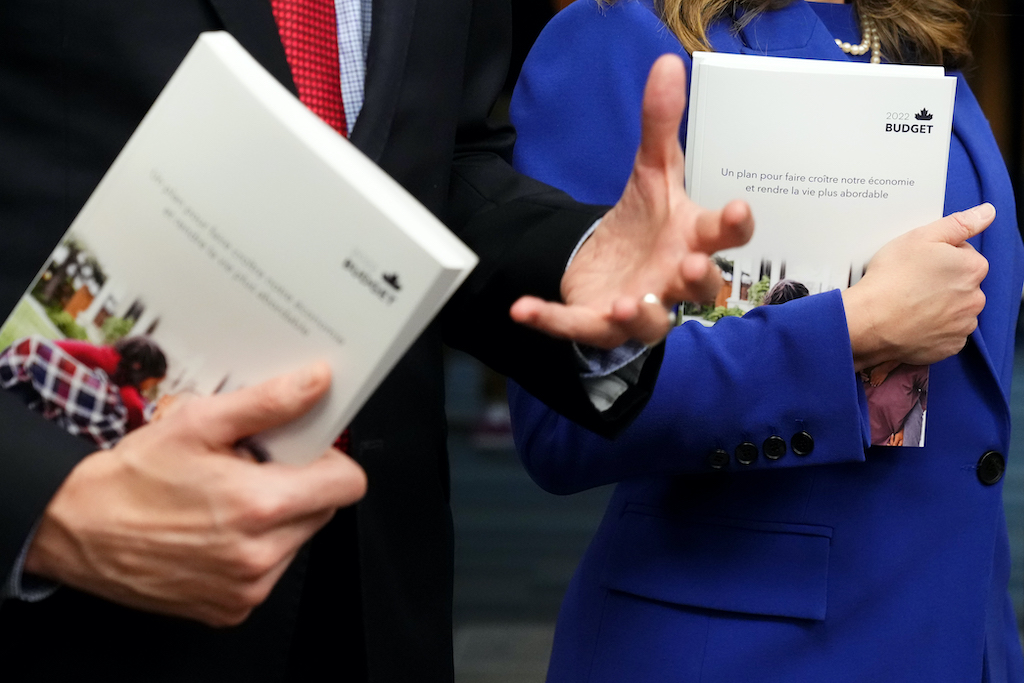
With their new budget, the federal Liberals pledge to tackle Canada’s “insidious” problem of flagging economic productivity, promising to overhaul innovation spending as last year’s pandemic rebound gives way to worries of slowing GDP growth.
Canada has a highly educated, growing population and excellent research capacity, but its long-term growth prospects are poor because we aren’t good at turning good ideas into products, services and better business practices, the government believes. We’re short of money to deal with climate change and to invest in our future, and the need to change that quickly underlies much of the budget.
There are some big-ticket spending plans that Liberals hope will right the ship: a $15-billion Canada Growth Fund and new innovation agency; a long-awaited 50 per cent tax credit on heavy industrial carbon-capture projects, a $4-billion “accelerator” to increase housing supply, $6.1 billion over five years to the Department of National Defence and a $5.3-billion program to help dental-care affordability.
Buried further in the 280-plus-page document are also big changes central to the innovation economy, from cleantech and critical minerals, to startups and scientific research.
In all, the $425.4-billion in projected pre-debt expenses aims to “firmly pivot” the country from a COVID-19 response that came at a “significant cost,” hoping the outlay will reassure a nation where business confidence is wavering.
Talking Point
Billions in funding for cleantech firms, miners and researchers in a federal budget released Thursday underlie the government’s hopes that investing $425.4 billion in projected pre-debt expenses with an eye toward economic productivity can outpace threats like inflation, climate change and the Russian invasion of Ukraine, coming out of the COVID-19 pandemic. Economists and the private sector have warned about Canada’s somewhat moribund economic productivity and investment levels, and the 2022 budget introduces new programs and policies to address that.
Green economy
What: New programs and incentives for the clean-energy transition.
How much: $2.6 billion over five years for a carbon-capture, -utilization and -storage (CCUS) tax credit; $15 billion over five years for the Canada Growth Fund, designed in part but not exclusively to help the government reach its climate goals; $780 million over five years to expand the Nature Smart Climate Solutions Fund; $2.2 billion over seven years for the Low Carbon Economy Fund to help provinces with emissions-reducing projects; $194 million over five years to help the industrial sectors adopt clean technology; a combined $877.4 million to expand clean electricity across the country, most of which will be spent over seven years; and $8 million over three years for the new International Sustainability Standards Board office in Montreal.
What’s happened so far: New proposed funding over the next five years amounts to about $12.5 billion, $9.1 billion of which was announced last week in the government’s 2030 Emissions Reduction Plan.
The fine print: Canada’s public and private sectors need to spend a combined $125 billion to $140 billion a year to reach carbon neutrality by 2050, the budget notes. Even at the low end, that’s about five times more than what the country currently invests. While the government’s proposed funding falls far short of filling that gap, it’s also announced incentives for the private sector to raise its contributions. The $15-billion Canada Growth Fund, for example, aims to attract at least three private-sector dollars for every public dollar spent.
The budget also introduced a new tax credit of up to 30 per cent for cleantech investments. The government plans to disincentivize oil and gas exploration by phasing out flow-through shares for the sector. And the budget proposes expanding the Canada Infrastructure Bank’s role to “accelerate Canada’s transition to a low-carbon economy,” allowing it to invest in energy-transition projects like small modular reactors, hydrogen production and CCUS. The government is also pressing for more accountability among institutional investors by creating environmental and social-risk disclosure requirements for federally regulated pension plans.
Who benefits: Companies developing solutions to decarbonize the energy sector and address climate change, as well as investors financing those firms. Traditional oil and gas companies are poised to benefit from the CCUS tax credit in particular, which is designed to cover a sizeable portion (starting with up to 60 per cent) of proposed billion-dollar investments in the technology.
Overhauling existing programs
What: A review of the scientific research and experimental development (SR&ED) tax incentive, assessing whether it’s “effective in encouraging R&D that benefits Canada.” Ottawa is also considering instituting a patent-box regime to ensure ideas generated domestically turn into IP that stays here.
How much: There’s no new money for the program, but Finance Canada estimates it will cost the government about $2.6 billion in foregone revenue this year.
What’s happened so far: Startups have long complained about the amount of paperwork involved with accessing SR&ED, spawning a cottage industry of filing-preparation firms and tech platforms. Canadian innovation-economy executives have also expressed concern that too much of the money flows to large companies, multinationals or “zombie” businesses that would fail without the annual payouts. The budget promises to reconsider eligibility criteria and simplify the program.
A patent box would allow firms to pay a lower tax rate on profits from the IP they put in it. Quebec introduced one in March 2020. Firms like Vancouver-based biotech AbCellera and General Electric’s local subsidiary have called for a similar incentive at the federal level, a recommendation backed by industry associations including the scale-up focused lobby group Council of Canadian Innovators.
Who benefits: Startups who could receive higher payouts from SR&ED, or at least have to file less paperwork to get them, and who will have more profits to play with in the early years of commercializing their products and services.
What: Extending and rebranding the superclusters program.
How much: The budget promises $750 million over six years starting in fiscal 2022–23, to be allocated between the original five organizations “on a competitive basis.”
What’s happened so far: The superclusters program was established in the March 2017 budget. Ottawa ultimately fronted $979 million to the non-profit consortia, which they used to fund R&D and other industrial projects. As The Logic first reported this week, the five superclusters have allocated most of that capital, and with the program due to expire in March 2023, asked Ottawa for a $1.5-billion renewal over five years. This year’s budget gives them half that, but a year ahead of schedule.
The fine print: The superclusters are being rebranded as “global innovation clusters.” Originally focused on specific industries—digital, plant proteins, advanced manufacturing, AI and oceans—the government now expects the organizations to take a greater role in its economy-wide goals, including “fighting climate change and addressing supply-chain disruptions.” In February, an advisory panel set up by Innovation, Science and Economic Development Canada (ISED) privately recommended the superclusters be given “common missions.” The government is also adopting another of the panel’s suggestions, requiring private-sector participants in supercluster-backed projects to put up a larger share of necessary capital.
Critical minerals
What: A national critical-minerals strategy.
How much: Up to $3.8 billion in cash in total over eight years to implement the strategy, including up to an additional $1 billion over six years starting in 2024–25, for a total of $1.5 billion, for ISED’s Strategic Innovation Fund to spend on critical-mineral manufacturing, processing and recycling. Natural Resources Canada will get a combined $149.2 million to release data to aid exploration and “advance Canada’s global leadership on critical minerals,” and another $144.4 million in research funds to share with the National Research Council over five years. Crown-Indigenous Relations and Northern Affairs Canada will get up to $40 million over eight years for northern regulatory processes, and “at least” $25 million of the expanded Indigenous Natural Resource Partnerships program is dedicated to critical minerals. On top of the $3.8-billion plan, Canada Infrastructure Bank budget includes a separate allocation of $1.5 billion over seven years toward critical-mineral mining.
What’s happened so far: It’s a big funding jump from last year’s budget, which established the Critical Battery Minerals Centre of Excellence with $9.6 million, and put $36.8 million over three years toward critical-minerals research. That centre will be renewed, with $10.6 million over three years starting in 2024–25 for provincial and territorial counterparts and mineral developers who are involved with it.
The big picture: Prospecting is a tough business, and the government is trying to make mining less risky when it comes to the key inputs for phones, computers and electric cars. As the country vies for investments like battery plants, the government appears to be prioritizing critical minerals as a key to building out auto-parts-manufacturing supply chains. It gave few details, however, on whether it will increase price caps or dollar amounts for electric-vehicle purchases, saying only that the $1.7 billion in EV sales incentives will extend until 2025 and include more vans, trucks, and SUVs. It reiterated earlier EV-charger investment commitments and said it would spend $547.5 million over four years toward a new incentive program for medium- and heavy-duty zero-emissions-vehicle purchases, and would expand funding for green freight assessments by $199.6 million over five years and $400,000 annually thereafter.
Who benefits: Mineral-exploration companies targeting nickel, lithium, cobalt, graphite, copper, rare-earth elements, uranium and other key metals will get a new 30 per cent Critical Mineral Exploration Tax Credit until 2027.
Cost of living
What: Numerous measures to cushion Canadians from rising expenses.
How much: About $10.1 billion over five years for housing, $5.3 billion over five years for public dental insurance, a further $625 million over four years for child care, $1.2 billion over five years for skills training and labour mobility.
What’s happened so far: The federal government has made deals with every province and territory to cut the costs of child care, which it considers a benefit not only for parents as individuals, but for the economy, because it increases the labour force. The costs for that were booked in the last budget. The pledge for dental coverage is part of the Liberals’ supply-and-confidence agreement with the NDP, and is to begin with children under 12 this year before expanding to cover by 2025 all families with annual incomes of less than $90,000.
The big picture: While the economy has boomed as the severity of the COVID-19 pandemic has waned, the Liberals have emphasized that the rising tide has not lifted all boats. Those with precarious jobs suffered most in the pandemic’s early months and the government has been determined to shield the most economically vulnerable from future pandemic-type shocks. The idea is also to help people feel confident enough in their financial situations to take risks and contribute to the economy. Finance Minister Chrystia Freeland calls these measures “modern supply-side economics,” borrowing a line from U.S. Treasury Secretary Janet Yellen.
Who benefits: In theory, everybody. Most directly, people struggling to pay for housing, uninsured health care, daycare for their kids, and training to upgrade their skills and find better jobs.
Also of note:
- The budget follows through on Liberal promises to hit the country’s banks and life-insurance companies to help deal with the short-term deficit: they’ll have to pay 15 per cent on taxable income above $1 billion in the 2021 tax year, and also face a permanent corporate-tax hike of 1.5 percentage points on income above $100 million. Both measures are expected to bring in a combined $6.1 billion over five years, with the latter raising $445 million a year indefinitely. The government argues that financial institutions’ balance sheets were effectively derisked by federal pandemic support programs, and they owe the country help in the recovery.
- ISED will get $45 million over four years to study the country’s chip capabilities, with most of the money—and likely the activity—in the 2024–25 and 2025–26 fiscal years. Canada’s Semiconductor Council, a new lobby group, has called for a national strategy like those for AI and quantum. In February, Ottawa allocated $150 million from the SIF for microelectronics manufacturing projects.
- The federal granting councils are getting $38.3 million over four years starting in the 2023–24 fiscal year to recruit up to 25 more research chairs in science, technology, engineering and mathematics. Universities, meanwhile, will be able to draw from an expanded research-support fund to “identify, assess and mitigate potential risks,” with $125 million in an initial five-year cash injection and $25 million annually thereafter. Last year, Ottawa began rolling out new guidelines and checks for federally funded research.
- The government will “introduce legislative amendments to the Competition Act as a preliminary phase in modernizing the competition regime,” designed in part to adapt it to “today’s digital reality.” Commissioner Matthew Boswell and policy experts have called for such a review.
- The Privy Council Office, the public service’s executive branch, is getting $10 million over five years, with $2 million annually after that, to “combat disinformation and protect our democracy.”
- Immigration, Refugees and Citizenship Canada will get $187.3 million over five years, and $37.2 million a year afterwards, to modernize its technology. Another $385.7 million over five years, and $86.5 million ongoing, between IRCC, the Canada Border Services Agency, and CSIS will “facilitate the timely and efficient entry” of new Canadians. The government is also planning legislation to enable automated biometrics processing.
- The charitable sector will see a new graduated disbursement-quota rate, with investment assets exceeding $1 million seeing a rate increase from 3.5 per cent to five per cent. The Logic’s investigation last year found that one in five of the country’s largest foundations failed to meet the 3.5 per cent minimum disbursement rate in 2019. Those 14 foundations collectively held $41.8 billion.
- The finance department will get $17.7 million over five years to lead a review on maintaining financial-sector security amid the digitalization of money, with the first phase directed at digital currencies, cryptocurrencies and stablecoins after “a number of high-profile examples” in the last several months where cryptocurrencies were used to avoid sanctions and fund illegal activities “both around the world and here in Canada.” The review will also cover the potential need for a central-bank digital currency. Separately, the Financial Transactions and Reports Analysis Centre of Canada will develop legislative proposals to manage emerging threats from the “digitalization of money.”
- The Canada Revenue Agency will get $1.2 billion over five years to “expand audits of larger entities and non-residents engaged in aggressive tax planning,” with spending also going to tax-evasion investigations and educational outreach.
Read more of The Logic’s coverage of the 2022 federal budget here.