OTTAWA — The federal government is taking in vastly more money than it expected to when Finance Minister Chrystia Freeland delivered the last budget in April, and the Liberals are fighting the urge to spend it.
Skip to content

Analysis
With inflation squeezing Canadians, Freeland banks the proceeds
Finance Minister Chrystia Freeland makes her way to a cabinet meeting on Parliament Hill, in Ottawa, on Nov. 3, 2022. Photo: The Canadian Press/Adrian Wyld
OTTAWA — The federal government is taking in vastly more money than it expected to when Finance Minister Chrystia Freeland delivered the last budget in April, and the Liberals are fighting the urge to spend it.
“We’re keeping our powder dry,” Freeland said in her speech introducing her fall economic statement. “The north wind is blowing,” she added later, and she didn’t mean it to say that Canada is somehow sweeping the globe. We have a sturdy house, she said, and we’re going to hunker down in it and wait for warmth to return.
Talking Points
- Federal revenues are much higher than the Liberals projected in their last budget, but so is inflation—so they’re not spending the windfall, lest they make the situation worse
- That means waiting until at least spring before making serious moves to make Canada more competitive with the economy-boosting measures in the U.S. Inflation Reduction Act
Anyone waiting for big federal action on almost anything will continue to wait. The list of matters the government is punting into the future is long, as The Logic’s coverage of the economic statement shows.
This is despite Freeland’s assertion Thursday that the green transition is the biggest economic transformation since the Industrial Revolution, that fellow democracies are looking for economic partnerships, and Canadian businesses and workers are looking at the greatest opportunity in a generation.
In April, Freeland talked about needing to act boldly to fix our anemic national productivity. It’s eye-glazing stuff, she acknowledged then, but it’s vital if we want our children and grandchildren to live better than we do. We’d kicked that can down the road for too long, she said.
But instead of productivity, inflation is the world’s biggest economic challenge right now, the new statement says, and big government spending would only worsen it, no matter how much Canadians might want more help.
More from the Fall Economic Statement

“In our view, this is not a time in the world for flash,” said the top Department of Finance official sent in to brief reporters on the statement and its plans, on condition they not be named. “It’s a time to be steady. That point about the importance of steadiness is fundamental to all of our thinking in the fall economic statement.”
We’re a long way from the spring budget’s promise to “build a country that we would be willing to fight for,” the language Freeland used to link that fiscal plan to Ukrainians’ then-new fight against Russian invasion. Even further from her promise in the 2020 fiscal update that we were “building back better” from the COVID-19 pandemic.
But inflation is one problem that government spending directly and explicitly makes worse: if the economy’s central problem is that there’s too much money washing around in it, pumping more money into it doesn’t help.
Back in April, the latest read on inflation had it at a 30-year high, at 5.7 per cent.
Inflation is trending down again, but it still clocked in at 6.9 per cent in September. A couple of weeks ago the Bank of Canada—whose key function as a central bank is keeping inflation under control—reported that despite repeated hikes in interest rates, “the bank’s preferred measures of core inflation are not yet showing meaningful evidence that underlying price pressures are easing.”
Related Articles
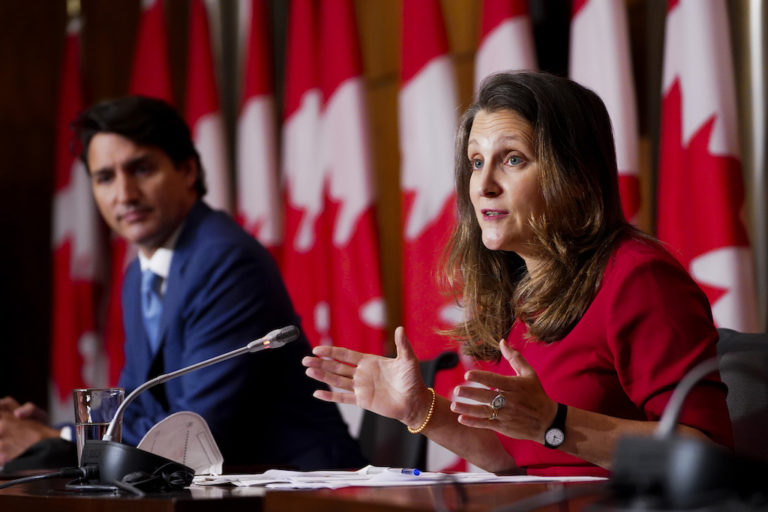

“As the central bank fights inflation, we will not make its job harder,” Freeland said in her speech. Spending more now could push inflation up, inducing the central bank to keep raising interest rates, hurting people more, and potentially pushing the country into a full-blown recession.
That could still happen, thanks to global forces like a deeper energy crisis in Europe or unexpected domino-falls from the slowing real estate market in China, a prospect the economic statement presents as a “downside risk” that’s unfortunately more likely than events being better than the government expects.
“We don’t want to put [the Bank of Canada] in a position where it has to raise rates higher and keep them there for longer,” Freeland added in a news conference. She struggles with whether the government has struck the right balance, she said, but thinks it has.
So the federal government is taking that higher-than-expected revenue, especially $37.6 billion in extra income taxes just this year, and applying much of it against the deficit. Instead of borrowing $52.8 billion in the 2022–23 fiscal year, the government expects to borrow $36.4 billion, with smaller but still marked declines in projected deficits in years to come.
That’s even after accounting for previously announced moves to increase GST rebates and send rent supports to people in the greatest need, and new ones to start pre-paying a benefit for low-income workers and end interest on federal student and apprenticeship loans.
This also means Freeland and the Liberals aren’t rushing to match the massive investments the United States is making in cleantech industries (through the Inflation Reduction Act) and semiconductors (through the CHIPS and Science Act).
The government is copying one U.S. move: telling businesses that it will start taxing share buybacks—which increase stock prices by using the company’s cash to buy its own shares on the open market—by two per cent, starting in 2024. The idea is to get them to spend the money on themselves, hiring or upgrading equipment or making other moves to increase productivity, rather than passing it to shareholders.
But more broadly, Freeland said, the Liberals are making only a “down payment” on a response to the ways the United States is racing past Canada in attempting to promote cutting-edge industries.
“No one knows for sure what’s going to happen,” Freeland said, but no country is better positioned than Canada to thrive in the medium- and long term. We’re just going to wait before working out for sure how we’re going to do it.



Loading...
Thanks for sharing!
You have shared 5 articles this month and reached the maximum amount of shares available.
CloseThis account has reached its share limit.
If you would like to purchase a sharing license please contact The Logic support at [email protected].
CloseGift the full article!
You have gifted 0 article(s) this month and have 5 remaining.
Recipients will be able to read the full text of the article after submitting their email address. They will not have access to other articles or subscriber benefits.
Photo: The Canadian Press/Adrian Wyld
Most Popular This Week




In-depth, agenda-setting reporting
Great journalism delivered straight to your inbox.
News
Canada faces a satellite-launch crunch as SpaceX retires its workhorse rocket
Briefing
Cohere says it caught an Alibaba model trying to send data to a server in China
Feds and First Nations to work on sharing resource revenue, with a sovereign wealth fund one option
Zafin buys U.S. fintech Naehas in nine-figure deal
Best business newsletter in Canada
Get up to speed in minutes with insights and analysis on the most important stories of the day, every weekday.
Exclusive events
See the bigger picture with reporters and industry experts in subscriber-exclusive events.
Membership in The Logic Council
Membership provides access to our popular Slack channel, participation in subscriber surveys and invitations to exclusive events with our journalists and special guests.