Fall Economic Statement 2022: What’s in it for the innovation economy
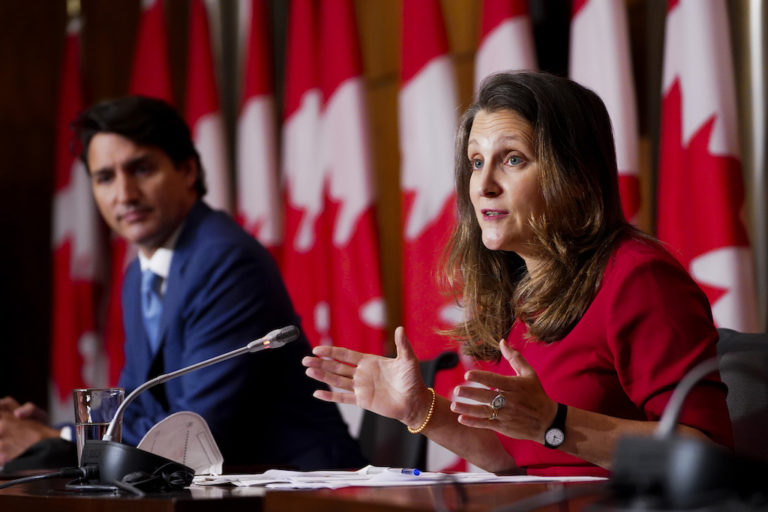
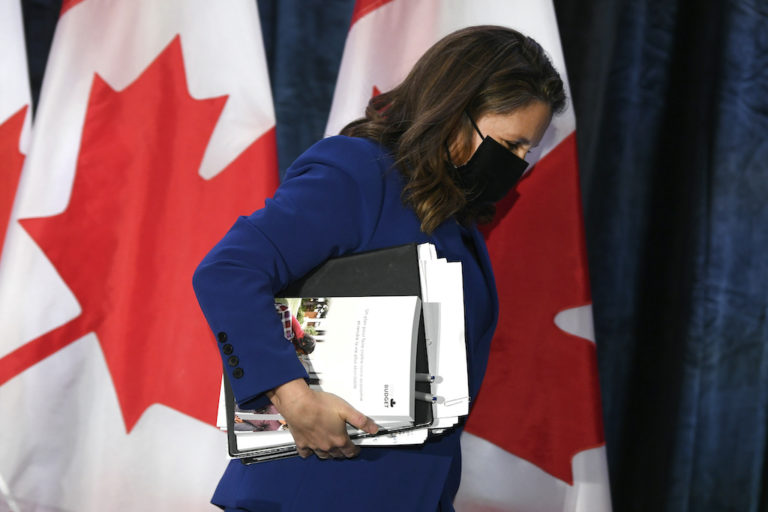
OTTAWA — The Liberal government’s fall economic statement on Thursday was light on new spending for the innovation economy, as departments focus instead on rolling out previously promised funding for sectors like venture capital firms and clean-fuel producers. A new cleantech tax credit headlined Finance Minister Chrystia Freeland’s mini-budget, which deferred details of several other new measures to next year’s full edition.
Looming over the exercise is the spectre of the U.S. Inflation Reduction Act, which pledged hundreds of billions for green energy and manufacturing. Business groups have urged Ottawa to respond in kind. Thursday’s document proposes some new measures, and promises more to come.
Here’s what’s in the fall economic statement for the innovation economy.
Special Report
Fall Economic Statement 2022: What’s in it for the innovation economy
OTTAWA — The Liberal government’s fall economic statement on Thursday was light on new spending for the innovation economy, as departments focus instead on rolling out previously promised funding for sectors like venture capital firms and clean-fuel producers. A new cleantech tax credit headlined Finance Minister Chrystia Freeland’s mini-budget, which deferred details of several other new measures to next year’s full edition.
Looming over the exercise is the spectre of the U.S. Inflation Reduction Act, which pledged hundreds of billions for green energy and manufacturing. Business groups have urged Ottawa to respond in kind. Thursday’s document proposes some new measures, and promises more to come.
Here’s what’s in the fall economic statement for the innovation economy.
Talking Points
A new refundable tax credit for clean technology and $1.67 billion to ease backlogs in government services highlight the Liberal government’s fall economic statement
The keenly anticipated Canadian Innovation and Investment Agency is one in a raft of initiatives the government has kicked down the road
The green economy
What: New investment tax credit for clean technologies.
How much: $6.7 billion over five years for a 30 per cent tax credit on eligible investments.
What’s happened so far: The federal government made bold climate pledges last year that included cutting emissions from 40 to 45 per cent below 2005 levels by 2030. It followed up with generous commitments for the green economy in its Emissions Reduction Plan and Budget 2022. They included about $12.5 billion for programs and incentives like a carbon-capture, -utilization and -storage (CCUS) tax credit; the Low Carbon Economy Fund to help provinces reduce emissions; incentives to help industrial sectors adopt clean technology; and funding to expand clean electricity across the country.
The finance department said it would consider launching a cleantech tax credit in Budget 2022, but hadn’t committed to it at that point.
The tax credit is meant to incentivize companies to kick in funding needed to achieve a net-zero-emissions economy by 2050. But the gap is still immense. While Canada’s private and public sectors invest between $15 billion and $25 billion in the energy transition combined each year, that outlay needs to be $125 billion to $140 billion.
The fine print: The new tax credit will cover capital costs of investments in solar, wind and hydro, and small modular nuclear reactors; non-fossil-fuel electricity-storage systems including batteries, compressed-air storage and thermal-energy storage; low-carbon heat equipment; and zero-emissions vehicles and charging or refuelling equipment.
The full rebate is available only to companies that “adhere to certain labour conditions,” like paying fair wages and creating apprenticeship opportunities. Those that don’t meet them will be eligible for a 20 per cent credit.
The credit will become available on the day that Budget 2023 is released. It’s designed to be phased out over time, starting in 2032 and fully ending in 2035.
Who benefits: Companies developing and investing in clean technologies and—if it works as intended—the planet.
Workforce and immigration
What: Financial support for the 2023–2025 Immigration Levels Plan and investments in helping tradespeople gain skills for jobs in a low-carbon economy.
How much: $1.6 billion over six years to process and settle new permanent residents. An additional $50 million to address immigration backlogs in 2022–23, plus $250 million toward sustainable jobs over five years, beginning in 2023–24.
What’s happened so far: Immigration, Refugees and Citizenship Canada (IRCC) announced on Nov. 1 its plan to welcome 500,000 immigrants per year by 2025. The government is creating the Sustainable Jobs Training Centre and a sustainable-jobs stream under the Union Training and Innovation Program to help a combined 35,000 workers upgrade or learn new skills for the low-carbon economy.
The bigger picture: The Canadian economy faced an acute labour shortage during the recovery from COVID-19, especially in health care, construction and STEM. The federal government could expect Quebec to absorb 115,000 of the 500,000 annual newcomers, but the province has said it cannot accept more than 50,000 immigrants per year, citing concerns with the capacity to teach newcomers French. The funding promised would support administrative processing at the federal level, and support organizations provincially that provide settlement services.
By
Anita Balakrishnan, Murad Hemmadi, Catherine McIntyre, David Reevely and Jesse Snyder
There are 1.49 million applications for residence and citizenship in the backlog. IRCC aims to process 80 per cent of all applications within its service standards, but fewer than half of all permanent-resident applications have been processed on time. However, the number of backlogged applications has declined steadily since January, and the government hopes the additional $50 million in 2022–23 will help clear the logjam.
Over half of all businesses reported skills gaps in their workforce, Statistics Canada found in October. The federal government’s training initiatives could help up to 35,000 workers transition into jobs contributing to Canada’s 2050 net-zero goal.
Who benefits: Those facing long waits to settle in Canada, and employers who are unable to fill jobs. Skilled tradespeople looking to change jobs also stand to gain, as do employers in the renewable-energy sector who have found it difficult to fill roles.
Making government work better
What: Spending on call centres, counter services and case managers to deliver “efficient, timely and high-quality government services,” and increasing funding to multiple government departments to more effectively handle major-project approvals.
How much: Just under $2.25 billion, more than two-thirds of it to Service Canada to process applications for employment insurance and old-age security supports faster and improve call-centre wait times.Other budget boosts go to the Canada Revenue Agency, Veterans Affairs and the Canada Border Service Agency. For major-project approvals, the Liberals are spending up to $1.28 billion over six years, spread among 13 agencies and departments.
What’s happened so far: One reason the Liberals created the few-questions-asked Canada Emergency Response Benefit when COVID-19 struck was that top officials realized the EI system simply couldn’t handle the crush of applications from suddenly jobless workers.
More recently, the government took heat for glacial processing times for passport applications and long lines at airports in the spring. It rushed to hire workers and open new offices to address Canadians’ anger that basic government services just weren’t functional. At Veterans Affairs, former service members with injuries have contended with slow benefits approvals for years.
The Liberals named a task force of ministers to address those and other backlogs that take up people’s time, slow access to services the government thinks are needed to make society work, and generally gum up life. They concluded that, fundamentally, the government needs more people to do things.
In environmental-impact assessments, years-long processes such as the examination of plans for a new container terminal at the Port of Vancouver—in progress since 2013—are creating crises in key industries.
The fine print: The spending on customer-service improvements is spread out over several years, starting with $600 million this year and $800 million next year. The money for more efficient project approvals is also spread out over six years.
Who benefits: In theory, anyone who needs to deal with some of the federal government’s most commonly used services. The OECD considers public trust in government’s basic competence a key factor to preserving democracy.
Problems for the future
Like any government fiscal update, this one kicked some funding promises and policy measures into the long grass, promising updates later on the Canadian Innovation and Investment Agency, National Supply Chain Strategy and SR&ED regime, as well as consultations for industries like crypto and hydrogen power.
• Canadian Innovation and Investment Agency: Details will be released in “the coming weeks” for the agency, first announced in the April budget.
• Scientific research and experimental development (SR&ED) program: Work is underway, including “consideration” of a patent-box regime, with details to follow in the 2023 budget.
• Critical minerals and electric-vehicle manufacturing: New measures to keep pace with the U.S. IRA—which is drawing firms from industries like hydrogen, biofuels and electric-vehicle battery production to the U.S.—will be announced in Budget 2023. Mineral deals will be included in the Canada Growth Fund.
• Clean hydrogen: The Finance Department will launch a consultation “in the coming weeks” on an investment tax credit for clean hydrogen, focused on labour and setting tiers of carbon intensity, similar to U.S. rules. Investments “made as of the day of Budget 2023” will be eligible and the credit will be phased out after 2030.
• Advanced manufacturing: Industry experts and unions will help craft measures for the 2023 budget, including for EVs and batteries.
• National Supply Chain Strategy: “Immediate actions” include modernizing clearance inspections, remedies for service disruptions and a “regulatory review,” but the strategy itself will be announced in the 2023 budget.
• Crypto and central-bank digital currencies: A consultation will launch Thursday on digitalization of money and “financial-sector stability and security,” including crypto, stablecoins, and central-bank digital currencies.
• Credit-card transaction fees: Government “intends to enter into negotiations” with financial institutions to lower transaction fees for small businesses and protect consumers’ reward points, and is publishing draft amendments to the Payment Card Networks Act Thursday. The government will introduce the legislation as early as possible next year, “should the industry not come to an agreed solution in the months to come.”
• Financial-crimes enforcement: Budget 2022 said in April it would reveal more details in the fall economic statement about a new Canada Financial Crimes Agency under Public Safety Canada, but the agency was not mentioned in Thursday’s report.
Correction: The original version of this article gave an incorrect total for the amount the government plans to spend to improve service delivery, leaving out $574 million to reduce EI and OAS call centre wait times. The story has been updated.
Recipients will be able to read the full text of the article after submitting their email address. They will not have access to other articles or subscriber benefits.
Great journalism delivered straight to your inbox.
News
AI could help invent new materials. First, firms must figure out how to make them
By
Murad Hemmadi
Briefing
Defence Investment Agency to be a Crown corporation so it can get deeper into Canada’s military industry
By David Reevely |
Mark Carney says he’ll work with Quebec separatist premier-to-be on housing, infrastructure, big projects
By David Reevely |
Mistral claims its new AI model closes the gap with leading Chinese developers
By Murad Hemmadi |
Best business newsletter in Canada
Get up to speed in minutes with insights and analysis on the most important stories of the day, every weekday.
Exclusive events
See the bigger picture with reporters and industry experts in subscriber-exclusive events.
Membership in The Logic Council
Membership provides access to our popular Slack channel, participation in subscriber surveys and invitations to exclusive events with our journalists and special guests.