CALGARY — Two months before Prime Minister Justin Trudeau said there has “never been a strong business case” to build LNG facilities on Canada’s East Coast, the country’s Foreign Affairs Department was touting the potential of that very sector and highlighting opportunities to increase natural gas exports to Europe, according to a document obtained by The Logic.
Skip to content


Exclusive
Trudeau downplayed potential for East Coast LNG despite Global Affairs touting benefits: Documents
Liquified natural gas exports could help Europe reduce dependency on Russia, GAC argued
Prime Minister Justin Trudeau responds to a question next to German Chancellor Olaf Scholz during a news conference in Montreal in August 2022. Photo: The Canadian Press/Paul Chiasson
CALGARY — Two months before Prime Minister Justin Trudeau said there has “never been a strong business case” to build LNG facilities on Canada’s East Coast, the country’s Foreign Affairs Department was touting the potential of that very sector and highlighting opportunities to increase natural gas exports to Europe, according to a document obtained by The Logic.
The document underscores the federal government’s conflicted position on natural gas, a resource that some analysts see as a “bridge fuel” that can displace dirtier power sources like coal and strengthen Canada’s efforts to reach net-zero carbon emissions.
Talking Point
- Months before Prime Minister Justin Trudeau downplayed the business case for developing LNG export capacity on Canada’s East Coast, the foreign affairs department was touting the sector’s potential, saying Canada could help Europe wean itself off Russia’s supply
In 2022, Russia’s invasion of Ukraine caused gas demand to spike as European nations sought to wean themselves off Russian energy supplies, reviving hopes in some corners that Canada could finally export liquefied natural gas (LNG) from the East Coast to buyers in Europe and other markets.
LNG proponents say the global market is poised for explosive growth in coming years that could inject new life into the Canadian economy, while environmental groups say natural gas development would only prolong the shift toward cleaner sources.
In a May 2022 briefing note prepared by Global Affairs Canada officials for International Trade Minister Mary Ng, the department said, “Europe can benefit from Canadian LNG, and Canada would benefit from an energy partnership with Europe” that could help the continent meet its energy security needs. The Logic obtained the document through an access to information request.
The briefing also said Canada was looking to expand pipeline and rail infrastructure to increase the country’s East Coast export capacity, and pointed to “several projects on the East Coast of Canada that present options for potential future exports to the EU.”
Related Articles
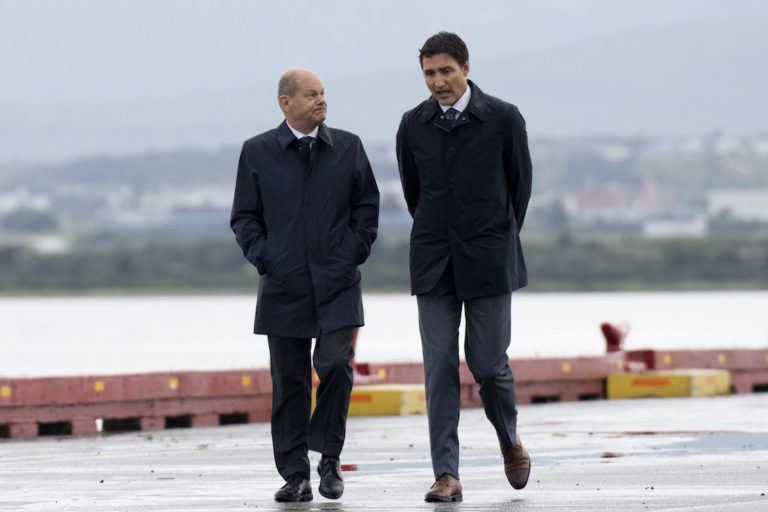

Less than three months later, Trudeau struck a starkly different tone during a joint press conference in August with his German counterpart Olaf Scholz, saying the economic feasibility of East Coast projects has never been strong. Ottawa could ease the regulatory burden on proposed export terminals in the region to streamline their development, Trudeau said, but insisted “it needs to make sense for Germany to be receiving LNG directly from the East Coast.”
Scholz, who was visiting Canada as part of an outreach campaign to secure new energy supplies, said Germany “will require LNG for a transition period” before it moves toward cleaner sources of electricity.
Trudeau did not agree to supply Germany with LNG following the 2022 meeting, but did sign a non-binding agreement to export green hydrogen to the country starting in 2025. Months later, Germany signed a 15-year LNG supply deal with Qatar, with shipments starting in 2026.
The Prime Minister’s Office did not answer The Logic’s questions about his comments, and instead passed those questions along to Global Affairs Canada. The department said the government “is open to industry advancing economically viable LNG projects” that can be used to “displace higher emitting fuels or Russian gas,” as well as projects that have relatively low emissions profiles.
Analysts, for their part, point to the U.S.’s booming LNG space as evidence of the sector’s inherent economic viability. Six LNG facilities on the country’s East Coast currently export LNG, about 60 per cent of which is sold into European markets, according to Lance Mortlock, managing partner for energy at the consulting firm EY.
“I still believe that there is a business case for Canadian gas and LNG on the West and the East coast, and we should be developing that,” Mortlock said in an interview.
Russia still supplies 20 per cent of Europe’s gas, according to Washington-based Center for Strategic and International Studies—a gap that presents an opportunity to “supply a clean, reliable alternative to Russian natural gas,” Mortlock said.
U.S. regulators have approved another 15 such facilities, all but one proposed for construction on the shores of the U.S. Atlantic Coast.
Meanwhile, in Canada, a nascent LNG sector is taking shape—on the West Coast at least—and has gained momentum since the controversial Coastal GasLink pipeline came online last year.
Construction of Canada’s first LNG project—the $40-billion LNG Canada plant led by a consortium of foreign conglomerates including PetroChina, Petronas and Mitsubishi—is nearing completion, while a second development, Cedar LNG, has made a final investment decision.
In Eastern Canada, long-held aspirations to develop LNG have continued to flounder.
Back in 2020, Warren Buffet’s Berkshire Hathaway pulled its planned $4-billion investment in GNL Quebec, a proposed liquefied gas export project located northeast of Quebec City, amid local opposition to the development.
In early 2023, Spanish energy giant Repsol dropped an idea to convert an existing gas-import terminal in Saint John, N.B., into an export facility, citing cost pressures. Last month, Calgary-based Pieridae Energy sold the rights to its proposed Goldboro LNG project in Atlantic Canada, ending the company’s years-long drive to develop it.
Berkshire Hathaway, Repsol and Pieridae did not respond to The Logic’s questions about their respective decisions.
Common among those projects is a lack of pipelines connecting gas fields in British Columbia and Alberta to proposed terminals in Eastern Canada, which makes supplying gas costly.
In response to The Logic’s questions, Global Affairs Canada said companies proposing East Coast LNG projects told the government that a lack of pipeline access was putting cost pressures on potential export terminals.
“In discussions with individual LNG project proponents in eastern Canada, the Government of Canada was informed that these projects would require natural gas from Western Canada and that the associated transportation cost (i.e. pipeline tolling) would challenge project economics,” department spokesperson Louis-Carl Brissette Lesage said in a statement.
Veteran energy executives say the pipeline shortage is the result of regulatory delays, jurisdictional uncertainty and lack of political will.
“It’s not a physical constraint, it’s a political constraint,” said Phil Hodge, CEO of Calgary natural gas producer Pine Cliff and a one-time energy adviser to Alberta Premier Danielle Smith.
Western producers export gas to markets around Chicago and St. Louis every day, but proposals to build similar pipeline connections to Eastern Canada have run aground. Quebec and Ottawa both rejected the $14-billion GNL Quebec project—and the proposed 780-kilometre pipeline that would have connected the terminal to TC Energy’s Canadian Mainline, the country’s main artery for west-east gas shipments—in 2021 and 2022, respectively.
It’s possible the federal government’s plans to export green hydrogen to Germany will encounter similar delays. In the briefing document prepared for Minister Ng, Global Affairs Canada acknowledges that the infrastructure required to house the hydrogen technology will take years to develop.
“We can immediately increase our exports of technologies that produce and use hydrogen,” the department said, “but expansion of hydrogen infrastructure to meet Europe’s energy needs in the medium to longer term will require additional investments, as well as considerations of regulatory issues.”



Loading...
Thanks for sharing!
You have shared 5 articles this month and reached the maximum amount of shares available.
CloseThis account has reached its share limit.
If you would like to purchase a sharing license please contact The Logic support at [email protected].
CloseGift the full article!
You have gifted 0 article(s) this month and have 5 remaining.
Recipients will be able to read the full text of the article after submitting their email address. They will not have access to other articles or subscriber benefits.
Photo: The Canadian Press/Paul Chiasson
Most Popular This Week



In-depth, agenda-setting reporting
Great journalism delivered straight to your inbox.
Commentary
Carmichael: Canadian ignorance about India is a strategic weakness
Briefing
Aritzia shares pop after earnings rise 204%
First Nation in Alberta goes to court over fast-tracked oil pipeline
Chinese EV maker Geely Auto Group to launch in Canadian market in 2027
Best business newsletter in Canada
Get up to speed in minutes with insights and analysis on the most important stories of the day, every weekday.
Exclusive events
See the bigger picture with reporters and industry experts in subscriber-exclusive events.
Membership in The Logic Council
Membership provides access to our popular Slack channel, participation in subscriber surveys and invitations to exclusive events with our journalists and special guests.